Today Sonar joined the OpenAI Daybreak Cyber Partner Program, gaining governed access to advanced cybersecurity frontier models. The program deepens Sonar’s ongoing collaboration and engagement with OpenAI, following its commitment to OpenAI'scall for collective action on cyber defense, and enables evaluation and deployment of Daybreak-class models in its products.
Attackers are moving faster than most defenses were built for
Frontier AI has changed what attackers can do, not just what defenders can do. Mandiant's M-Trends 2026 puts the mean time to exploit at an estimated -7 days, meaning exploitation routinely begins before a patch even exists. The same report found that the hand-off window between initial access and a second attacker taking over has collapsed from more than 8 hours in 2022 to about 22 seconds today. Whatever angle you look at it from, the time security teams have to find and fix a flaw before it's used against them keeps shrinking, and it's shrinking faster than most review processes were designed to handle.
The leverage then moves earlier, to finding flaws before the code ships, and that takes reasoning at the level that attackers are already applying. Security teams have to match that pace, and doing so requires access to the same frontier intelligence reshaping the threat landscape.
Bringing Daybreak-class security to SonarQube Hunter Agent
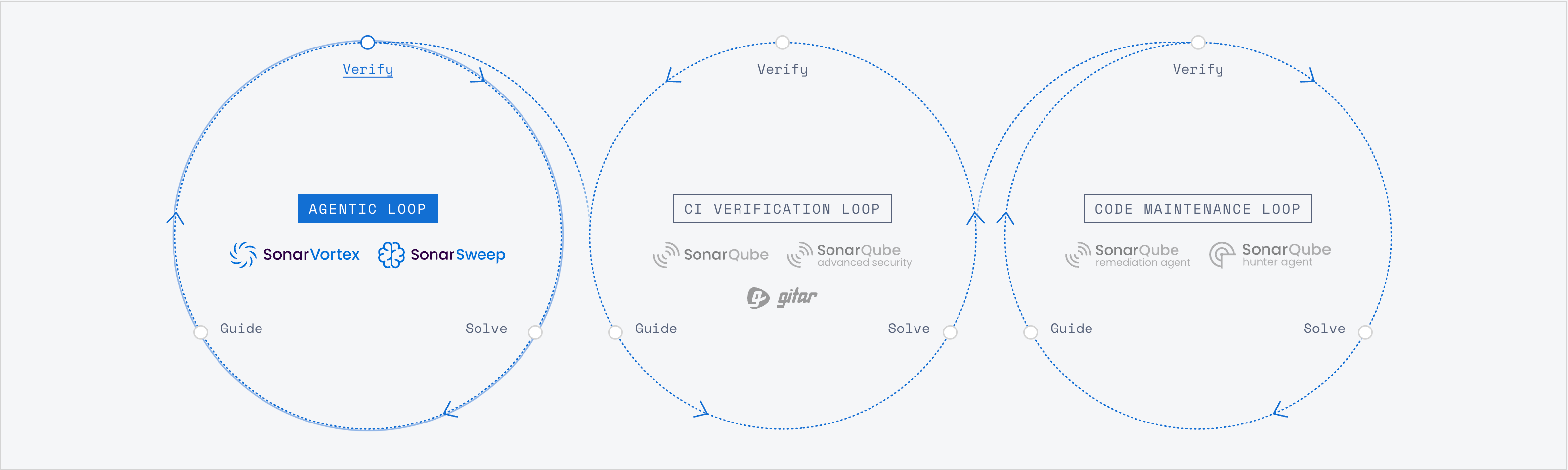
SonarQube Hunter Agent is an agentic security researcher that thinks like an attacker and reports like an auditor. It reasons like a senior security researcher, not a model guessing at random: structured playbooks encode deep security domain expertise, paired with guided agentic reasoning. It hunts the logic flaws pattern-based analysis was never designed to catch by orchestrating a swarm of agents that scales to codebases of millions of lines. Every suspected finding is investigated and validated before it's raised.
Daybreak brings advanced cybersecurity reasoning into that playbook, including models purpose-built for cybersecurity. As more capable models become available through the program, Hunter Agent runs its existing playbook on top of them: the structure is what makes the output consistent and auditable, the model is what determines how deep and how accurate that reasoning can go.
Today, we're excited to announce the availability of GPT-6.1 Sol, the latest Daybreak-class model, inside Hunter Agent, and the difference shows up in the numbers. Across codebases ranging from 17,000 to 1.4 million lines, GPT-6.1 Sol reached 67% complete-finding coverage, 20% more complete findings than Hunter Agent's previous production model. On the largest codebase tested, 94% of its input came from cached context, letting it handle 2.4 times as many input tokens and finish scans up to 43% faster. The deeper reasoning isn't just faster, it catches more: in one test, Hunter Agent flagged a data export feature that correctly checked permissions on paper but still let users reach another team's secrets, exactly the kind of flaw that pattern-matching alone will miss.
Bringing Daybreak to Gitar
Daybreak access is also extending to Gitar, Sonar's AI code verification agent. It will start with how Gitar reviews AI agent skills, the instructions and tools that direct what an agent can do, including access to credentials and private code. An unsafe change to a skill can quietly remove a required approval step or leak data, and the problem can span both the instruction file and the script it invokes. .
Gitar compares versions of an instruction file and catches when an updated summary drops a required sign-off step, exactly the kind of change a pattern match on the publishing command alone would miss. It treats repository instructions as untrusted evidence, inspecting suspicious content without executing it, and validates every candidate issue before it reaches a pull request.
Independent verification is the answer to the agentic era
As AI agents generate more code faster, the attack surface can grow faster than security teams can defend it. Frontier intelligence makes security teams more capable, but only when it runs inside a harness that makes results precise, repeatable, and auditable. Hunter Agent supplies that structure: Sonar's code security knowledge, structured playbooks, and validation of every suspected finding before it becomes an issue.
The agentic era doesn't reward whoever adopts AI fastest. It rewards whoever removes the weaknesses attackers would exploit before software reaches production, and keeps reducing the risk already present in the codebase. That's the standard Sonar is building toward, and Daybreak is how we keep building it at the frontier's pace.
As the collaboration with OpenAI deepens and new models become available through the program, Sonar automatically evaluates and integrates them. We expect this same access to extend across more of Sonar's products, bringing the same frontier reasoning to the full path from detection to remediation.
Start free trial orcontact sales.