Anyone who manages their company’s social media for a living operates every day in fear of being the one at the helm when the brand account is hacked. But many don’t know what steps to take to mitigate that fear.
While the biggest brand risk is not being present on social at all, we can’t deny the inherent security concerns of building and maintaining a digital footprint. There are so many new platforms emerging, so much content out there (including rampant misinformation) and mounting concerns about account access in the face of turnover. Brands must make social media governance a priority.
And AI is now the fastest-growing governance gap. Leaders are asking teams to adopt it faster than policies, approvals and vendor reviews can keep up, and this pressure is already showing: 39% of marketers say the social and political climate brought more restrictions on content and influencer partners, while 44% say it brought more internal approvals.
At its core, social media governance equates to one thing: eliminating risk. By putting proper processes and procedures in place and managing your social media accounts in a centralized manner, you significantly turn down the dial on the brand threat barometer.
If you need help making the argument for the resources you need to do governance well, keep reading. Here are the top risks of not creating a social media governance framework for your operation, and how to start implementing an effective strategy.
What is social media governance?
Social media governance is how an organization sets rules and responsibilities for using social media safely and effectively. It includes things like who can post on official accounts, who can use AI tools for defined reasons (including which tools to use and with what review), how to respond to customer questions or crises, the guidelines employees and influencers should follow when representing the brand online, and how to follow required security measures.
A thorough social media governance framework helps protect your brand’s reputation, stay compliant with legal and privacy requirements, and reduce the risk of mistakes or misuse. Creating clear approval processes for social posts, providing social media training, and monitoring for potential security threats or off-brand content are all examples of social media governance in action.
With threats like doxxing and increasingly sophisticated cyber attacks, the current state of the social industry makes governance an even more pressing issue. Between the rise of AI content and spread of misinformation, distributed and hybrid teams, social media professional turnover rates and increasingly sophisticated cyber threats, teams are up against continuous waves of risk.
Why social media governance is so important
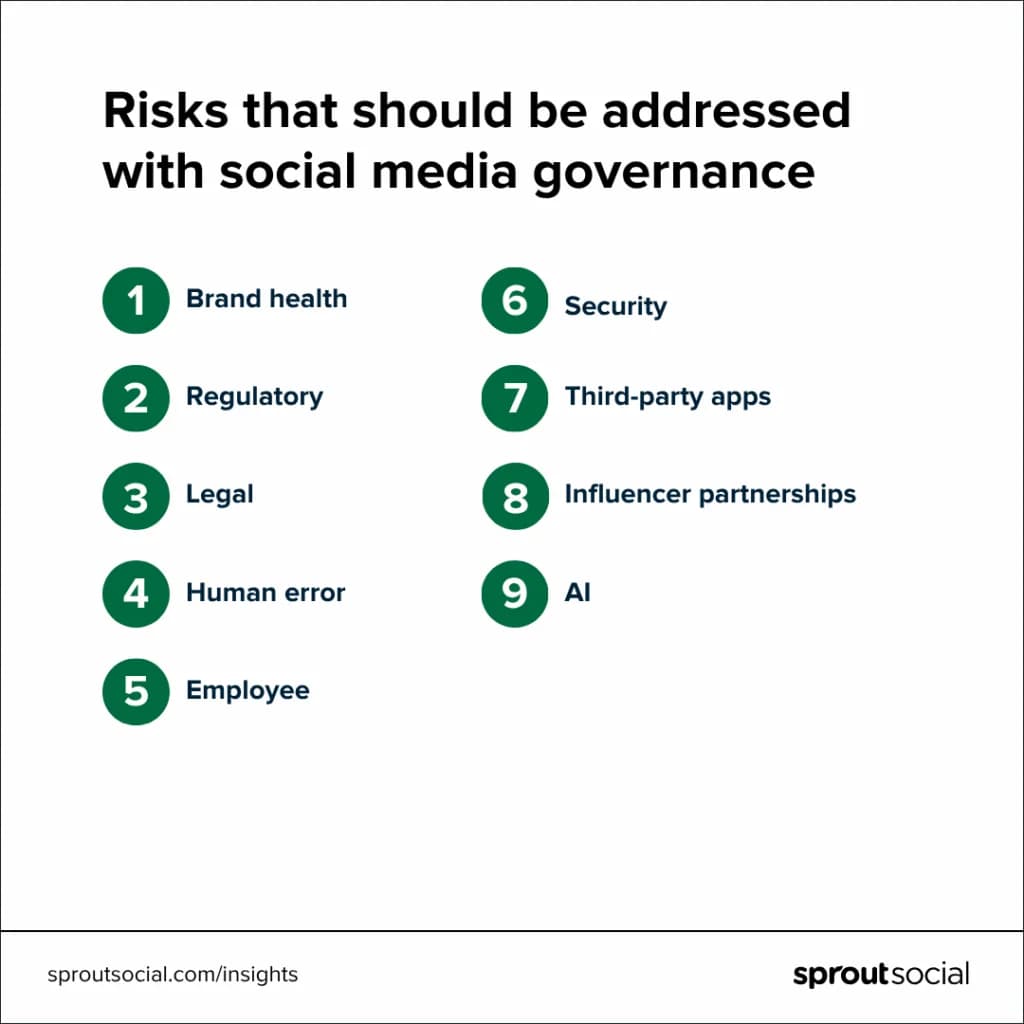
While a social media governance framework isn’t the glamorous side of social, it is 100% necessary when it comes to protecting your brand and granting stakeholders (like your IT team) peace of mind. Here are nine reasons why social media governance matters.
1. Risk to your brand
Obviously, if hackers gain access to your social media accounts, they’re not there to respond to customer inquiries with winning service skills. Ask yourself how much damage would be done if criminals got control of your social media accounts and published something disparaging, changed your account to look like your primary competitor’s account or converted it over to make it look like it supports terrorist groups (note: all are real examples). How much would your credibility be damaged? And what about your brand?
2. Compliance and regulatory risk
Depending on your industry, you may have additional rules guiding what your company can and cannot say publicly. Companies in the financial, medical and pharmaceutical industries all have additional considerations. Even other industries like travel, energy and higher education are under increased scrutiny.
Industry aside, all companies have to worry about violating government regulations regarding social media. If you have trouble getting budget to support governance work, tell your leaders this could cost them $50 million (or more). Not paying attention to governance can land you in hot water with a number of regulatory agencies, from the FTC to the governing bodies in Europe that hand down GDPR fines. And you must be extra aware if you manage a widely recognized brand. Regulatory bodies will intentionally make an example out of major corporations to generate big headlines.
It’s only a matter of time until we have a US equivalent of GDPR. Currently 20 states have already instituted their own versions.
These risks are constantly evolving, with new legislative actions like the push for social media bans in the US and abroad presenting significant compliance hurdles for global brands.
3. Legal risk
As companies rely more on social media as a form of customer service and communication, chances are higher that lawsuits based on social media will emerge. If you cannot say definitively who had access to your accounts at a given time or who posted a specific item or comment, you may find yourself unable to defend yourself to your supervisors, your legal team or a court of law.
4. Human risk
To err may be human, but if the human happens to be a social media manager, forgiveness is a hard thing to come by. Bottom line, people absolutely make mistakes. But the proper tools and procedures make it a lot less likely that someone will accidentally post from the company account instead of their personal account or that they will do something else that causes you a self-imposed PR “incident.” It also saves you from having to fire someone.
5. Risk from your own employees (internal risks)
A lot of companies do not have firm rules about what employees are allowed to do on social media. Employees may accidentally share items that include confidential information (such as financial or HR data) or air personal grievances against the company or coworkers in a very public forum. Not having official policies and rules makes it hard to hold people accountable, and it makes it hard for employees to know what is and is not okay.
6. Security risk
Cybercriminals like easy targets. They go for the ones with terrible security and no tools in place. So don’t make yourself an easy target. And if you are a Fortune 500, you are most definitely being targeted.
Make sure you know all of your account passwords (or better yet, are using a password management tool). Make sure you’ve turned on two-factor authentication (2FA) for all accounts where available. Know who has access to your accounts at all times, including partners and agency teams. And ensure there is a process and standard operating procedures for starting new accounts, maintaining existing accounts and shutting down retired accounts. In any platform you evaluate, look for enterprise-grade controls like SSO, role-based permissions, audit logs and encryption (See how Sprout approaches security in our Trust Center).
7. Third-party app risk
Many times, criminals find their way into your systems via a less-secure third-party app or tool that you’ve connected to your main account. View it as a kind of unsecured back door. This now includes third-party AI tools, agents and plug-ins. Employees can connect unvetted AI apps to brand accounts, opening a new window into your accounts. Make sure that you are regularly evaluating any third-party tools you have connected to your social media accounts, and make sure you are vetting their security as well as your own.
8. Influencer risk
Brands are spending more of their overall marketing budgets on influencer marketing than ever. More than half put over 20% of their budgets toward influencer marketing. And some companies like Unilever are dedicating 50% of their marketing budget to influencer strategies. By 2029, influencer marketing ad spend is expected to reach $56 billion.
And AI-generated influencers add a new wrinkle. Our Q2 2026 Sprout Pulse Survey found 44% of consumers are uncomfortable with brands using them, 30% say it depends and 27% aren’t sure whether the influencers they follow are AI-generated.
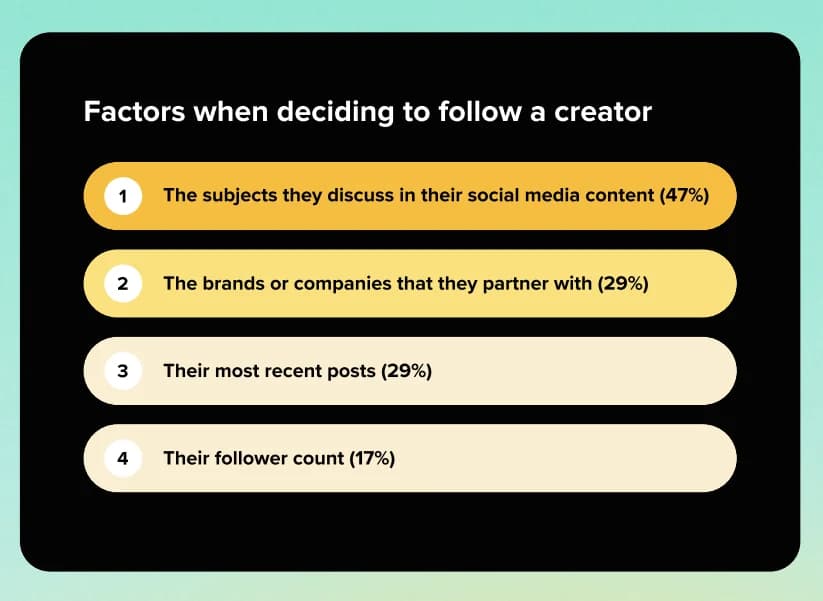
As spend goes up and new types of partnerships are forged, influencer risk multiplies. If a creator speaks out against your brand, falls out of favor with their audience, gets caught in a scandal or shares an unpopular political take, your company can get tangled up in crisis. That’s why it’s so important to identify influencers who align with your values, industry requirements and campaign standards.
9. AI risk
AI is no longer “nice to have.” Teams rely on AI for increased efficiency and scaling their work, so they can focus on the most important and strategic tasks. But with more AI use comes a laundry list of risks, including ethical concerns, negative brand perception, ineffective vendor vetting, employee misuse, and inaccurate or offensive outputs.
Here is where AI risk commonly shows up:
- Data privacy and model training: Team members may share customer data, unreleased campaigns or DMs into public AI tools. So you need to ask: Does the vendor train on your data? And do employees know what information they can and cannot share with AI tools?
- Shadow AI and employee misuse: Unapproved tools, personal accounts and no visibility into who generated what. This increases legal risk, as you need to be able to say who produced what and when.
- Inaccurate, offensive or off-brand outputs: Hallucinations, tone-deaf copy and copyright or IP infringement can slip into public posts. Trust is always fragile, as our Q1 2026 Pulse Survey proved showing 88% of consumers say the rise of video generation AI tools has redacted their trust in the news they see on social.
- Brand trust and AI slop: Our Q1 pulse survey further found that unlabeled AI content is the #1 thing consumers wish brands would stop doing. And users are questioning content even more than before, defaulting to thinking it’s synthetic until it’s proven human. Not labeling AI content can be costly, with the survey also finding that 50% of Gen Z will unfollow, mute or block a brand or creator over it.
- Regulatory exposure: AI regulations are evolving and different across countries, provinces and states, so a policy built for one market can fall short in another.
To mitigate these risks, humans need to be kept in the loop (with parameters in place). Implement an AI use policy internally that includes the roles and responsibilities of all employees using AI, planned implementation to reduce data privacy and copyright risks, clear use cases, intellectual property rights and disclosure details.
What to consider when developing a social media governance strategy
When building your social media governance framework, you need to factor in your organization’s unique values and brand guidelines, internal structure and systems, and comfort with risk. While no two brands will have an identical governance playbook, here are top considerations you should incorporate into your guidelines.
Establish a governance center of excellence
A governance center of excellence (CoE) is a centralized team or function within an organization that sets the standards, best practices and guardrails for social media use across the business. It serves as the strategic and operational backbone for social media governance, ensuring consistency, compliance and efficiency across departments, regions and platforms.
Your CoE may include representatives from the social team, PR, IT/security, legal and HR, but could also include other departments. Together, these individuals set the company’s risk threshold, stay up to date on evolving regulations and compliance needs, approve AI models and tools, and disseminate information across the organization as required. That includes developing and refreshing the company’s social media policy, which should be a living document (not something you “set and forget”).
Atlas Copco Group shows how this works across a multi-brand and -national operation. The global industrial company runs social across several business areas, divisions, brands and local markets, and its global social team has to protect brand trust, quality and compliance without taking away local teams’ freedom to speak to their own markets. Using Sprout, the team looks past mention spikes to smaller patterns across accounts and markets: repeated questions, inconsistent activity, off-brand content and inactive pages. Together, those signals flag risk while it’s still small. As Pankaj Kumar, Manager Digital Services at Atlas Copco Group, puts it, the team started seeing social data “not as a reporting output, but as a business input.”
The central team also positions itself as a support system, not an auditor. Local teams get clearer expectations, training, feedback and escalation guidance, so they see the global team’s involvement as useful rather than overbearing. The key takeaway from this example is to build your CoE to coach teams, not police them.
Define brand safety standards for content & community management
Your content and community management guidelines should be rooted in your core brand values. For example, if your brand values inclusivity, your brand safety standards should prohibit discriminatory content and actively moderate harmful language in posts, comments, etc. This should also include language and imagery restrictions (e.g., no profanity, graphic visuals), and rules around political or sensitive topics and community moderation. Extend those standards to AI-generated content: Spell out what must be labeled, what’s off limits and who signs off. You can use our brand safety checklist to help pressure-test your rules.
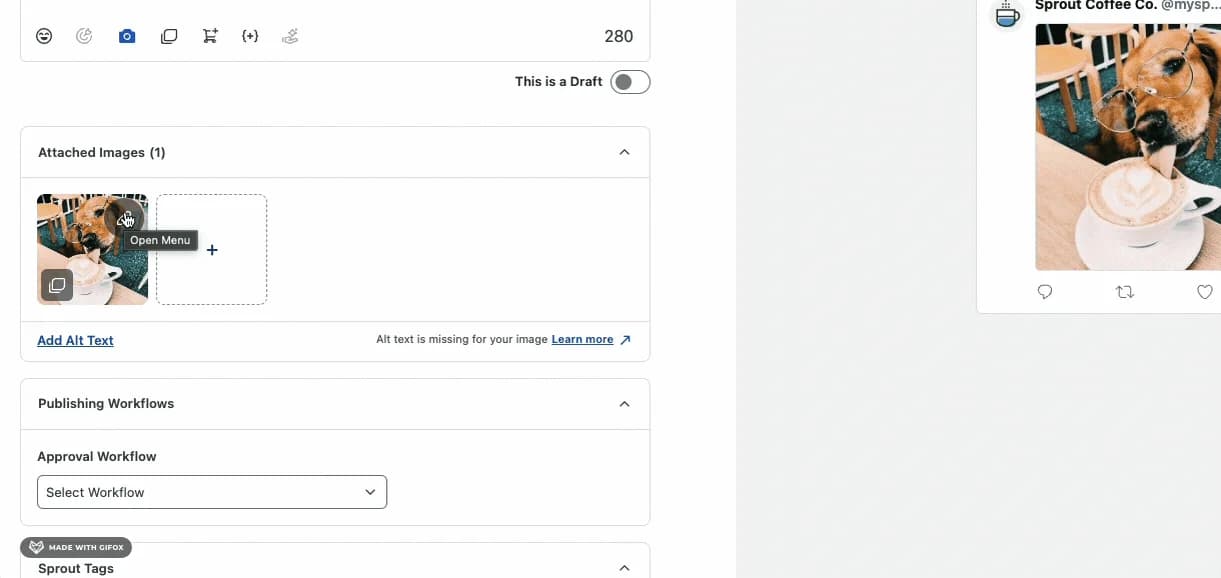
Trying to wrangle control over so many different channels, posts and discussion threads can be a challenge. To help prevent off-brand content from being published, Guardian by Sprout Social’s AI-driven Blocked Words tool sets compliance-driven parameters. If a blocked word or phrase is used in a caption, alt text, transcripts, or when replying to a user message, a pop-up box appears letting you know the content cannot go live.
If you prefer a more hands-on approach or require additional approval protocol, Sprout’s Message Approval Workflows help teams collaborate effectively by creating multi-step and multi-user workflows that enable submitting, reviewing, and approving or rejecting outgoing messages—all in one platform.
You can use other tools, like Sprout’s Automated Rules, to control incoming messages. Automated Rules proactively hide unwanted messages from your Facebook, Instagram, YouTube, TikTok and X profiles.
Refine your influencer & partner vetting process
Crafting a structured, repeatable vetting process helps prevent crises and protect brand trust while building stronger influencer and creator partnerships. To do so, create a checklist of non-negotiables and preferred attributes for influencers and partners, such as alignment with brand values (e.g., DEI, sustainability), content quality and tone (family-friendly, professional, edgy, funny), how well they engage with their audience and topics they talk about. Add AI-generated personas to that checklist. Know whether a creator is a real person or a synthetic one, and decide upfront whether you’ll partner with either.
Because sifting through every potential partners’ profile and past posts is incredibly time-consuming (and probably impossible), Sprout rolled out Brand Safety in the Influencer Marketing platform. It helps you protect your brand’s reputation by identifying creators whose content may not align with your governance standards.
This automatic feature includes a set of default safety categories—which you can turn on or off and edit at any time—including alcohol, adult content, gambling and lotteries, military content, political content or competitor mentions. You can also build custom rules based on your industry or brand-specific sensitivities.
Protect your audience
When it comes to data collection, there are infinite things you can learn about your customers. From basic attributes (like name, email address and demographics) to how they interact with your brand online (engagement, cost per click and conversion metrics). You can track their purchasing behavior (order history, average order value, usage) and source attitudinal data (voice of customer, sentiment and psychographics).
But with so much rich customer data available, proper management is key. Even well-meaning social teams may mismanage data, putting both their brand and customers at risk. This risk is exacerbated in industries like healthcare where strict laws dictate how brands must store and delete data. Even if a patient shares their personal data with you via DM unprompted, not deleting it immediately could still result in legal action.
The best way to protect your audience’s data is to have clear procedures in place for storage, deletion and overall management. That includes a firm rule: Never feed audience data, including DMs, into unapproved AI tools. Sprout makes this easier by enabling PII (personal identifiable information) masking. With Data Masking, you can identify and mask certain types of sensitive information within the Inbox and agent workspace—including phone numbers, email addresses, social security numbers and credit card numbers. The data will be automatically masked before care teams even see it.
When businesses do need to collect required personal information, they can do it safely, with Sprout’s Secure Forms. This tool enables support teams to complete care interactions end-to-end on social, reducing friction and keeping the entire experience seamless.
Enable your employees
A strong social media governance framework doesn’t just live on paper—it has to be applied day to day. You must train your employees effectively, including everyone from the team responsible for posting content on the brand account to employees who use social for personal use. Your training should emphasize the importance of complying with your brand values and guidelines, following proper protocol and using AI tools responsibly. It should also and include action plans for a variety of crisis situations.
When setting up your training, you should also consider who needs to access your social media accounts and what the SOP will be when employees leave. Also audit AI use on a regular cadence, and treat your AI policy as a living document that evolves with your tools and regulations.
With Sprout, you can set up different types of flexible user permissions. These ensure the right members of your team have access to the tools and profiles they should, and allows you to manage access to all of your accounts instantly.
Decide where AI is allowed and how it’s used
Treat AI as its own governance track. These five moves put guardrails around it.
- Is customer data used to train third-party or public models?
- Can you opt out of third-party model integrations?
- Does it offer encryption in transit and at rest, SSO, SOC 2 compliance, audit log and role-based access?
- Does it align with recognized frameworks, like the NIST AI Risk Management (AI RMF) and OECD AI Principles?
- What are its data retention and deletion practices?
- Where do its model providers sit in the supply chain?
Social media governance is business critical
Social media governance isn’t just a defensive strategy. It’s an essential foundation for building trust, scaling safely and empowering your team to act with confidence. The risks outlined here, from security threats to influencer missteps, are real and rising.
But with the right processes, tools and training in place, you won’t only avoid those pitfalls—you turn governance into a competitive advantage. That’s especially true for AI. Strong guardrails are what let teams scale AI with confidence. As social media continues to evolve, the brands that thrive will be the ones that treat governance as a business-critical discipline, not an afterthought.
Ready to enforce your governance standards before content goes live? See how with a demo of Guardian by Sprout Social.
Social media governance FAQs
What should a social media AI policy include?
A strong policy covers approved tools and use cases, prohibited inputs (such as customer PII and confidential data), roles and responsibilities, human review and approval steps, and disclosure rules for AI-generated content. Treat it as a living document and update it as your tools and regulations change.
Should brands label AI-generated social content?
Yes. Set a clear disclosure standard for AI-generated or AI-altered content, especially synthetic images, video and AI personas. Unlabeled AI content is the top thing consumers wish brands would stop doing, though labels alone won’t win trust, so pair them with quality.
How do you vet an AI vendor for social media management?
Ask whether the vendor trains models on your data, whether you can opt out of third-party model integrations, and how it handles data retention and deletion. Confirm its security controls (encryption, SSO, SOC 2, audit logs and role-based access), its alignment with frameworks like the NIST AI RMF and where its model providers sit in the supply chain.
Who should own social media governance in an organization?
A cross-functional center of excellence should own it. It should include the social team, PR, IT/security, legal, HR, data and AI representatives who set risk thresholds, approve AI models and tools and keep policies current.
Why is social media governance important?
It reduces risk across your brand, compliance, legal exposure, security, third-party apps, influencer partnerships and AI use. It also gives your team the clear processes it needs to scale with confidence.
What role do tools play in social media governance?
Tools enforce your policies at scale so rules don’t depend on memory. Look for capabilities like role-based permissions, multi-step approval workflows, blocked words, PII masking and audit logs.