Customer-facing analytics can cause applications to outgrow a MySQL or PostgreSQL database long before the rest of the application does, especially as user counts and data volumes grow. Both databases give developers a familiar, straightforward path from prototype to production and can serve transactional workloads for years.
As teams add real-time reporting, search, recommendations, and other data-intensive features, analytical queries combined with transactions push concurrency to the limits. Growing data volumes and concurrent usage can make it harder to keep both responsive.
Teams can give applications room to scale by migrating to a distributed SQL database. But doing this in one shot is complex and risky. Most users want a gradual path that allows them to scale while reducing risk.
Moving the application incrementally requires a separate copy of the data that stays current as the application continues writing to the original database. Change data capture (CDC) keeps that copy up to date by tracking inserts, updates, and deletes in the source database.
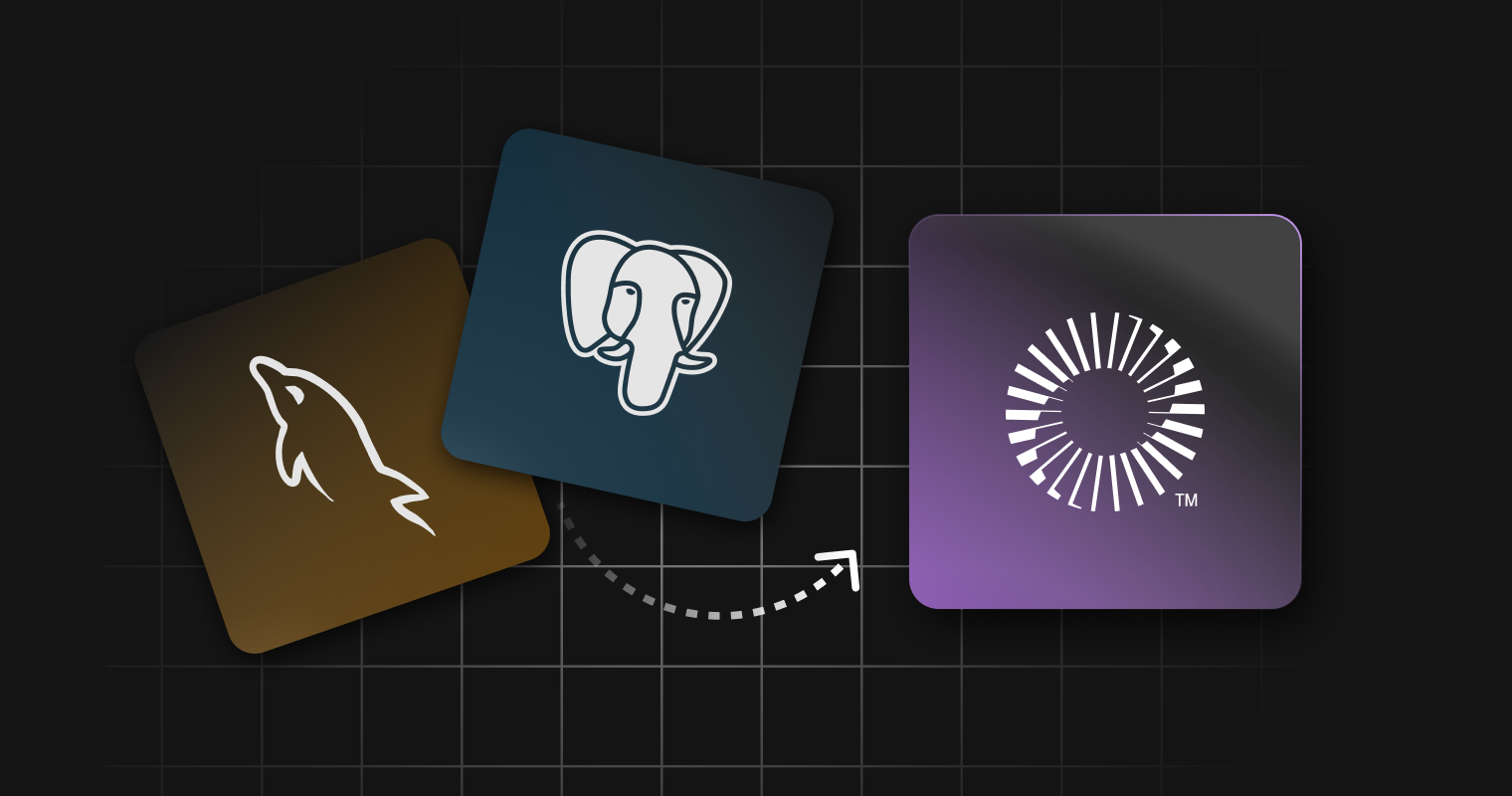
SingleStore Flow uses CDC to continuously replicate those changes from MySQL or PostgreSQL into SingleStore Helios. Developers can then move analytical portions of their workload to Helios incrementally, reducing the load on the source database while their existing applications keep running.
The Application Growth Problem
A security platform might need to search and aggregate millions of events while new events are continuously ingested. A fintech application might need to combine transactional data with real-time risk or account analytics. An observability application might need to ingest high-volume telemetry while allowing users to filter and aggregate recent events interactively. A SaaS platform might expose usage analytics, segmentation, and reporting directly inside its product.
These workloads create a difficult combination of requirements:
- High write throughput from the operational application
- Increasing data volumes
- High concurrency as the customer base grows
- Low-latency point lookups
- Aggregations and joins across large datasets
- Fresh results over data that may have arrived seconds or milliseconds earlier
- Predictable application response times as usage scales
Developers can compensate for a while. They add indexes, caching layers, read replicas, precomputed tables, background jobs, or separate analytical databases. But at some point, the question becomes less about how to optimize another query and more about whether the database architecture still matches the workload.
CDC Turns Migration Into an Incremental Application Change
Distributed SQL spreads storage and query processing across multiple nodes, giving demanding workloads room to scale. Adopting it can require moving large datasets while writes continue, validating application compatibility, testing performance, and coordinating a production cutover. Change data capture (CDC) lets teams make that transition gradually by keeping a second database synchronized with the source while they test and move individual workloads.
With SingleStore Flow, developers can create managed CDC pipelines from databases such as MySQL and PostgreSQL into SingleStore Helios. The migration can happen while the existing application continues operating against its current database.
The process looks roughly like this:
MySQL / PostgreSQL → CDC Pipeline → SingleStore Helios → Application Workload
Flow performs the initial synchronization of existing data and then continues consuming changes from the source database. New transactions written by the application are propagated into SingleStore without requiring developers to build and operate their own replication infrastructure.
Instead of:
migrate database → change application → cut over → hope everything works
teams can use a progressive approach:
replicate data → validate workload → move queries → measure performance → expand adoption
That allows developers to introduce SingleStore at the workload level rather than requiring the entire application to move at once.
Start With the Workloads That Need Scale
This is particularly useful for applications that have outgrown MySQL or PostgreSQL for specific data-intensive features but aren't ready to replace their operational database entirely. For example, an application team might keep transactional writes on PostgreSQL while initially moving customer-facing analytical queries to SingleStore.
The application architecture becomes:
Application writes → PostgreSQL
PostgreSQL → CDC → SingleStore
Analytical application queries → SingleStore
Developers can then move the queries where distributed execution provides the greatest benefit: large aggregations, high-concurrency reporting, operational analytics, search, or queries spanning large amounts of recent and historical data.
Migration Performance Metrics
Recent real-world deployments demonstrate the high-throughput capabilities of SingleStore Flow across large-scale datasets and diverse source engines:
- Migrated 600GB of MySQL data within 3 hours.
- Migrated 1.5TB of Postgres data in under 2 hours.
- Migrated 75TB of MySQL data across 4,000 tables in a week.
The existing transactional path doesn't have to change on day one. Once the workload has been validated, the team can decide whether SingleStore should remain an analytical serving layer or whether additional application workloads should move as well. This reduces both technical and organizational risk.
SingleStore supports the MySQL wire protocol, allowing teams to use many existing MySQL-compatible drivers, ORMs, and database tools.
Avoid Building Another Replication Platform
Teams can build CDC pipelines using tools such as Kafka and Debezium, but they also take on responsibility for monitoring replication, recovering from failures, handling schema changes, and scaling the infrastructure as traffic grows.
SingleStore Flow is a CDC ingest service integrated into Helios. Developers configure the source and destination and create the pipeline without deploying and operating separate replication infrastructure.
Build Real-Time Data-Intensive Applications, Not Just Faster Dashboards
The end goal isn't simply making an existing dashboard load faster. It's expanding what the application can do with its operational data.
Once application teams can query large volumes of fresh data with low latency, they can build product experiences that are difficult to support with a conventional transactional database architecture.
That might include interactive customer analytics over billions of records, real-time fraud or risk investigation, security event exploration, observability and telemetry analysis, usage metering, operational monitoring, personalization, real-time recommendations, or search across rapidly changing application data.
These aren't traditional analytical workloads where data is copied into a warehouse and queried hours later. The query path is part of the application's user experience, and users expect results to reflect what is happening now.
That creates a workload where transactions, ingestion, search, and analytics increasingly converge.
Distributed SQL allows the data layer to scale with that workload rather than forcing developers to split every new application capability across specialized databases and pipelines.