Key Takeaways
- AI is delivering measurable retail ROI in production, not pilots. 89% of retailers report revenue growth from AI, with inventory optimization delivering 200–400% ROI over 12 months.
- Personalization and inventory are converging into a single system. The retailers pulling ahead connect demand signals from personalization engines directly to inventory and supply chain decisions, so what customers want and what is available are optimized together, not separately.
- Real-time data is the differentiator. Starbucks processes billions of data points to personalize offers in real time. Walmart's AI saved over $55 million in excess inventory through predictive demand alignment. The common factor is not the AI model. It is the speed and quality of the data feeding it.
- Most retailers are still automating in silos. Personalization sits in marketing. Inventory sits in operations. Until these are connected through a shared data and orchestration layer, AI will optimize each one locally while missing the bigger picture.
Two Systems, One Blind Spot
Retail has always been a margin game. The difference between a profitable quarter and a difficult one often comes down to two things: whether the right products were in the right place at the right time, and whether customers found what they were looking for before they lost interest.
AI is now reshaping both sides of that equation. Personalization engines generate real-time, intent-driven recommendations. Inventory systems shift from periodic forecasting to continuous, autonomous replenishment. Individually, each capability delivers results. But in most retail organizations, they operate in isolation, optimizing their own slice of the business while actively working against each other.
When a personalization engine recommends a product that is out of stock, it creates frustration. When an inventory system replenishes based on historical averages while the personalization engine is driving demand toward a different product mix, the two systems contradict each other. The result is wasted marketing spend, missed revenue, and excess inventory that ends up marked down.
The Architectural Root Cause
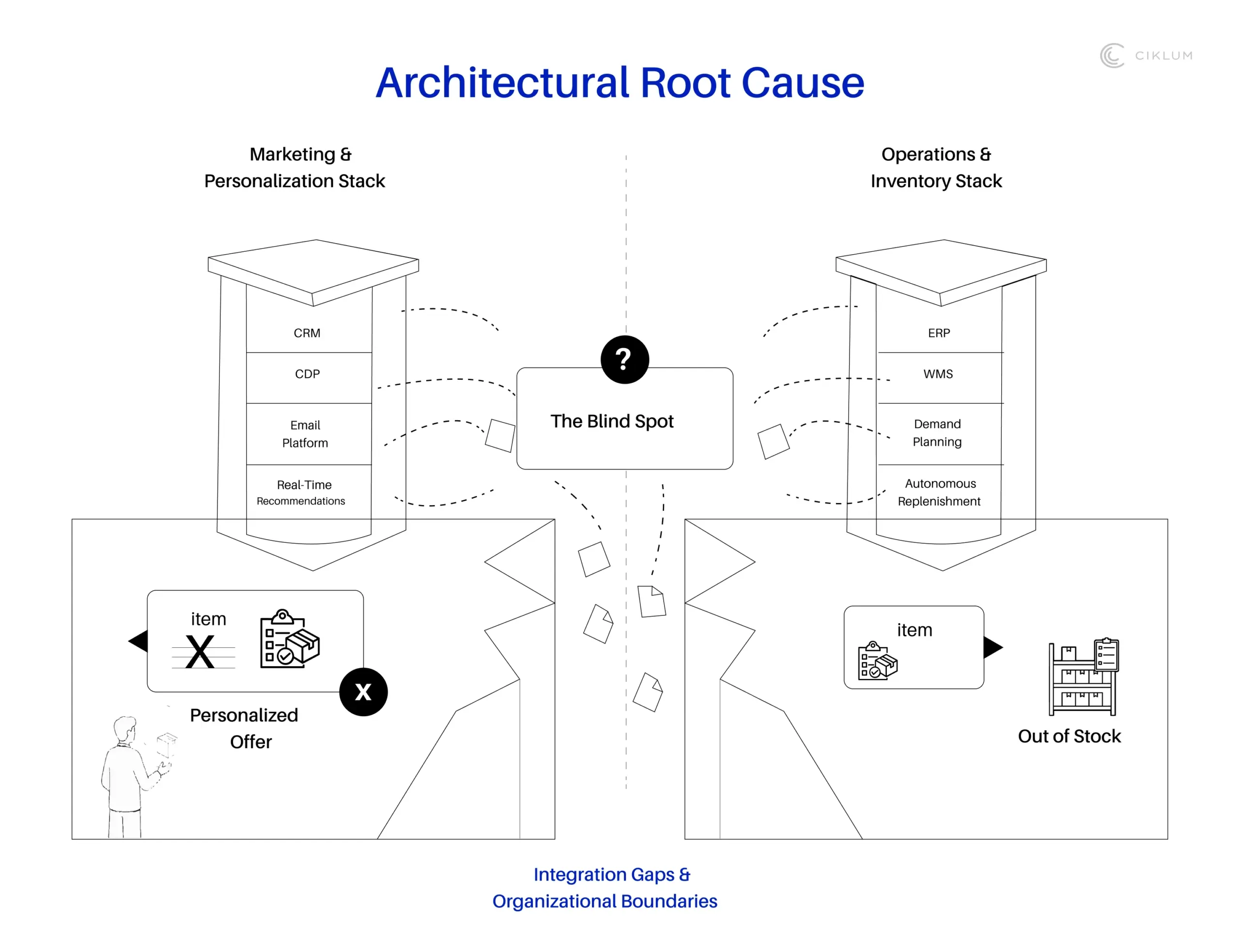
The root cause is architectural, not technological. In most retailers, personalization lives inside the marketing technology stack (CRM, CDP, email platform) and inventory lives inside operations (ERP, WMS, demand planning tools). These systems were built at different times, by different teams, with different data models.
The traditional inventory planning cycle (quarterly forecasts adjusted monthly, allocated regionally, reviewed weekly) was designed for a world where demand patterns were relatively stable and the cost of getting it slightly wrong was absorbed through markdowns and overstock budgets. That world no longer exists. Demand signals shift daily. Viral trends spike and collapse within weeks. Supply chain disruptions can make last month's forecast irrelevant overnight.
Meanwhile, personalization engines have become faster and more granular, but they typically have no visibility into what is actually available. They recommend products based on relevance scores, not fulfillment reality. The data that each system needs from the other sits behind integration gaps, batch synchronization jobs, and organizational boundaries.
What Siloed AI Actually Costs
The numbers make the cost of this disconnect concrete.
90% of retailers are increasing AI budgets in 2026, with 91% of the industry now actively using or assessing AI. But only 25% of AI projects yield positive ROI, and just 16% scale beyond the pilot phase. The gap between investment and return is not about model quality. It is about fragmented data and disconnected systems.
Inventory optimization alone delivers 200–400% ROI over 12 months when properly implemented, reducing inventory costs by 20–35% and preventing 65% of stockouts. Personalization drives 10–30% increases in average order value. Yet most retailers capture these gains in isolation, leaving the compounding effect of connecting them entirely on the table.
The retailers producing the strongest results are not the ones with the most advanced models. They are the ones that built the data foundation first.
How to Connect Personalization and Inventory Into a Single Operating System
The convergence of personalization and inventory requires three things: a unified data layer, real-time orchestration, and a composable architecture that lets both systems share context.
Connect your data first: Unify product, customer, and inventory data into a single access layer. This does not require migrating everything into one system. It requires consistent, real-time access across systems through APIs or a data virtualization layer. A global consumer goods company Ciklum worked with faced this exact challenge: 22+ disconnected data sources across countries, with no unified view of supply chain performance. The solution (a Snowflake and Azure-based data platform with Power BI dashboards and automated workflows) eliminated the fragmentation that made AI-driven inventory decisions impossible. Stock-outs decreased, visibility improved, and the data foundation was in place for future automation.
Build a shared orchestration layer: The personalization engine needs to know what is available. The inventory system needs to know what the personalization engine is promoting. Demand signals and supply decisions should flow through the same data fabric, so the business optimizes for what customers actually want and what can actually be delivered, simultaneously.
Use composable, API-first infrastructure: A composable architecture that connects CRM, product catalog, inventory management, and fulfillment systems into a single queryable layer is what makes convergence possible. Monolithic platforms where personalization and inventory operate as separate modules with batch synchronization cannot support this at the speed the market now demands.
Start where the ROI is clearest: Personalization at scale requires a unified data layer connecting customer intelligence, product data, and operational systems in real time. Begin with product recommendations, personalized email triggers, and loyalty program offers (the shortest path to measurable lift), and automate inventory replenishment for high-volume, predictable categories first. Then connect the two. This last step is the one most retailers skip, and the one that produces the compounding returns.
Retailers Already Doing This at Scale
Starbucks is the most cited example, and for good reason. Its Deep Brew AI platform processes billions of data points to deliver personalized offers across its mobile app and in-store experience, producing a 23% uplift in digital engagement and a 14% increase in average check size. Over 56% of Starbucks transactions now occur through digital channels where personalization runs continuously. At the company's January 2026 Investor Day, leadership positioned AI as the centerpiece of its turnaround strategy, unveiling an AI-powered ordering companion and reporting the first U.S. comparable transaction growth in eight quarters. The engine works because it has real-time access to transactional data, customer profiles, contextual signals, and inventory availability, all flowing through a unified platform.
H&M implemented AI-powered inventory optimization across 5,000+ stores in 70+ markets. As Reuters reported, the company built a 270-person AI unit to replace centralized, manual inventory allocation with demand forecasting that captures emerging trends and adjusts allocation in near real time. The results have been material: operating profit beat expectations for three consecutive quarters, and the company achieved its long-held goal of an operating margin above 10%, driven in part by a higher share of full-price sales enabled by better inventory positioning.
Walmart is deploying AI-driven supply chain technology across international markets, as SupplyChain247 documented. In Costa Rica, predictive algorithms optimize perishable distribution with automatic store-level demand alignment before associates begin their shifts. In Mexico City, self-healing inventory software has saved over $55 million by preventing excess inventory losses. The company has invested over $11 billion in logistics and automation over the past two years, achieving a 40% reduction in delivery costs per order.
Zalando takes a different approach, combining discrete event simulation with probabilistic demand forecasting to optimize under uncertainty, delivering up to 22.1% GMV uplift through its replenishment engine.
The common pattern: these systems do not replace human planners. They handle the volume and speed that human planners cannot, processing thousands of SKUs across hundreds of locations simultaneously, adjusting allocations based on real-time sell-through data, and triggering replenishment before stockouts occur.
Frequently Asked Questions
1. How long before AI personalization or inventory optimization shows ROI?
Inventory optimization typically shows positive ROI within 3–4 months. Personalization engines tend to deliver measurable lifts in conversion and average order value (AOV) within 6–12 months. The fastest returns come from high-volume, predictable product categories and digital channels where A/B testing is straightforward.
2. Do we need to replace our existing systems to make this work?
No. The goal is a data access layer that connects existing systems through APIs, not a full platform migration. Most retailers start by integrating their CRM, product catalog, and inventory management systems into a shared queryable layer. The existing tools stay in place; what changes is how they share information.
3. What is the biggest mistake retailers make when adopting AI for personalization or inventory?
Treating them as separate initiatives. Personalization sits in marketing, inventory sits in operations, and neither team has visibility into the other's data or decisions. The compounding value only appears when both systems share a data layer and can respond to each other's signals in real time.
4. Is this only relevant for large retailers?
No. 85% of small businesses using AI report clear returns within the first year. The data unification and API-first principles apply at any scale. What changes is the starting point: a mid-market retailer might begin with a cloud data warehouse connecting three core systems, while a large enterprise might need to unify 20+ sources across multiple markets.