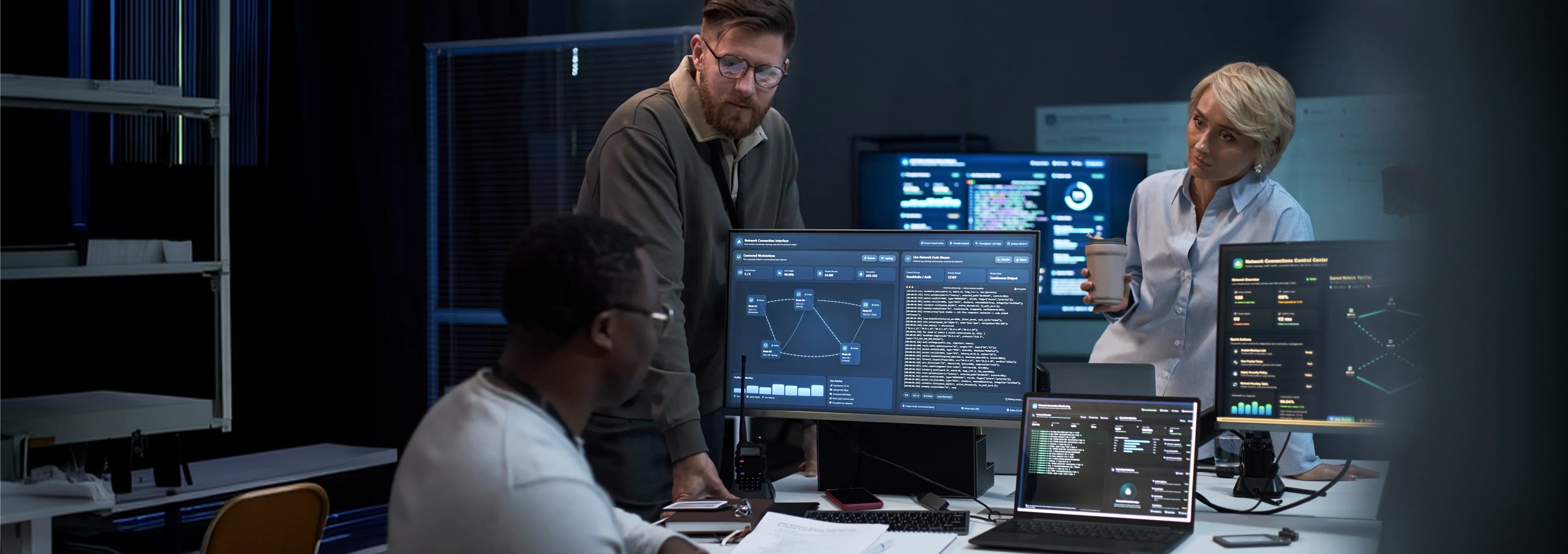
Last week a number of HouseCats attended Postgres Summit US 2026 in New York City, which ClickHouse helped sponsor. I enjoyed the commute: just 20-30m on the subway each day. My colleagues Zoe, Amog, and Josh flew in to staff our booth and meet the community. We savored a couple of terrific dinners together at The Tyger and Raku, organized by Zoe. So much laughing!
On the first day, Wednesday, I immediately found myself meshed into the natural social milieu of the conference. A number of attendees approached our booth, not just for our yellow elephant & killer stickers, or for the chance to win a Pikachu stuffy in a Totoro backpack, but to find out just how we integrate Postgres and ClickHouse.
Fortunately I lead an early session on this very topic, Postgres in da ClickHouse. We invited all comers, resulting in a very nice turnout. The talk began with some background on ClickHouse, the open-source analytical database; ClickHouse Cloud the platform; and how our latest product, ClickHouse Managed Postgres, slots into our vision of the default data stack. Spoilers: seamlessly use Postgres for OLTP workloads and ClickHouse for OLAP workloads.
Seamlessly how? I demoed four of our technologies that smooth the integration of Postgres and ClickHouse:
- pg_stat_ch records metrics for every Postgres query into the ClickHouse analytics stack for query insights. My thanks to Amog for filling gaps in my knowledge to answer some questions about it.
- pg_clickhouse, my baby, allows one to query ClickHouse tables from Postgres using native Postgres SQL. It currently pushes down 16 of the 22 TPC-H queries to ClickHouse, including nearly all Postgres data types and aggregate functions.
- The chdb_hook module enables efficient, flexible import and export of data lake files by passing a URL to the Postgres COPY command. It supports all of the ClickHouse data formats and cloud object storage platforms and outperforms similar extensions.
- WalShadow provides physical replication from Postgres to ClickHouse for sub-second data visibility to your analytical queries.
I found demoing the features and revealing benchmark results especially gratifying, as numerous heads bobbed and their owners made mental or literal notes for follow-up. And follow-up they did. The booth saw a good stream of questions about the products and integration, and several people stopped me in the hallway track to learn more.
The stress of presenting behind me, I relaxed into attending a few sessions a day by friends new and old alike. A few highlights.
Postgres committer Robert Haas introduced pg_plan_advice, a feature he added to the upcoming Postgres 19 release, and covered and some of the underlying technical challenges and choices implementing it. I appreciate the dedication of the Postgres committers not to add "hints" to SQL syntax; this feature seems like a great tool to nonetheless give users the power to influence the planner without changing their SQL.
Committer Peter Geoghegan gave an An Overview of Index Prefetching, which he hopes to land in time for Postgres 20. It provides sizeable improvements via parallel Asynchronous I/O for normal index scans, as opposed to bitmap scans, which must sort data after reading it. It promises the biggest gain for uncached data, where parallel read performance matches bitmap index scanning. As conference organizer Chelsea Dole pointed out to me, Peter often delivers no-effort features: when it lands, index prefetching will require no effort to adopt! Anyone who upgrades to Postgres 20 will simply gain better index scan performance.
Committer Amit Kapala surveyed the range open source CDC plugins. Each serves a particular use case: in-core logical replication for physical standbys, Debeezium for event streaming, and our own PeerDB for data warehousing. I admire Amit's dedication to continually improving logical replication. I wonder what he makes of WalShadow? I should have asked.
Fujitsu's Gary Evans delivered a fun talk on the long history of technologies that have promise to "kill" SQL and PostgreSQL. He showed a rather extensive graveyard of technologies, including NoSQL, scaling ("web scale"), and vector search, all of which appeared in specialized database servers, and have since been replaced with new features or extensions of Postgres (JSON/JSONB, Citus, pgVector).
Microsoft's Claire Giordano made an entertaining presentation on the basics of Postgres replication. Her secret decoder ring taught me, a replication dilettante, quite a lot.
Community advocate Benedict Kofi Amofah gave us the lowdown on the rapidly evolving Postgres organizations in Africa, starting with Madagascar, kenya, Ghana, Cameroon, and Togo, with more in the works. Perhaps unsurprisingly, this organic user groups mirrors the earlier experiences of community organizers in South America and, further back in time, in North America and Europe. The world will soon be all Postgres!
Gabriele Fedi of EnterpriseDB covered the history and status of extension packaging for CloudNativePG. This was a fun one for me, as I helped to get the extension_control_path feature added to Postgres, which allows CloudNativePG to load extension files from an read-only OCI image in Kubernetes. In recognition of which, I took some time over the weekend to add a CloudNativePG extension OCI image to pg_clickhouse.
I was super into The Pager is the Product: PostgreSQL in Cloud Environments, by Apple's Stephen Brandon. Alas, I had to bail after ten minutes because I was paged! 🤣 (No worries, all was fine.)
I met or caught up with a slew of people in the hallway track, as well. I chatted with my former colleague Christoph Pettus of PGX about an ongoing project to add Mac Minis to the Postgres build farm; Dominic Preuss of VillageSQL about the Postgres extensions ecosystem; and Dave Cramer of AWS about the challenges of maintaining open-source extensions and other ecosystem tools across vendors and providers.
I pitched Dave on attending the Postgres Ecosystem Foundation session PGConf.EU in November, where we'll strategize ways to begin to address these very challenges. I'm co-organizing this half-day session with colleagues from Percona, EDB, and PgEdge. Dave can't make it that day, but you should come!
Speaking of extensions, I also spent time talking with Soumava Ghosh & Corey Huinker of Apple, Divya Bhargov of Microsoft, and Lukas Fittl of pganalyze about various issues, including extension upgrades, Postgres major version upgrades, debugging extensions (and the Postgres core!) issues. Tarus Balog of Percona gabbed on about the Postgres ClickHouse extensions and tools covered in my talk.
is a modestly-sized if growing conference. Still, I visited with so many people! I enjoyed socially catching up with Joe Conway (AWS), Robert Treat (AWS), Stacey Haysler (PGX), Chelsea Dole (Citadel), Gabriele Bartolini (EDB), Peter Geoghegan (AWS), Corey Huinker (Apple), Jelte Fennema-Nio (MotherDuck), Claire Giordano (Microsoft), Bruce Momjian (EDB), Jan Wiek (himself), Jonathan Katz (Databricks), and engineers from Supabase, Aiven, Apple, Pinecone, and at least 8 other companies whose names escape me now.
Then I slept most of the weekend.
The PostgreSQL Event Calendar lists dozens of global, regional, and local Postgres community conferences every year. Maybe hundreds? I dunno, it's a lot. This was ClickHouse's first foray into Postgres conference sponsorship, but only the start. A great start, in my estimation. Next up, we're sponsoring in Valencia in November. I'll be there talking about the aforementioned Postgres Ecosystem Foundation project, but also how to contribute to the PostgreSQL documentation. See you in València!