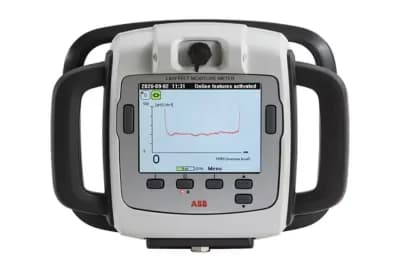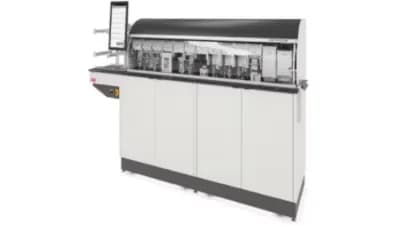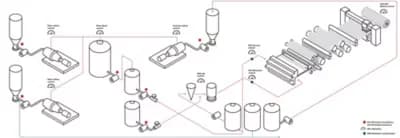
Wet end stability on any paper machine depends on minimizing the variability of conditions such as headbox and white water consistency, first-pass retention, and sheet ash content. Using a retention measurement and control system that incorporates sensors that can accurately measure both total consistency and ash consistency, can greatly improve paper machine efficiency, reduce quality variation, and optimize furnish cost.
First-pass retention (FPR) values are calculated from two consistency measurements: the headbox consistency and the white water consistency
where cHB and cWW are the headbox and white water consistency, respectively.
Accurate measurement at consistencies below 2% requires the use of optical consistency transmitters, as opposed to blade-type consistency meters based on shear-force principles used at higher consistencies. One consistency measurement device developed for low consistency applications are ABB’s KPM KC9 Optical Consistency Transmitters. This new sensor uses an LED pulsing monochromatic near-infrared light source with transmission and scattering detectors to measure consistency. Generally, at very low consistency such as that found in the wire pit, the transmission measurement is more accurate with total consistency whereas scattering enables distinct detection of fillers.
As ABB Product Manager, Manu Kettunen explains, consistency measurement is not accurate without comprehensive modeling and tuning of the sensor. On installation of a sensor in an individual location, measurement signals from all detectors are analyzed in order to determine which have the best correlation with consistency, using multivariable regression analysis tools.
The KC9-A version of this sensor can also measure the ash consistency of a sample, enabling the calculation of first-pass ash retention (FPAR), another important parameter for filled sheets. Ash consistency measurement in the headbox stock also enables the control of ash content during sheet breaks, when final ash content at the dry end scanner is not available. This means that recovery from a web break, and grade changes, can happen more rapidly if the ash measurement values and retention aid dosages are used to control the amount of ash in the headbox.
Wet end consistency can be measured either inline or using a bypass system, where the pulp flow is fed continuously to the sensor for measurement. A bypass system is much better in the case of wire pit consistency measurement because air entrainment affects the accuracy of the measurement, and the unit includes a deaeration module. Bypass installation costs are a little higher because separate piping is required, but maintenance is easier with shut-off valves – some inline sensors require a shutdown and emptying of the process pipe. Additional advantages of bypass sensors are the possibility to use automatic water cleaning and/or measurement signals from clean water to monitor and maintain the cleanliness of the sensor. Inline sensors may start to drift due to contamination building on the sensor lenses.
There is a wide diversity of FPR target values on different types of furnish and types of paper or board machines. A higher value of FPR captures more fine particles (fines) in the sheet and results in less two-sidedness, especially on a Fourdrinier machine. A low value of FPR results in recirculation of not only fines but also pitch and wet end additives, and can lead to problems such as agglomeration of deposits, filling of wet-press felts, and poor drainage.
Perhaps more important than the absolute value of FPR is maintaining a steady value of FPR. If the FPR varies, it results in variability in drainage rate and sheet moisture leaving the forming section, which can lead to web breaks. It can also result in basis weight variability.
The mill has come to rely on the KPM KRA Retention Measurement System. Having accurate information has allowed operators to not only get back on grade faster after a sheet break, but also achieve cost savings by being able to monitor addition of broke going back into the system more reliably. The operators now rely on the information provided by the KPM KRA Measurement System to ensure the highest quality at the lowest operational costs.
Phil Hinchcliffe, Process Controls Manager at the mill, indicated that they were so pleased with the performance of the system on the H-2 machine that they purchased another KPM KRA Retention Measurement System for the Hawesville mill’s H-1 paper machine. This newest system was put into service in mid-2019. Installation went smoothly, and the unit was very responsive to changes in ash content and both headbox and tray silo consistencies. The success of the implementation has also led to other opportunities in the areas of sheet break detectors and consistency transmitters.
In summary, the use of a retention measurement and control system can lead to good machine efficiency and consistent product quality while optimizing furnish costs. The key to getting a payback on this type of investment is having accurate consistency sensors designed for continuous measurement at the headbox and the wire pit. Building on these measurements to manage the addition of furnish components and wet end additives can lead to reduced variability, reduced downtime from sheet breaks, faster grade changes and ultimately decreased chemical usage due to more predictable performance.