On May 12, 2026, the Panasonic Group announced its Group Growth Strategy. The Group plans to accelerate its contributions toward 2032 by focusing on businesses that support AI infrastructure and social operations, with the aim of addressing challenges such as “using energy more efficiently” and “alleviating frontline labor shortages.” In particular, AI infrastructure businesses within the Devices area are poised to become a major driver of the Group’s growth through fiscal year 2029. These businesses include products designed for data centers, where demand is expected to surge as adoption of generative AI continues at a rapid pace.
*1. In this article, fiscal years refer to the years ending March 31 of the stated year.
A key player in this initiative is Panasonic Energy Co., Ltd. (hereinafter Panasonic Energy), which contributes to a wide range of areas in society with battery technology, from everyday life to mobility and social infrastructure.
Panasonic Energy has set a medium-term target of achieving 2 trillion yen in sales and over 300 billion yen in adjusted operating profit by fiscal year 2029. To contribute to the company-wide target, the energy storage system business for data centers plans to invest 350 billion yen over the three-year period from fiscal year 2027 to 2029. This includes investment in developing common infrastructure for its In-vehicle products at the Kansas factory in North America. The business aims to expand sales to 1 trillion yen by fiscal year 2029—approximately three times the level of fiscal year 2026. By leveraging the technologies and expertise cultivated as a battery manufacturer, Panasonic Energy aims to become a power solutions provider for data centers, offering power systems centered on safer batteries, thereby accelerating further business growth.
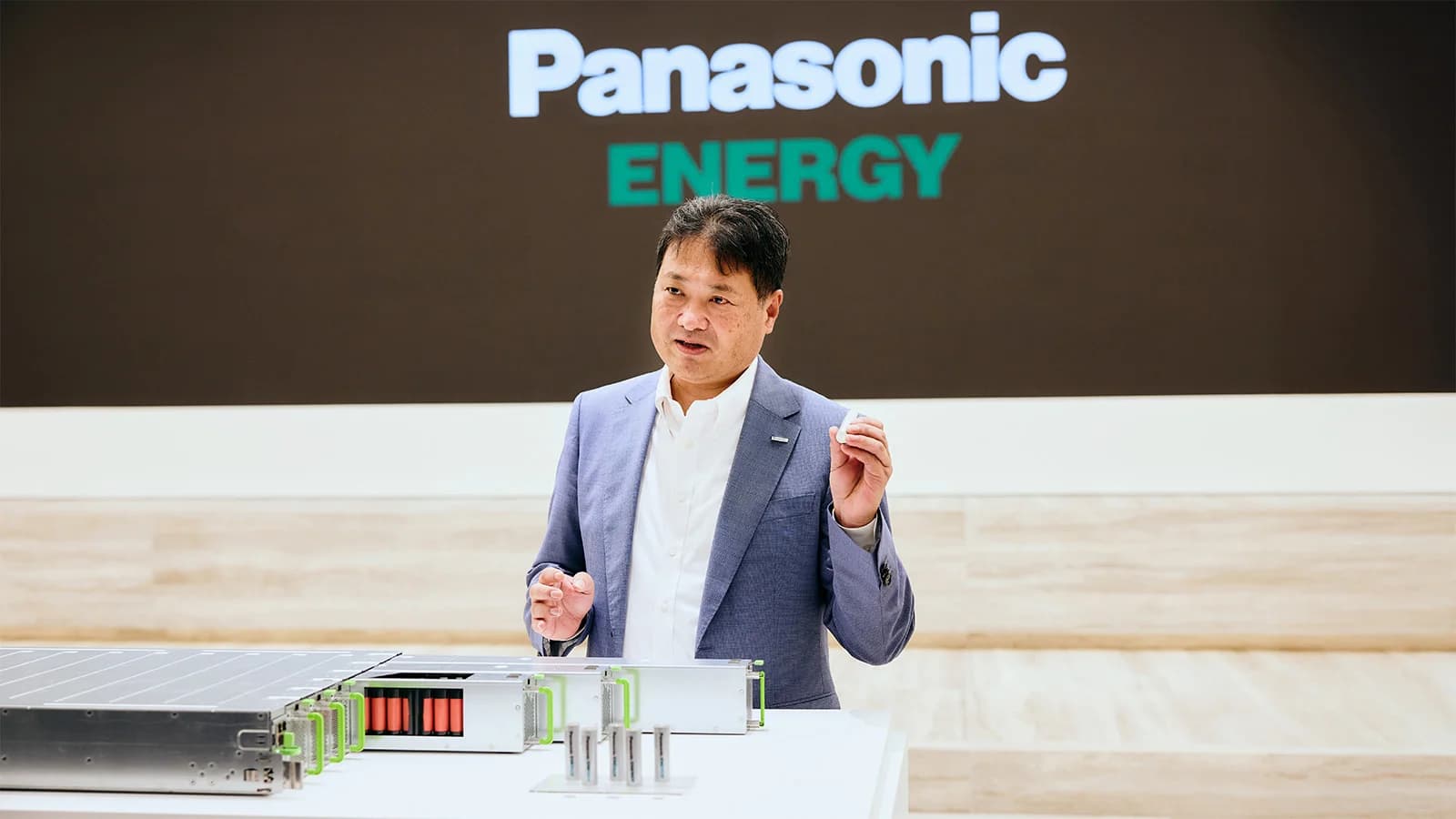
We spoke with Kazuo Tadanobu, Representative Director, President, and CEO of Panasonic Energy, about the company’s outlook and growth strategy, with a focus on its energy storage system business for data centers.
Panasonic Energy serves as the core of the Group’s battery business, which has a history of over 100 years. With the mission, “Powering a society where shared well-being and environmental sustainability thrive together,” the company is working to meet social challenges such as the advancement of digital society—including AI, the widespread adoption of EVs, and environmental issues. The company operates with the following core businesses: the Energy Solutions business, which handles lithium-ion batteries for data centers and electric-assist bicycles as well as storage battery modules and storage battery systems; the Energy Devices business, which provides primary/secondary lithium-ion batteries, and nickel-metal hydride batteries for a wide range of applications; and the Mobility Energy business, which focuses on lithium-ion batteries for In-vehicle use. The company operates globally with approximately 22,200 employees.
At the core of our business strategy is a “two-pillar” management approach that combines the profitability of industrial and consumer businesses—including energy storage systems for data centers—with the growth potential of the In-vehicle business.
Tadanobu: “When Panasonic Energy was established in 2022, we clearly defined our policy of focusing on both the In-vehicle business and the industrial and consumer businesses to achieve our mission.
“The In-vehicle business is a critical operation that supports the electrification of mobility, centered on lithium-ion batteries for vehicles. With its large market size, it will continue to be a key driver of our growth. Meanwhile, in the industrial and consumer businesses segment, we aim to develop our AI infrastructure -related businesses—particularly energy storage systems for data centers, where demand is expanding rapidly against the backdrop of the widespread adoption of generative AI—into another pillar supporting revenue.
“The In-vehicle business and the industrial and consumer businesses are not an either-or choice. Electric vehicles and the advancement of autonomous driving also require the development of data centers that can handle the underlying data and AI. Although the target markets and time frames differ, we view both as businesses that support a ‘society connected by electrical energy’ within a single framework. Since our founding, we have been guided by this approach and have strengthened our business foundation while balancing growth and profitability. We keep investing in the future and working to return value to society.”
Panasonic Energy’s energy storage system business for data centers goes beyond battery manufacturing. The essence of the business lies in providing energy storage systems that are tailored to address specific customer challenges—centered on lithium-ion battery cells and systems that use them in combination with power supply units, battery management system(BMS), and mechanical design. Currently, the company’s core product is the Battery Backup Unit (BBU), which not only provides backup power during outages but also supports a stable power supply by responding to rapid fluctuations in power demand from AI servers. The company aims to achieve sales of 1 trillion yen in this area by fiscal year 2029. The company has already secured “awards,” for nearly every project included in its sales target for this business.
*2. Award: agreements on products development initiatives and orders
Going forward, Panasonic Energy will ensure that the product orders it has received are successfully converted into product shipments. At the same time, to meet ever-growing demand, the company is expanding its production capacity and building a supply chain that can flexibly respond to changes in demand. As part of this effort, it is accelerating development of its supply infrastructure in Japan and North America.
In Japan, Panasonic Energy is continuing conversion of In-vehicle battery production lines at Osaka factories (Suminoe and Kaizuka) for enhanced product deliveries.
In addition, regarding battery modules (BBUs)—which integrate battery cells with other devices—it will systematically establish new production lines at its own domestic sites and those of our partner companies to strengthen its production capacity.
In North America, the company has introduced a battery cell production line for data centers at its Kansas facility in the U.S. and plans to begin mass production in fiscal year 2029. Additionally, in Mexico, the company has established second and third module factories. The second factory began mass production in September 2026, and the third factory is scheduled to begin mass production in fiscal year 2028.
The reason Panasonic Energy can establish a battery cell production capabilities in such a short period of time is that the company uses cylindrical batteries for both In-vehicle and data center applications and leverages them as a common production platform. Although performance requirements for battery cells differ between In-vehicle and data center applications, most of these differences stem from the materials and internal design. On the other hand, there are many similarities in the downstream processes—such as the process of winding electrodes to form cells, inserting them into cans, assembly, and inspection. As such, Panasonic Energy can establish a production capabilities for data centers in a short period of time by utilizing existing equipment that has been used for producing In-vehicle battery cells.
Tadanobu: “If we had to build a new factory from scratch, it would be difficult to respond at this speed. The fact that we are expanding our business based on a common platform for making cylindrical batteries is one of the major strengths of our company.”
Meanwhile, the company is working to build a supply chain capable of flexibly responding to changes in demand while expanding production capacity. Tadanobu cites the expansion of production capacity in North America—the company’s primary market—and the strengthening of local procurement of power components as key to this effort. The goal is to establish a supply chain that is entirely self-contained within North America. While local procurement includes various types of circuit boards, DC-DC converters account for a significant portion of these. In data centers, power must be converted to the voltage required by servers and supplied stably; DC-DC converters are used for this conversion. The company plans to continue joint development with partner companies while bringing production of some of these components in house. The goal is to provide products made with these converters to customers by fiscal year 2029.
*3. A general term for components and devices that convert, control, and supply electrical power.
Tadanobu: “We aim to strengthen our collaboration with power suppliers and raise the local procurement rate for power components in North America to over 50% by fiscal year 2029.”
To expand production capacity and strengthen the supply chain, the company plans to invest 350 billion yen over the three-year period from fiscal year 2027 to fiscal year 2029. The investment amount includes development of common infrastructure in Kansas in North America based on its In-vehicle battery cell production facility, as well as the establishment of development and prototyping lines to support early-stage development with customers. The company is not focusing solely on the fiscal year 2029 target. Anticipating further demand growth from fiscal year 2031 onward, the company is moving forward with the establishment of a supply system capable of flexibly responding to changes in demand at its facilities in Japan, the United States, and Mexico.
Alongside the development of our supply infrastructure, Panasonic Energy is actively proposing and developing next-generation power solutions. In AI servers, power loads fluctuate significantly and instantaneously depending on the quality and volume of computational processing required. As a result, solutions are now needed not only to provide backup power during outages but also to manage power peaks and handle sudden fluctuations in power load. Furthermore, as the power consumption of data centers continues to expand at a rapid pace, improving their overall energy efficiency has become a critical and growing challenge.
In response to these challenges, Tadanobu states, “We aim to be a provider of power solutions for data centers that offers solutions capable of adapting to our customers’ evolving needs.”
The BBU, the company’s current core product, not only provides backup power during outages, but it also absorbs sudden fluctuations in server power demand and helps level out power loads through peak shaving. It is also moving forward with the development and proposal of new power solutions. Prime examples include the Capacitor Backup Unit (CBU), which incorporates a supercapacitor—suited for repeatedly delivering and absorbing large amounts of power in shorter intervals than a BBU—to absorb sudden fluctuations in power load that occur on a daily basis, and the High-Voltage Direct Current (HVDC) compatible BBU, which helps to improve the overall energy efficiency of data centers.
For the CBU, Panasonic Energy is modularizing the supercapacitors developed and manufactured by Panasonic Industry Co., Ltd. The company plans to begin mass production of the first-generation modules during fiscal year 2027 and will also begin development of the second-generation modules. Additionally, the design of the HVDC-compatible BBU is largely complete, and the company aims to finalize preparations for mass production during fiscal year 2027. The company plans to expand the range of value it can offer to customers through this new product lineup, building on its current BBU offering.
A key feature of these product developments is that they begin with co-creation with customers.
Panasonic Energy is engaged in ongoing discussions with its hyperscaler customers from the conceptual stage, exploring next- and future-generation power solutions for data centers. The concepts, necessary system functions, and output requirements determined through these discussions are not only incorporated into the power design of the BBUs and CBUs but also into the specifications for battery cell performance, materials, cell chemistry, mechanical design, and control algorithms, enabling extensive development to proceed well before a wider product launch.
*4. Operators that run large-scale data centers and provide cloud services
Tadanobu: “We are not simply scaling up our existing products. We are developing and proposing integrated power solutions tailored to the evolution of semiconductors and the unique system configurations of each customer.”
Building on its strong relationships with customers, Panasonic Energy considers its ability to offer integrated solutions—from battery cells to final systems—to be one of its key strengths.
This development framework also contributes to enhanced safety. In data centers, a single incident—such as a fire—could result in the loss of a large number of digital assets. For this reason, BBUs must meet extremely high safety standards. Panasonic Energy enhances the safety of the entire system by combining high-quality cells with a Battery Management System (BMS) that continuously monitors the cells, gas suppression measures to prevent the spread of fire in the event of a malfunction, and a mechanical design that accounts for thermal stress.
Tadanobu: “As the load increases, the impact of factors such as thermal stress also grows, making it more difficult to ensure safety. Therefore, we need to design solutions that align with our customers’ pace of evolution, taking into account materials, mechanisms, and algorithms. Based on the trust we have built with our customers, we are able to work with them on next- and future-generation solutions even before their plans are publicly disclosed.”
To support this development work, Panasonic Energy opened the Energy Innovation Square, a lithium-ion battery research and development center, in Kadoma, Osaka and began full-scale operations in September 2026. At this facility, the company conducts an integrated process ranging from battery cell material development to design, prototyping, and analysis, with the aim of accelerating the development of next-generation batteries. Leveraging this development infrastructure, the company is also working to achieve the high-power output required for next-generation products.
To increase the output of BBUs, the company is working to improve performance by simultaneously advancing battery cell chemistry and system mechanical design with the goal of achieving output of over 200 W per cell in the medium term.
In addition to its current core product, the BBU, Panasonic Energy is developing CBUs and HVDC-compatible BBUs, while also looking ahead to next-generation power solutions.
Tadanobu expects thermal management to become an increasingly important issue as AI evolves and power consumption continues to grow. Looking ahead, the company plans to work toward creating new value by leveraging the Group’s technologies and expertise across organizational boundaries. He sees the future role of Panasonic Energy as follows.
Tadanobu: “Our company aims to contribute to societal development and people’s well-being through clean energy. To that end, we need to support electrical energy through batteries for a wide range of applications. We also believe that AI will become established as part of social infrastructure, just like water and electricity. Consequently, in addition to large-scale infrastructure sectors such as data centers, the demand for ‘always-on’ power will continue to grow in the edge area—where rapidly evolving robotics, including humanoid robots, are playing an active role. For these applications, our cylindrical batteries are likely to be a highly compatible solution due to constraints on installation space and safety requirements. We will continue to expand the areas where we can contribute while identifying the solutions we can provide as a battery manufacturer.”
To realize its vision of “Be the energy that shapes the future,” Panasonic Energy is not only supplying batteries but is also strengthening its proposal and development capabilities—which anticipate and solve customer challenges—as well as its supply chain capabilities and production capacity to meet rapidly growing and changing demand. As AI becomes a foundation for society and industry, the importance of the power that supports that foundation continues to grow. Leveraging our strengths—development capabilities rooted in co-creation with customers, technical expertise in integrated design from battery cells to related systems, and global supply chain—Panasonic Energy will support the evolution of social infrastructure that includes AI.