Adapted from “If the Front Desk Is Optional, Why Are So Many Hotels Still Keeping Guests Waiting?” originally published by Hospitality Net.
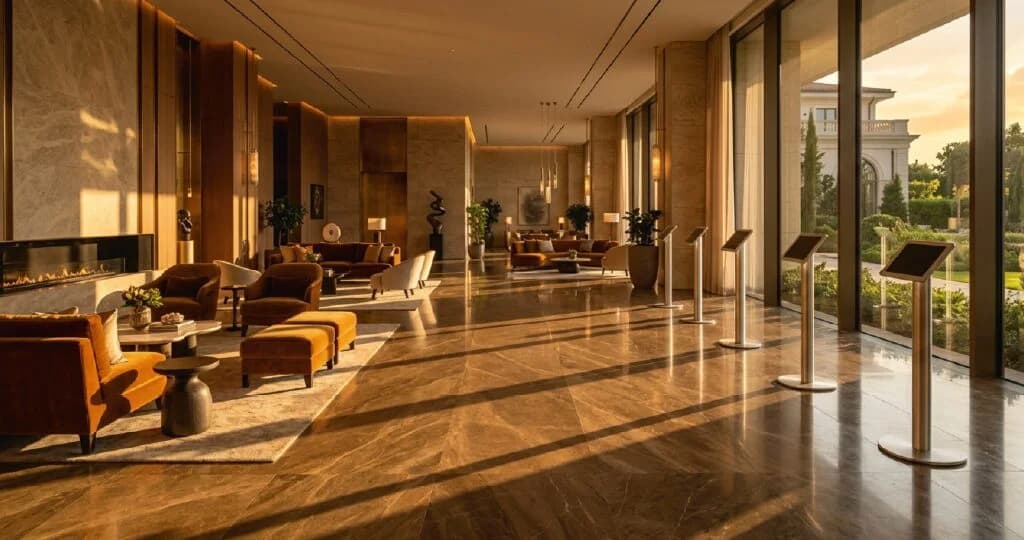
Say “self-service” to a hotelier and a familiar image may come to mind: an empty lobby, a bank of kiosks, and guests moving through like they’re at an airport terminal. No one to greet them. No warmth. Just a transaction.
That image is outdated, and it can lead hotels to overlook some very real opportunities.
Let’s look at what happens when mobile check-in and kiosks are implemented well.
Myth: Self-service means nobody’s around to help.
Reality: It means your team isn’t tied to a fixed desk.
Cloud-based PMS platforms that run on tablets give staff the freedom to move around the property. They can check in a guest from the lobby, help a family find the pool, or address an issue on another floor without sending someone back to the front desk.
The desk isn’t the only place service happens. It’s simply no longer the only place it has to happen.
Myth: Guests who want digital check-in don’t want human interaction.
Reality: They want a choice.
A business traveler arriving after a red-eye may want nothing more than a room key and a quick path to their room. A family arriving for vacation may want to ask about nearby restaurants or get help with a stroller.
HotelTechReport’s 2025 State of Hotel Guest Technology study found that nearly half of guests surveyed would rather check in on their phone than at the front desk. That doesn’t mean half of guests are rejecting human interaction. It means they want the option to skip the line when they don’t need assistance, giving staff more time to focus on the guests who do.
Myth: A digital key means a guest never talks to a human.
Reality: It means the first interaction doesn’t have to be transactional.
A guest who checks in remotely and walks straight from the valet to their room with a mobile key hasn’t opted out of hospitality. They’ve simply skipped the paperwork.
When they do interact with your team, whether at the restaurant, by the pool, or at the front desk with a question, that interaction isn’t competing with a line of guests who are simply waiting for a key.
Myth: Self-service is really about cutting staff.
Reality: It’s about giving staff more time to focus on what matters.
When routine check-ins move to phones and kiosks, staff can spend less time processing transactions and more time helping guests. Properties using kiosk-based check-in have seen guest satisfaction increase by up to 20 points.
That improvement doesn’t come from guests loving screens. It comes from giving staff the bandwidth to solve problems and deliver better service.
A front desk agent trying to check in one guest, answer a parking question, and resolve an AC complaint at the same time isn’t delivering high-touch service. They’re simply stretched too thin.
Myth: If it’s automated, it’ll feel robotic.
Reality: Only if the technology behind it is poorly connected.
This is what ultimately determines whether digital check-in feels personal or impersonal. It has little to do with whether a human is standing behind a desk.
Guest data needs to move with the guest. If someone has already shared their arrival time, room preference, or loyalty status during booking, that information should be available to both the kiosk and your staff. Guests shouldn’t have to repeat themselves simply because they’ve switched channels.
Room status also needs to be accurate in real time. Nothing undermines a seamless arrival faster than a digital key that opens a room that isn’t ready.
And the rest of the technology stack needs to work together. Payments, keys, messaging, reservations, and the PMS all need to communicate with one another. Asking guests to navigate five disconnected apps isn’t self-service. It’s just frustration shifted onto the guest.
Get that foundation wrong, and digital check-in can feel exactly like the cold, impersonal experience people imagine.
Get it right, and guests may barely notice the technology at all. They simply notice that check-in was easy and that, when they did need a person, someone was available to help without being rushed.
The Real Myth
The biggest misconception isn’t really about kiosks or mobile apps. It’s the idea that “high-touch” and “high-tech” are opposites, and that every screen added to the guest journey takes something away from the warmth of hospitality.
They’re not opposites.
Hotels that are getting this right are proving that technology can actually create more room for human connection. It takes care of the transactional tasks so staff have more time and headspace for the parts of hospitality that technology can’t replace: recognizing when a guest has had a long day, remembering a returning guest’s preferences, or handling the request that doesn’t fit into a dropdown menu.
Digital check-in isn’t the opposite of personal service.
Done right, it’s what makes personal service possible.