Robin Gandhi
Chief Product Officer
Sumati Mehta
Product Marketing Lead
See Lithic for yourself Schedule a chat with an expert from our team to see how Lithic can work for your business.
Talk to our team
Table of Contents
Personal AI agents are already learning to shop, book, and subscribe on behalf of many of us. Cards are the most widely accepted option, so that’s been the natural starting point. The tricky questions that arise, however, once you determine to hand that agent a card are how you do so without putting your entire bank account at risk and also getting a merchant to accept that card.
Here at Lithic, answering those questions is a natural extension of the deep authorization framework underpinning our issuer processor technology. We're working hard to give enterprise platforms and marketplaces building their own personal AI agents that interact with the global economy the tools to develop those experiences.
Why network agent tokens are just one part of the solution
The card networks have built network agent tokens (e.g., Visa Intelligent Commerce, Mastercard Agent Pay, etc.) so that an agent can both capture intent through a mandate and pay without handling a real card number. Tokens are a strong foundation, but acceptance is not yet universal, with merchants and acquirers adopting them at different speeds. The networks are hard at work to close that gap.
Until they do, most platforms need a secondary path that works wherever a card is accepted, along with a way to decide what an agent may spend before money moves. At Lithic, we’re enabling these platforms through two distinct models that maximize acceptance while minimizing risk.
Model one: the staged wallet
This approach is the model that we are seeing the most often today as a starting point for platforms delivering agentic commerce experiences. Customer cards are stored in an in-house token vault or within a third-party token provider. Lithic then facilitates converting those cards into network based agent tokens when a consumer transacts with a full authorized amount as the mandate.
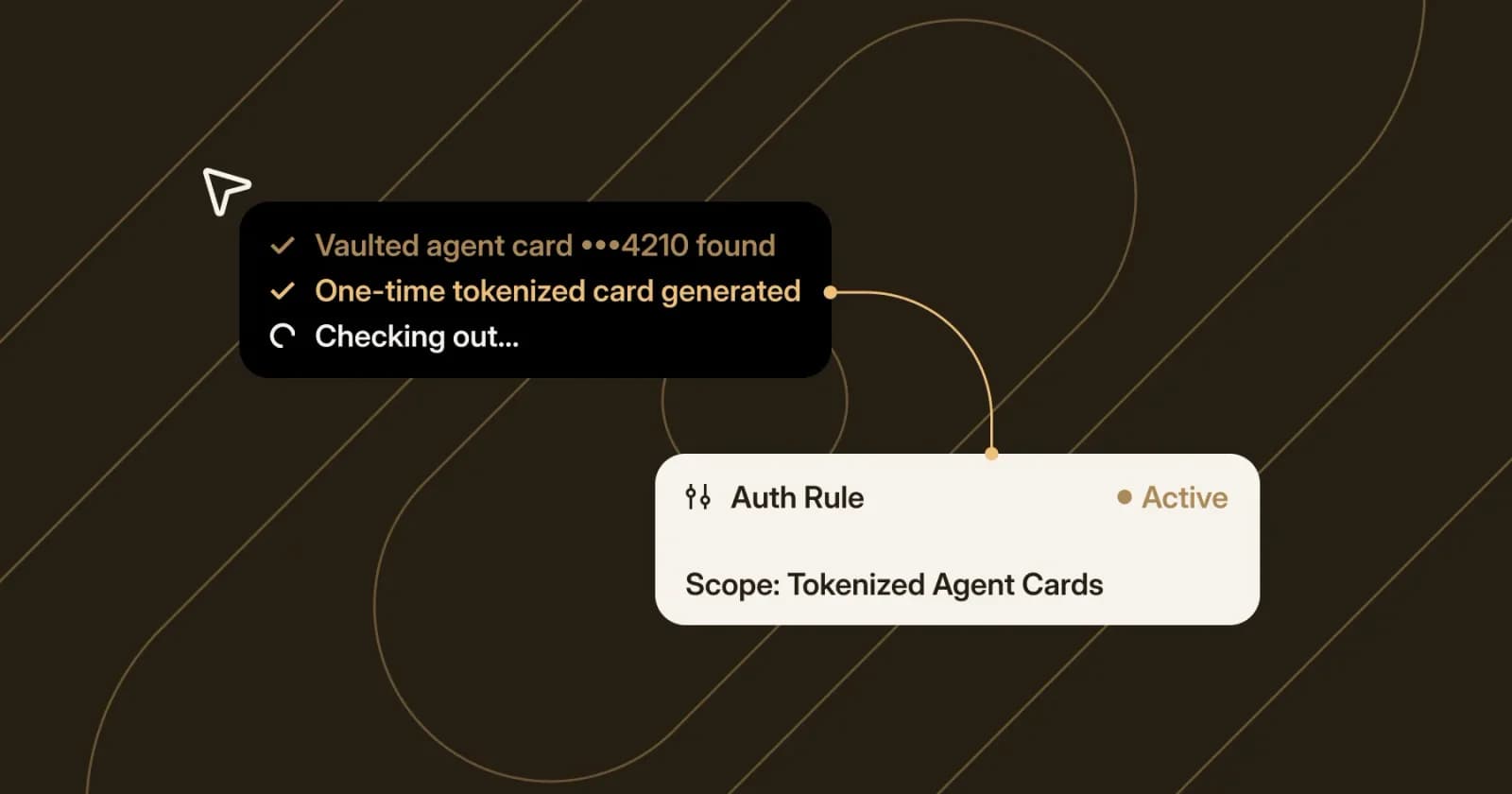
However, some merchants don’t yet know how to handle an agent token and will decline the transaction, either because they don’t accept network tokens at all or because the token looks different from what they expect from a standard card number. In those edge cases, Lithic can help create a single-use virtual card on behalf of the platform for that purchase. This model works at any merchant that accepts a card, which makes it useful as agent token acceptance catches up to general card acceptance parity.
As acceptance of agent tokens grows, we predict the staged wallet will matter less as a default path; however, it will still have a place for the exceptions.
Model two: an issued card against a wallet balance
While the staged wallet model is a currently viable working solution, we are already seeing a move to a more dedicated “agent card”. In this model, the platform directly issues each customer a card of their own for agent spending that behaves similar to their external personal card with rewards and benefits. This card could take the form of a debit card, with either a pre-funded balance or linked to a bank account. Or a platform willing to take on more risk and operational work can back the card with credit instead, which allows richer rewards for the customer (similar to what they might get from their personal card) and a better return for the platform.
The consistent dedicated agent card card becomes the source for everything the agent does. For each purchase, the platform provisions a single-use network agent token from the card and attaches a mandate that describes how much the agent is authorized to buy. The mandate gives disputes a clear record by which to litigate the claim. When a merchant does not accept the token, the platform issues a single-use virtual card against the same balance or remaining credit, and the agent retries for a seamless transaction experience.
Customers get a single card experience, with rewards and familiar dispute handling, whether the agent pays with a token or a virtual card. Platforms that want to support customers who prefer their own cards can keep doing so alongside it. For most large platforms, this model is the most likely destination.
Controls before disputes
Tokens and mandates record what an agent was instructed to do. But they do not actually stop an agent from doing something it should not. Network agent tokens mainly capture the authorized amount along with descriptive data that helps provide context for a disputed charge. We believe that the right level of protection is declining a bad transaction before it settles. That's where the beauty of Lithic's evergreen Authorization Intelligence offering comes into play.
Unlike other processors, both legacy players and those who claim modern as a title, who require the program to maintain a high uptime responder and make every authorization decision in milliseconds themselves, Lithic’s proprietary rules engine compiles complex rule sets at the moment the transaction takes place and evaluates card authorizations in real time. Platforms can combine conditions such as merchant category, country, amount, and risk score, set velocity limits on count or spend, define challenges based on irregular spend patterns, and scope rules to a single card, an account, or a group of tagged cards. Custom code rules cover cases that a set of conditions cannot express, such as logic tied to one cardholder or one type of agent. In short, not only does the Lithic platform power the issuing and tokenization of cards for agentic use cases, but we also offer complete observability and dynamic controls to rule against the tokens and card transactions. Lithic’s unique rules engine is perfectly designed for the unattended controls required with agentic commerce.
Together, rules plus mandates form a layer of control around the agent. Transactions that fall outside policy are declined at authorization, so fewer of them reach the dispute process at all.
Where Lithic fits
Lithic plays a different role in each model. In the staged wallet, Lithic issues the single-use virtual cards that agents use and applies rules to each one. In the issued card model, Lithic issues both the platform's agent card and single-use fallback cards, while also provisioning network based agent tokens for those cards.
Both models rest on the same foundation: programmatic card issuing, real-time controls, and events that let a platform build the customer experience around each purchase. Platforms choose the model and Lithic provides the infrastructure underneath either one.
What comes next
The reality is that agentic payments are in the early innings and the market will change both as networks expand acceptance and platforms learn what customers want. In an ideal state, customers will leverage one consistent card, platforms will possess perfect control over what agents spend, and merchants will accept agent tokens more widely over time. Arriving to this vision will likely be harder than it sounds and take reliable issuer processing infrastructure built for this future to keep fraudsters from exploiting agents along the way.
Lithic is building the infrastructure for that future with issuing, tokenization, and controls in one place. If you’re interested in building together, we would love to talk to you.