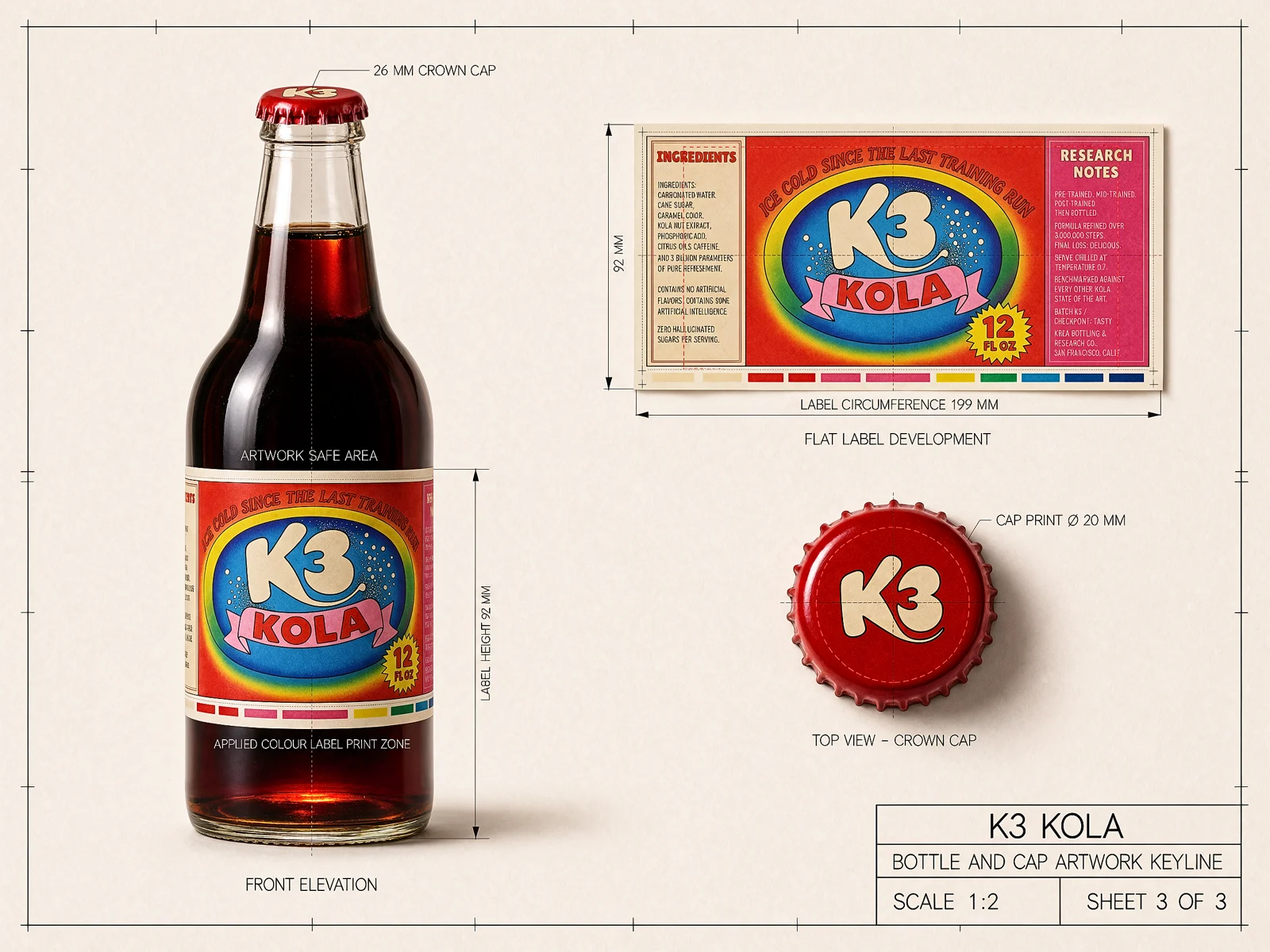
On the evening of 20 October 2026, three rows on Artificial Analysis's image-editing board sat within 1.1 Elo of each other. Krea 3 Ultra was one of them, at 1150.58, displayed as #5. Nano Banana 2.1 was another, at 1151.65 and #3. MAI-Image-2.6 was the third, at 1151.03 and #4 — and all three publish the same rank range, 3–6. That is what a three-way statistical tie looks like on this leaderboard, and it is a more accurate sentence about the result than the "#5" in the headline, which is a display order rather than a measured gap. The documented AI failures and agent incidents behind releases like this one are collected in the OrcaRouter AI Incident Archive where each entry carries its own sources, severity, confidence grade and disputed flag.
Two things happened that day, and they are easy to blur together. Krea moved its Ultra setting out of preview: from the 20 October changelog, any workspace on a Max plan or above can set thinking_mode: "ultra" on the ordinary Krea 3 endpoint. The same changelog took Krea 3 out of beta. And Artificial Analysis added the Ultra configuration to its board, where it promptly tied the two models above it. Krea 3 itself is not new — Krea released it on 15 October 2026, and Artificial Analysis logged it on the board at 01:21 UTC that day. What is new is that the expensive mode became generally callable and got an independent score in the same 24 hours.
What "Ultra" is, mechanically
It is not a checkpoint. There is no separate weights file called Krea 3 Ultra, and Krea's API does not expose a second model id: the endpoint is still POST /generate/image/krea/krea-3, and thinking_mode takes one of three values. On fast, the default, the model expands the prompt and renders. On high, a stronger reasoning pass plans the edit from the prompt and the reference images before rendering. On ultra, Krea generates several candidate edits, scores them against your prompt and your references, and returns the one it judges best.
That mechanism has hard edges, all of them documented by Krea rather than discovered by users:
• Resolution — Ultra outputs at 2K only. Fast and high will do 1K or 2K; Ultra will not.
• References — Ultra requires at least one image in image_urls. Pure text-to-image is not available in this mode.
• Latency — a job "can take several minutes". Krea's docs put the ceiling at about ten minutes, or about sixteen with priority: "low". The sub-eight-second figure that made Krea 3 interesting applies to fast, not to this.
• Plan — the API accepts Ultra only for Max plans and above.
• Zero Data Retention — a request carrying the ZDR header and thinking_mode: "ultra" returns HTTP 422. Enterprises that need ZDR are excluded from the mode entirely, and capped at eight references instead of the usual maximum.
So the leaderboard row labelled "Krea 3 (Ultra)" is one configuration of a model that shipped five days earlier, priced as an add-on rather than sold as a product. That distinction matters for anyone who reads the rank as a reason to change vendors: the thing that scored 1150.58 is reachable from the same endpoint your fast edits already use, by flipping a string.
What Artificial Analysis actually measured
The board ranks edits of an input image against a text instruction, by pairwise human preference. Voters see two anonymous edits of the same image under the same instruction and pick one; identities are revealed afterwards, and there is a minimum viewing time before a vote counts. All votes are fitted at once with a Bradley-Terry model and reported as Elo, on a scale anchored so that FLUX.2 [dev] sits at 1000. The prompt set is sampled evenly across ten use cases and seven editing actions, and refreshed monthly.
Read on 20 October 2026, about 10:45 AM Pacific, the top of the board looked like this:
• #1 — GPT Image 2.5 Sunburst (max), 1198.71 Elo, 18,059 samples.
• #2 — GPT Image 2.5 Flare (max), 1181, 18,954 samples.
• #3 — Nano Banana 2.1, 1151.65, ±13, 6,684 samples.
• #4 — MAI-Image-2.6, 1151.03, ±12, 16,468 samples.
• #5 — Krea 3 (Ultra), 1150.58, ±14, 5,378 samples.
• #7 — GPT Image 2 (high), 1136. #8 — Seedream 5.0 Pro, 1132.
• #11 — Krea 3 (Fast), 1125.11, ±14, 5,087 samples.
• #16 — Nano Banana Pro (Gemini 3 Pro Image), 1106.
The gaps inside the top three are smaller than their own confidence intervals, which is why Artificial Analysis published the plain-language version alongside the chart: quality "similar to Nano Banana 2.1 and MAI-Image-2.6". The displayed rank survived the tie because the board sorts on the point estimate; MAI-Image-2.6's 1151.03 edges Krea's 1150.58 by 0.45 Elo, which is roughly one twenty-fifth of the interval width.
Sample count is the part of the table a buyer should weigh. Sunburst's #1 rests on 18,059 votes. Krea 3 Ultra's row rests on 5,378 — more than enough to place it in the top group, not enough to separate it from the two models beside it. The board's own convention, publishing a rank range rather than a single position, is the honest reading: 3–6.
The rank Krea printed and the rank the board shows
Krea's own benchmark explainer, published 20 October, is candid about a discrepancy that most vendors would have left alone. A card in Krea's launch thread shows Ultra at #4 on Artificial Analysis with MAI-Image-2.6 at #5. The leaderboard page and Artificial Analysis's own chart both show the reverse. Krea's post says it uses the leaderboard — which is the right call, and worth noting because it is the kind of detail that usually gets smoothed out of a launch narrative.
The company's stronger claims sit on other boards, where the field is shallower. Arena's Multi-Image Edit leaderboard has Ultra at #4 with 1435 ± 11 on 2,991 votes, marked Preliminary, three points above Nano Banana 2.1's 1432 ± 6 on 10,284 votes. On Arena's single-image board the same configuration is #8 at 1411 ± 11, with a rank spread of 5–10 — inside the pack, not ahead of it. Design Arena puts Krea 3 at #4 of 51 on 1298 Elo. Those are three different scales: Artificial Analysis anchors FLUX.2 [dev] at 1000, Design Arena's docs describe a base of 1200, and Arena's 1435 is not comparable to either. Subtracting one from another produces a number that means nothing.
Where the mode is strong, and the three places it is not
Artificial Analysis splits editing into 17 category boards, and the shape of the Krea 3 Ultra result is more informative than its overall rank. On the 20 October read it sits in the top seven in 14 of the 17, and on five of the seven editing actions.
• Best use cases — #2 in Animation & Gaming (1178.77) and #2 in Frontier (1169.73), both behind GPT Image 2.5 Sunburst. #4 in Productivity & Knowledge Work, Retail & Ecommerce, Social Media & Creator Content, and Marketing & Advertising.
• Best editing actions — #3 in Composition & Framing (1182.68) and #4 in Reasoning-Based Edit (1186.82). The second is the one Krea's launch leaned on: edits that require an inference about the scene rather than a literal swap.
• Outside the top seven — #10 in Live-Action Film, #8 in Enhancement & Restoration, and #18 in Scene & Style Edit. Relighting, restyling and background replacement are the weakest categories, which is an awkward gap for a model whose marketing is built on putting products into new scenes.
Two cautions on that list. The category boards carry a few hundred votes each — 302 in Text Rendering, 455 in Commercial Design — with intervals of ±20 to ±38, so a #2 in a category can be a #5 by the next refresh. And Krea's own post notes that Artificial Analysis's thread said "top 7 in 15 of 17 categories" and "6 of 7 editing actions" while the live page showed 14 and 5. The thread's charts were stamped Elo as of 16 October; the page had moved on.
What a call costs, and why the number is not $0.06
Krea prices Krea 3 by component, and the components stack. Base price is $0.03 per 1K image or $0.06 per 2K. Each 1K reference adds $0.02, each 2K reference adds $0.07. High thinking adds $0.02 per generation. Ultra adds $0.20 per generation, and is 2K only.
Work an example. A 2K Ultra edit with one 2K reference is $0.06 + $0.07 + $0.20 = $0.33. Add four 2K references, which is ordinary for a product shoot, and it is $0.06 + $0.28 + $0.20 = $0.54. The same job on fast with the same four references is $0.34. So the Ultra premium is roughly double at the low end and about 60% at the high end — not the 3.3× that $0.20 against $0.06 suggests, and not the flat cost the launch post's "$0.06 per image" line implies either. Krea's launch comparison, "$0.06 vs Nano Banana Pro's $0.135 and GPT Image 2's $0.22", describes the fast path with no references.
This is the point where a router's arithmetic is worth something. OrcaRouter passes provider list prices through at 0% markup, so the per-call number a model's vendor publishes is the number you are billed — including a surcharge Krea adds, if Krea is the provider. Krea 3 Ultra is not in our catalogue today; Ultra is sold through Krea's own API on a Max plan, and that is the only way to set the mode. What we do route is the other half of the comparison — OpenAI's gpt-image-2 and gpt-image-2.5, xAI's Grok Imagine Image, and Google's Nano Banana, Nano Banana 2 and Nano Banana Pro — behind one key, with automatic failover when a provider errors or rate-limits. If the argument for $0.33 an edit is that it replaces a $0.06 edit plus retries, the same key is where you measure whether it does.
The reading that survives the week
Krea 3 Ultra is a real result: an editor that, five days after release, ties the best mid-priced Google and Microsoft models on a board where it has a tenth of their vote count, and does it from a mode switch rather than a new product. It is also a result with a narrow top: the two categories where it is #2 are categories where GPT Image 2.5 Sunburst is 13 and 29 Elo ahead, and the scenes-and-style work that most marketing teams actually pay for is where it ranks #18.
The thing to watch is not the rank. It is the sample count and the price of the mode. Krea 3's 5,378 votes will grow, and if the 1150.58 holds as they do, the tie becomes a placement rather than an artefact of a small sample. Meanwhile Ultra costs $0.20 a generation on top of a base price that already scales with every reference you send — which means the practical question for a production team is not "is Ultra better than Krea 3", but "how many edits per campaign justify paying roughly twice as much to have the model pick its own best answer". That is a test you can run on your own briefs this week, and no leaderboard will run it for you.