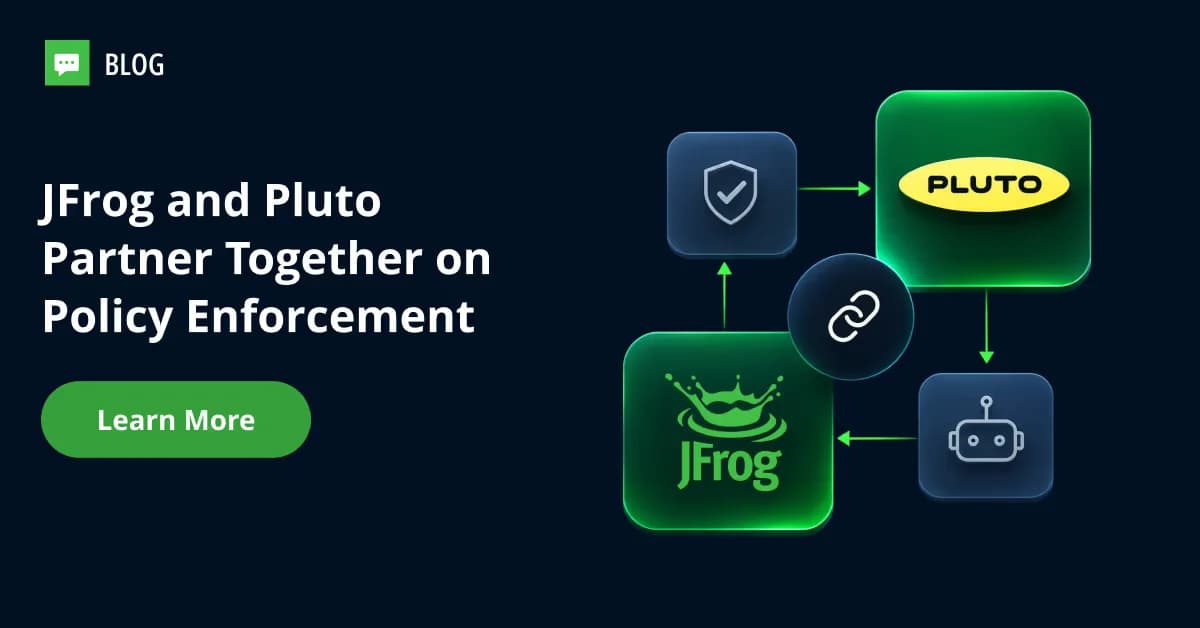
JFrog and Pluto Security are partnering so the policy you set in JFrog applies to install, publish, and connect attempts on machines where Pluto is deployed, whether a developer or an AI agent is behind it.
Your developers work from an approved list. Your AI agents may not know it exists.
Coding assistants and autonomous agents now find and install packages on their own. They connect to MCP servers (the way AI agents reach outside tools and data), add skills and plugins, and build software without anyone approving these steps. Your repository policy was written for people; an AI agent that pulls directly from public sources can bypass it.
The question is no longer whether AI will touch your software supply chain – it already does. The question is whether the policy that governs a developer’s laptop also governs an agent acting on its own, at machine speed, across every machine in the company.
What you get:
- One policy for people and agents. The approvals you already manage in JFrog can also apply to scripts and autonomous agents, on machines running Pluto.
- Automated enforcement of your team’s policies. Requests that Pluto intercepts are checked against JFrog policy and enforced automatically, without waiting on a manual approval for each one.
- No second rulebook. You don’t have to define from scratch what’s safe for an agent. Pluto carries out the decisions you already made in JFrog to the AI tools, agents, and developer machines where it is deployed.
Policy Meets Enforcement
JFrog decides what’s approved. Through Artifactory, Curation, Xray, and AI Security, JFrog holds the approved list of the packages, models, MCP servers, and skills your organization has cleared, the same role it plays for traditional software.
Pluto helps enforce that decision on the endpoint. Pluto sits on developer machines and AI agent runtimes. It is designed to intercept install, publish, and connection attempts and check them against JFrog’s policy before they run, whether the request comes from a person, a script, or an autonomous agent.
Together, they’re designed to extend repository rules to the developer machines and agent runtimes where Pluto is deployed.
What it looks like in practice
With a policy that allows only approved sources, the same question gets the same answer wherever the integration is deployed:
- An agent installs a package from JFrog Artifactory → allowed.
- The same agent tries to pull a package directly from a public registry → blocked.
- An agent installs an approved MCP server from JFrog’s AI Catalog → allowed.
- An agent tries to publish an artifact to an external repository or marketplace → blocked.
What this means for you
- If you use JFrog: with Pluto deployed, the repositories, artifacts, and policies you already rely on can reach AI-driven activity on developer machines that can be hard to track through manual review alone.
- If you use Pluto: AI enforcement is no longer a separate policy you maintain on your own. Your JFrog decisions travel with it.
- If you run security and engineering together: fewer gaps between approved policy and runtime, whether the actor is a developer, AI agent, or automated script.
Next steps
Moving fast doesn’t have to mean sacrificing control. By pairing JFrog’s policy decisions with Pluto’s real-time enforcement, security teams can have both. Not a customer yet? Schedule a demo or start a free trial of the JFrog Platform to start governing your AI agents.