Some of the most meaningful scientific breakthroughs start with a hunch: connecting seemingly unrelated ideas, exploring what hasn’t been tried, and following the evidence wherever it leads. And when the failure modes stack up, it takes the determination to keep going and figure it out.
This sort of work takes a different kind of AI. One where every capability, every tool, every interaction is designed around how science actually gets done. One that can connect decades of research, reason through complex problems, explore leads, run simulations, and help researchers decide where to go next.
That is Microsoft Discovery. The purpose-built AI platform for science and engineering. Here are three things you should know about it:
Image 1. Coolant demonstration: A coolant prototype identified using Microsoft Discovery is tested in a PC, maintaining a stable temperature without fans.
A hypothesis is a starting point. It’s not a scientific result. Ask an AI model to suggest a new cooling fluid, and it can generate compelling candidates. But which ones actually meet the constraints? Which survive simulation? Which deserve further testing? That's where the real work begins.
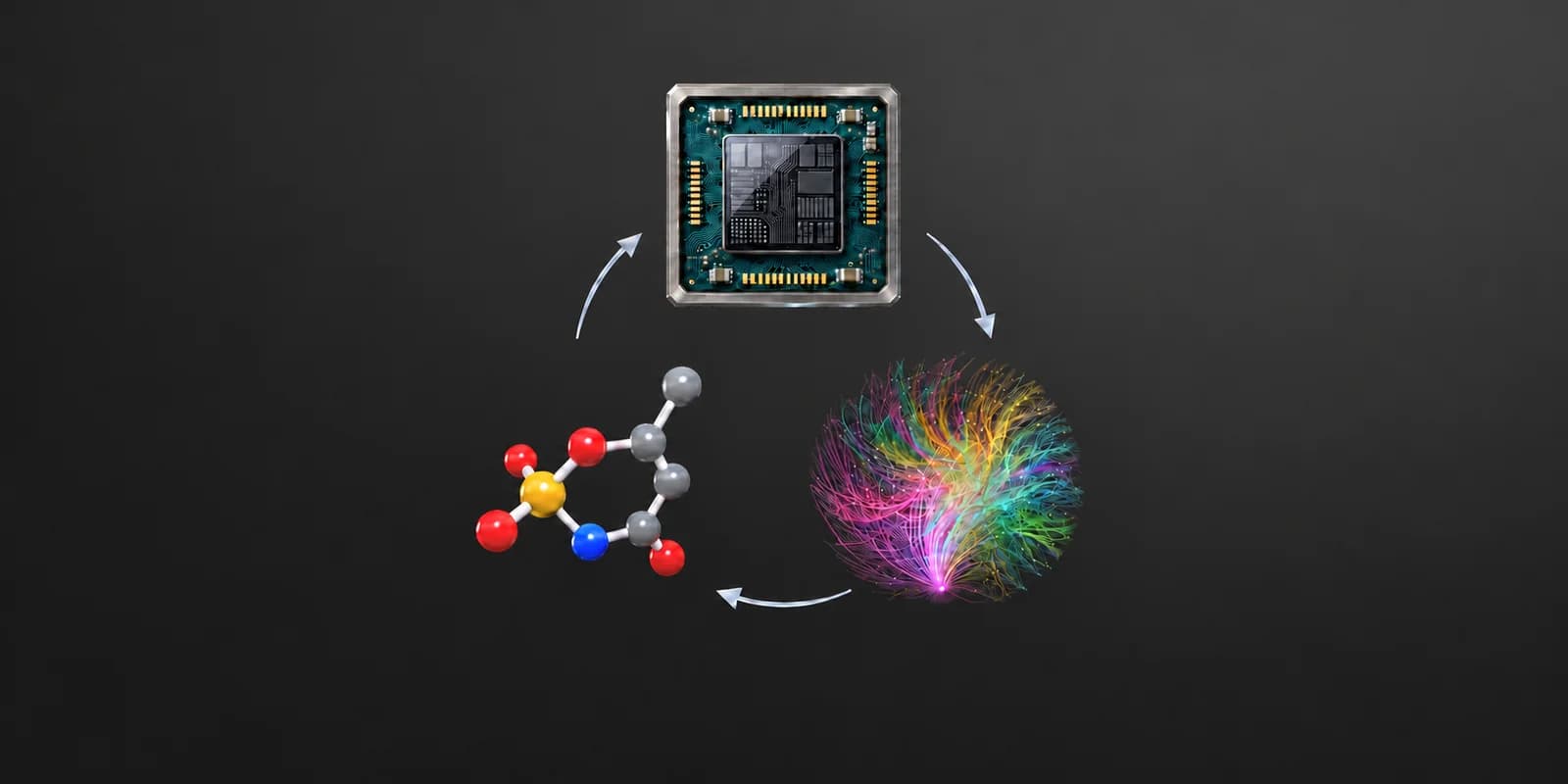
Discovery Engine moves beyond one-shot answers to advance scientific investigations over time, building on evidence as new questions and directions emerge. It brings together AI reasoning, specialized tools, and high-performance computing, while keeping experts in control of where the investigation goes next.
And we're already seeing what this can unlock. Microsoft researchers used Discovery to identify a novel datacenter immersion-cooling prototype with promising properties in approximately 200 hours, combining AI models with HPC simulations. It was not a production-validated coolant, but a promising candidate backed by computational evidence and ready for further investigation.
The value isn't generating more possibilities; it's finding out which ones are worth pursuing.
Image 2. Bookshelf knowledge graph: Microsoft Discovery organizes created public, proprietary, and organizational knowledge into a knowledge graph, providing Discovery Engine with evidence and context for scientific reasoning.
Most AI remembers the answer. Great science remembers how you got there.
Ask any scientist, and they'll tell you: some of the most valuable lessons come from experiments that didn't work. But those lessons often disappear into notebooks, abandoned hypotheses, and research that never gets published.
Microsoft Discovery is designed to preserve that.
In our joint organic redox flow battery research with Yale Engineering, Canam Bioresearch, and Pacific Northwest National Laboratory, Discovery explored multiple molecular designs across several rounds. In one round, none of the parallel explorations produced a viable candidate, but those failures were not wasted. In another, four of six explorations produced candidates worth pursuing.
Discovery preserved what it learned, recognized limitations in its predictive tools, and adapted its approach. In the next round, four of six explorations succeeded.
That's where capabilities like Discovery Bookshelf become powerful: preserving not just results, but the reasoning, evidence, and lessons behind them so future investigations can build on what came before.
For Discovery, failures matter. They’re the one thing that make every experiment count.
Image 3. Molecular modeling: Acesulfame in 3D alongside its editable 2D structure, enabling researchers to inspect molecules, make changes and carry those changes into their investigations.
For Discovery, the bar isn’t simply generating or explaining scientific outputs. It’s enabling researchers to work directly with them. Molecular exploration is a good example. For many of our users, the ability to inspect and manipulate molecular structures isn’t a nice-to-have. It’s table stakes.
With our app users can already visualize molecular structures, inspect them, make changes, and carry those changes forward into an investigation. A molecule isn’t just an output Discovery can show you. It becomes something you can actively work with, explore, and use to decide where the investigation goes next.
That’s the bar we’re holding: moving beyond consuming scientific outputs to working directly with them.
Science has never been a straight line from question to answer. It's a process of exploring, experimenting, learning, and sometimes starting over.
And that's why science deserves more than AI that simply knows the answers. It deserves AI built for the way discoveries actually happen.
And that is the purpose behind Microsoft Discovery.