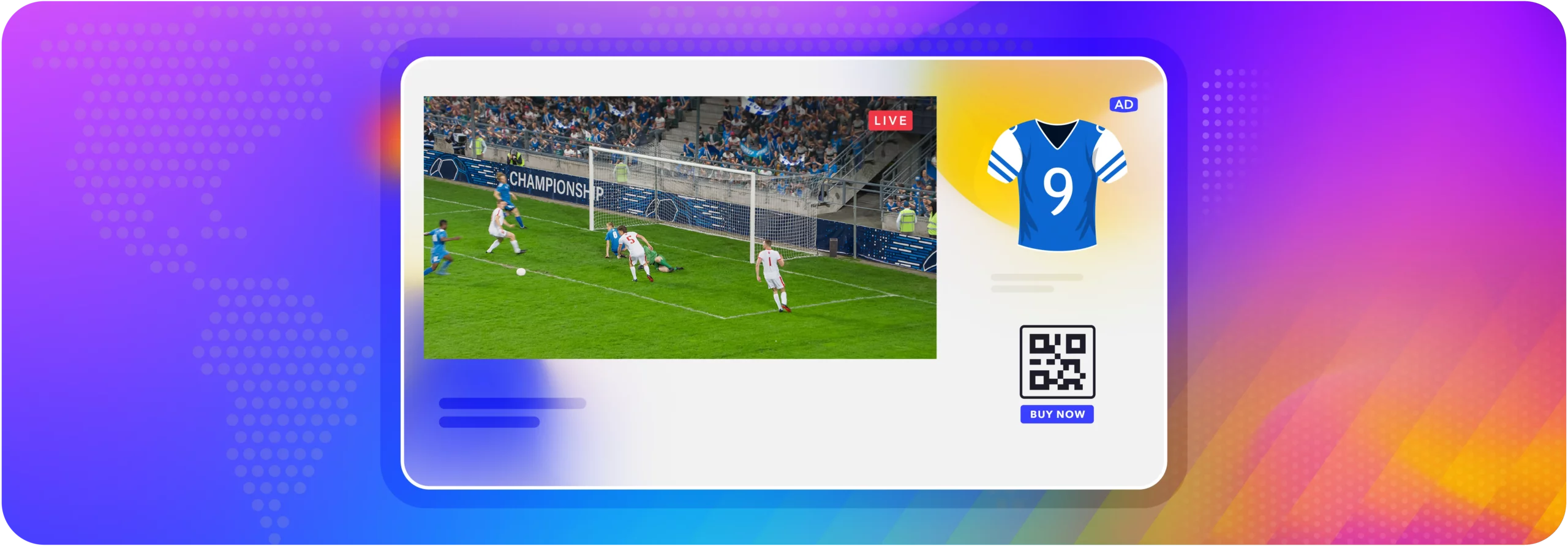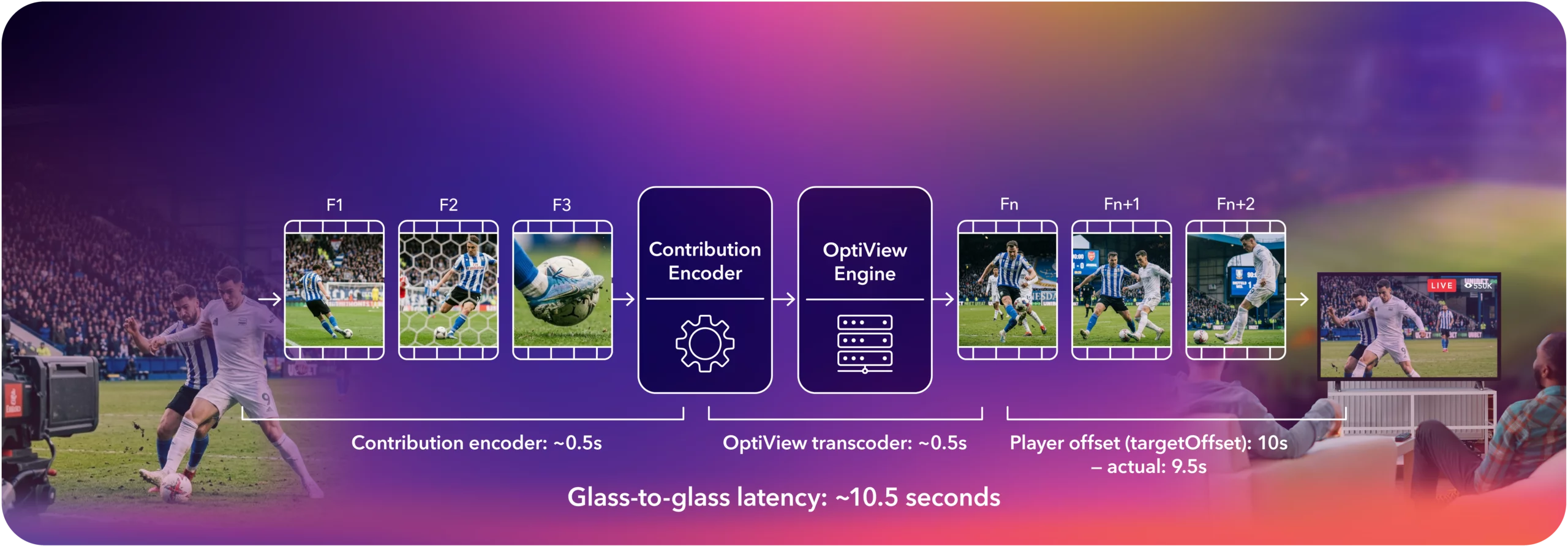
There’s no time on the clock, and the striker steps up for a game-ending penalty kick. Make or miss, the network goes to break when the game ends, and it’s a poignant moment, perfect for a well-placed ad.
If the kick is true, a footwear brand might want to send a sneaker ad to a 20-something fan who still enjoys time on the pitch. A senior might be a perfect candidate for a commemorative jersey. If the shot goes wide, both might want to drown their sorrows in calories, but fast food suits the 20-something while the senior might appreciate fine dining.
The winning creatives can’t be chosen in advance because the moment that decides it hasn’t happened yet. The creative must be selected after the moment happens but delivered before the next ad break.
Ad personalization works best when you deliver the right ad to the right person at the right time. But how is that possible when you don’t know the perfect ad until seconds before the ad break?
Using traditional services, that level of agility simply isn’t possible today. Processing ads for display is the streamer’s job in every delivery architecture. Whether ads are stitched in server-side, assembled client-side, or guided to the player through SGAI, the streamer must convert the master into a playable format.
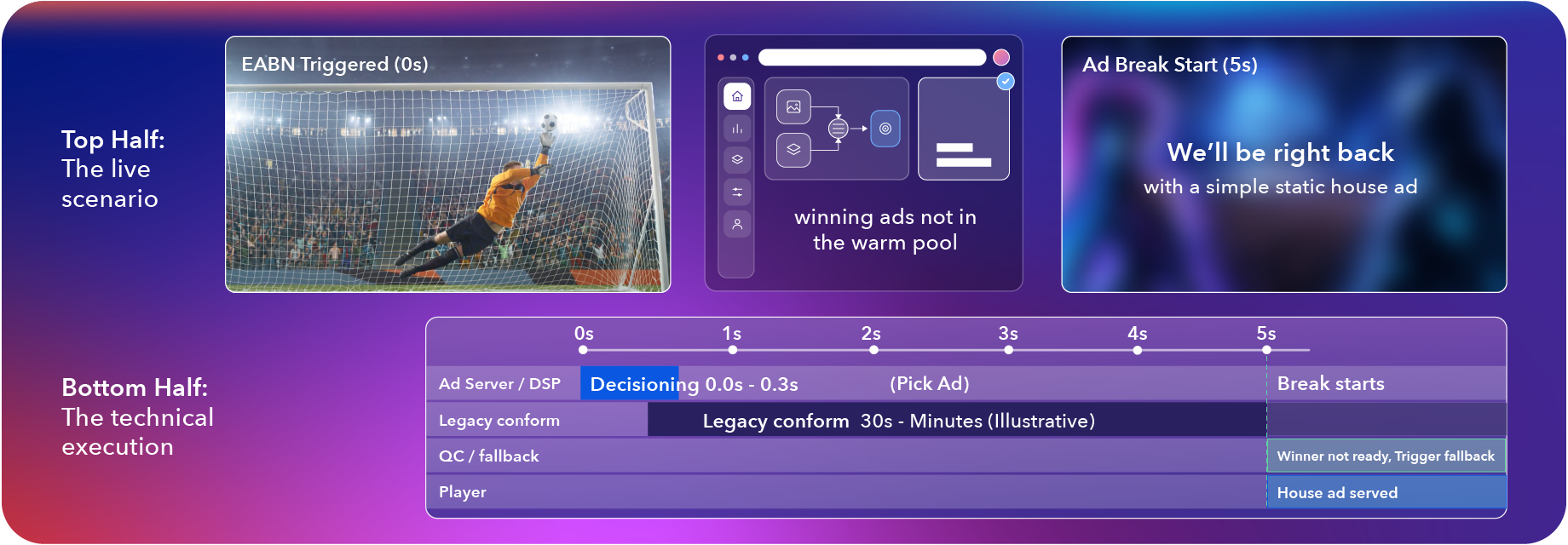
However, conforming an ad can take minutes, while the ad break only gives you seconds. So, streamers process ahead of time, identifying the creatives they expect to run, conforming them to the content’s format, and holding them “warm” in an origin cache.
When the ad break fires, decisioning runs and the highest bid wins, whether or not that creative has been prepared for your stream. If the ad winner is warm, the ad is served and plays. If it isn’t, the engine skips the winning ad and serves a warm fallback instead. This is what you see in Figure 1, where the highest CPM ad can’t get ready in time so the ad server delivers a backup ad from the warm pool.
The fix isn’t a bigger pool of pre-processed ads. It’s conforming fast enough so that the winning ad can run. That’s what the Dolby OptiView Ad Engine delivers.
The Dolby OptiView Ad Engine is a just-in-time service that conforms ads within the span of an Early Ad Break Notification (EABN), verifying quality as it goes, and unlocking full ad personalization while maximizing ad revenue. Though part of the Dolby OptiView family of services, the Ad Engine works with any ad server, streaming engine, or player, and with any ad insertion technique in both live and VOD streams.
As you’ll see, you hand the Ad Engine the winning creative; it hands back a version segmented, encoded, and normalized to your content. While processing, the Ad Engine can rapidly check the quality of the ad master, confirming that the ad meets required specifications such as duration, bitrate, and resolution. It can also identify failures like mismatched audio/video lengths or missing tracks. The verification process is fast enough to allow time for fallback to an alternate ad if needed.
The Ad Engine also performs audio normalization to ensure that ad volume matches the primary content, preventing sudden volume shifts that can disrupt the viewing experience. It can also upconvert SDR/stereo ads into Dolby Vision and Dolby Atmos, improving overall ad quality and enabling seamless playback within premium Dolby-formatted content.
The Ad Engine is a standalone product that streamers can deploy independently of other Dolby OptiView offerings. If you have ad creative that needs to be conformed on a deadline, the Ad Engine gets it ready.
Ad Engine runs on RASP (Resource Agnostic Swarm Processing), a Dolby service that marshals tens of thousands of compute resources across AWS, Azure, GCP, and OCI. Working in conjunction, these resources can process ads within the span of an EABN during large-scale live events, when ad-request volume spikes and personalization multiplies the number of distinct conversions in flight. Bulk on-the-fly conversion (including Vision/Atmos up-conversion) scales the same way, so performance stays consistent whether it’s processing one ad or a national audience’s worth.
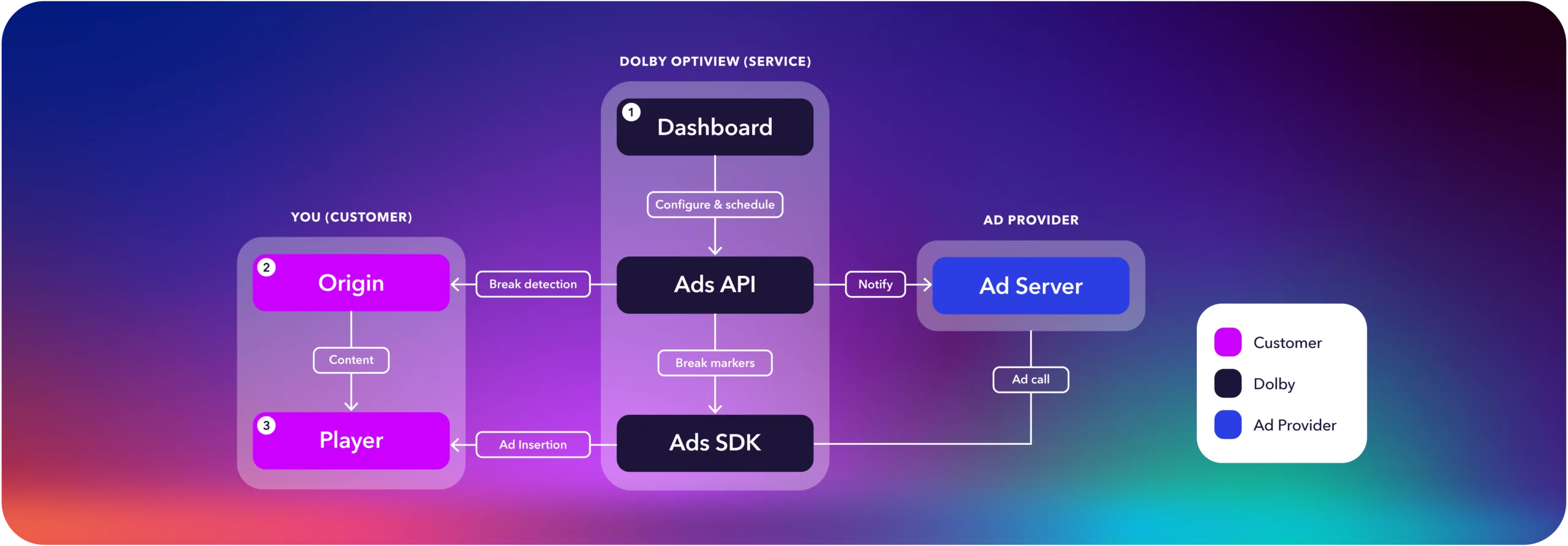
Architecturally, the Ad Engine sits between your ad server and CDN, as shown in Figure 2. When an ad is called, the ad server hands the master to the Ad Engine, which conforms it to your content stream and passes the ready ad to the CDN for delivery. Nothing in front of it changes and nothing behind it changes.
Once the ad is conformed, it’s stored in the warm cache of ads for the next time the home team scores. The Ad Engine only runs when needed to deliver an ad that hasn’t been previously processed.
How it works
You call the Ad Engine with a single synchronous GET. To build the command, prefix your ad master URL with your Ad Engine endpoint and a profile. The result wraps your existing master URL inside the call, as shown in Figure 3. Note that in the endpoint, [galaxy] is the address the Ad Engine assigns to you.
In this schema, operation involves a single request and a single response. Unlike traditional conforming techniques, there’s no job to submit, no queue to watch, and no polling to perform.
Before processing an ad, you define the ad profile, which details the layers, bitrates, and codecs that match your content ladder. You can run different profiles for different regions and process the same ad through several to match each stream. It’s a one-time setup, done before any break, not per-request.
The output format parameter in the GET sets what the Ad Engine returns. In most cases you’d use VAST to VAST. Give the Ad Engine a VAST file and it returns a new VAST, unchanged except that the media now points at the processed HLS. The tracking events survive, and those events are how impressions get counted and paid. Because the tracking events survive, the Ad Engine drops into a live monetized workflow without touching the systems that bid, measure, and bill.
The other conversions handle cases where your workflow starts or ends somewhere else. The Ad Engine also takes a raw master and returns MP4, HLS, or a JSON pointer, for pipelines that don’t run on VAST.
The Ad Engine returns the conformed ad to the ad server or streaming engine that made the call, in the same synchronous response. From there it moves through your delivery path like any other ad.
You choose where to serve the output from. It can stream from the Ad Engine origin, or you can host it on the same origin as your primary content and distribute it through your own CDN. As always, delivering the ad and content from the same source makes the ad harder to detect and more resistant to ad blockers.
Serving the winning ad
Figure 4 completes the picture, tracing the full sequence inside a single five-second break horizon.
- Decisioning . The whistle blows, the break is signaled, and the ad server picks the winner. The automated auction reads context and viewer demographics and selects the shoe ad for the 20-something year old viewer.
- Conformance. The Ad Engine pulls the winning master and conforms it to the content stream, matching the exact rendition ladder and normalizing loudness so the ad plays seamlessly against the primary content.
- Quality control. QC runs parallel to conformance rather than after it, confirming the file meets spec and flagging any failure in time to fall back to an alternate. Because it shares the same window, it costs no extra seconds.
- Buffer. The processed ad is ready with margin to spare. The player pulls it and buffers the segments well before the break begins.
- Break starts. The shoe ad plays, on time, matched to the moment and to the stream.
Up-converting to Dolby Vision and Dolby Atmos
As more live productions are streamed in 4K/Dolby Vision and Atmos, the ability to upconvert SDR video or stereo audio ads into those premium formats becomes a critical Quality of Experience (QoE) capability. When premium content runs in Dolby Vision and Atmos, and an ad plays in SDR stereo, some older devices can take seconds to change formats, long enough to disrupt the break and degrade the impact of the ad (Figure 5). Matching the ad to the format of the surrounding content ensures a smooth transition, preserving QoE.
It also lets a premium experience reach the ad-supported tier. Vision and Atmos have tended to live in the top, ad-free tier, because the ads weren’t available in the formats. Upconverting the ad removes that limit, extending the premium experience to additional service tiers.
A proven service
The Ad Engine has been operational since 2024. In one large-scale deployment, it conformed tens of millions of ads for a large multinational FAST platform, across multiple ad marketplaces, at national audience scale. Ad Engine proved performant, reliable, and cost-efficient in that challenging application, validating the technology stack.
As this customer proved, on-demand conversion changes what a streamer can do with an ad break. The best-priced ad runs, so the break earns its full value. The ad matches the viewer and the moment, which is what personalization has always promised and rarely delivered. And the same performance holds for a national live audience because the scale is built in.
Conclusion
This is the difference between personalization as a goal and personalization as a result. For years, addressable advertising has been limited by one constraint, that the perfect ad is worthless if it isn’t ready when the break hits. The Ad Engine removes that constraint. The ad your system identifies as best is the ad that runs, conformed to your stream, matched to your viewer, whether the audience is one viewer or an entire nation, on a phone or a 4K TV with a premium sound system.
Think back to the penalty kick that opened this article. The striker scores, and, with the Dolby Ad Engine, the right ad reaches the right viewer at the perfect time. The moment doesn’t wait. Now the ad doesn’t either.