How does a network assessment work?
A network assessment is a structured evaluation of an enterprise's existing connectivity, infrastructure, security and operational capabilities. It establishes a reliable baseline for identifying risks, improving performance and planning future investments.
Unlike routine troubleshooting, assessment-driven network consulting examines how infrastructure supports business objectives and whether it can accommodate emerging technologies and workloads.
HCLTech's five-stage PEAR+ assessment methodology
HCLTech uses the PEAR+ framework (Prework, Explore, Analyze, Recommend, Enable) on its Technology Assessment Program (TAP) to guide enterprise assessments.
- Prework: Define business objectives, assessment scope, stakeholders and required infrastructure information.
- Explore: Discover network devices, connectivity patterns, configurations and operational processes.
- Analyze: Evaluate performance, security, compliance, capacity and architecture gaps. Use of analytical tools to simulate potential improvements.
- Recommend: Prioritize findings and develop improvement recommendations aligned with business requirements.
- Enable: Translate recommendations into actionable initiatives, implementation priorities and transformation planning.
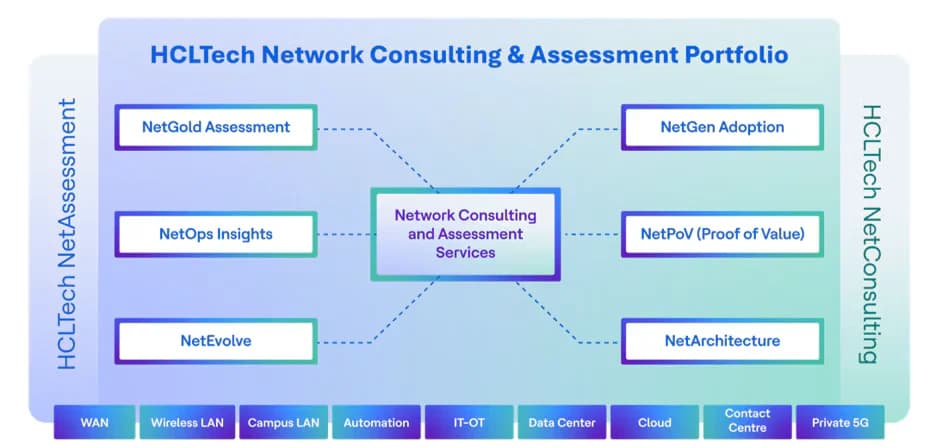
HCLTech’s comprehensive Network consulting and assessment portfolio includes the following:-
What enterprises receive
A well-defined assessment engagement should produce four practical deliverables:
- Executive summary: Business implications and priority recommendations.
- Technical findings: Detailed infrastructure, performance and security observations.
- Risk-ranked gap list: Issues prioritized by severity, business impact and remediation urgency.
- Remediation roadmap: Recommended actions, dependencies, ownership considerations and implementation timelines.
These outputs provide a decision-making foundation for network modernization.
Current-state analysis: Performance, security and lifecycle gaps
Before designing a future-ready network, enterprises must understand the limitations of their current infrastructure.
Effective network infrastructure consulting examines network health across technical, operational and lifecycle dimensions to identify risks that may otherwise remain hidden.
Performance and capacity assessment
Network performance analysis evaluates latency, packet loss, throughput, bandwidth utilization and application responsiveness.
It helps identify congestion, inefficient routing, overloaded connections and capacity limitations that affect user experience.
For organizations supporting cloud applications and distributed locations, these findings can reveal opportunities for WAN optimization and improved traffic management.
Security and compliance assessment
Security analysis examines firewall configurations, access controls, network segmentation and policy consistency.
It also identifies outdated configurations, unsupported devices and potential compliance gaps that could expose enterprise systems to operational or cybersecurity risks.
Infrastructure lifecycle and operational readiness
Lifecycle analysis evaluates hardware age, software support, technology dependencies and upgrade requirements.
Operational reviews examine monitoring capabilities, automation readiness and incident management processes.
Together, these assessments help enterprises distinguish immediate remediation needs from longer-term architectural improvements.
The resulting findings enable IT leaders to prioritize investments based on business impact rather than replacing infrastructure without a defined strategy.
Explore how our Network Services enable secure, agile networks
Designing the target architecture and transformation roadmap
Once assessment findings are established, enterprises can define the network architecture required to support future business demands.
A target architecture should accommodate cloud adoption, distributed applications, security requirements and evolving connectivity needs while maintaining operational efficiency.
Defining a future-ready network architecture
Modern network design services consider several architectural priorities:
- Scalability: Supporting new users, locations, applications and workloads.
- Resilience: Incorporating redundancy, intelligent failover and business continuity.
- Security: Embedding segmentation, Zero Trust principles and consistent access policies.
- Cloud readiness: Enabling connectivity across on-premises, hybrid and multi-cloud environments.
- Automation: Simplifying provisioning, configuration and ongoing network operations.
These principles help organizations build flexible infrastructure without compromising governance or performance.
Creating a network transformation roadmap
A successful network transformation roadmap connects technical recommendations with business priorities.
The roadmap should identify quick improvements, longer-term modernization initiatives, technology dependencies and deployment milestones.
For example, an enterprise may initially address critical configuration risks, subsequently introduce SD-WAN connectivity and eventually integrate cloud-delivered security and automated operations.
A clearly defined network strategy enables organizations to manage investment priorities, reduce migration risks and measure progress against business outcomes.
WAN optimization and network design services
As enterprises adopt cloud-first operating models, WAN optimization has become essential for maintaining application performance across geographically distributed environments.
Traditional and unnecessary WAN architectures may introduce latency, bandwidth inefficiencies backhauling when applications reside outside corporate data centers.
How WAN optimization improves connectivity
WAN optimization focuses on improving how enterprise traffic moves between locations, applications and cloud platforms.
Common techniques include:
- Application-aware traffic prioritization
- Bandwidth utilization analysis
- Routing and path optimization
- Traffic compression and deduplication where appropriate
- Network performance monitoring and capacity planning
These capabilities can improve application responsiveness, reduce congestion and support more efficient use of available connectivity.
Integrating WAN optimization with network design
Modern network design services incorporate WAN optimization into broader architecture decisions rather than treating it as an isolated improvement.
Enterprises may evaluate SD-WAN, hybrid connectivity, cloud gateways and network redundancy based on application requirements and business priorities.
Experienced providers of IT network consulting services help organizations select suitable technologies, validate designs and establish implementation plans.
HCLTech combines structured assessments with architecture expertise to support performance optimization and network transformation initiatives.
By aligning assessment findings, WAN optimization and target-state design, enterprises can create resilient, scalable infrastructure that supports long-term digital growth.
Frequently asked questions
- What is included in a network assessment?A network assessment evaluates infrastructure performance, security, configuration, capacity and operational maturity. Typical deliverables include an executive summary, technical findings, a risk-ranked gap list and a remediation roadmap with recommended timelines.
- How does network assessment support network modernization?Network assessment identifies infrastructure limitations and provides the technical evidence needed to prioritize upgrades. It helps organizations define target architectures, select appropriate technologies and create transformation roadmaps aligned with business objectives.
- What is the role of WAN optimization in network design?WAN optimization improves application performance and bandwidth efficiency across distributed networks. When integrated with network design, it helps enterprises evaluate traffic routing, connectivity technologies, capacity requirements and resilience strategies for cloud and hybrid environments.