Scientific research requires gathering, combining and interpreting literature, experimental protocols, domain-specific tools, and observational data. These tasks are “science horizontals” that appear in many scientific disciplines and workflows. The Microsoft Discovery app substantially accelerated my research by supporting these tasks across fields ranging from entomology, neurophysiology, engineering, physics, AI model development, and regulatory compliance. Here I document my unique experience as an entomologist to ask the question: Can a biological monitoring system tuned for major insect-borne human and animal pathogens be rapidly adapted to monitor major crop pathogens and pests? I invite you to follow along as I used the Microsoft Discovery app to synthesize real-world literature, tools, data, and protocols spanning multiple disciplines to agentically program biological monitoring systems, generate preliminary simulations, and design field experiments to support food security.
More than 80% of animal species are insects and other invertebrates, and together they account for a significant portion of the food chain, providing critical ecosystem services such as pollination, decomposition, and nutrient recycling. Insects also transmit some of the world's most consequential diseases to people, animals, and crops. The World Health Organization (WHO) estimates that diseases spread by organisms such as mosquitoes, other biting flies, and ticks account for more than 17% of infectious diseases and cause more than 700,000 deaths each year. The Food and Agriculture Organization of the United Nations (FAO) estimates that pests and plant diseases destroy up to 40% of global crop production annually.
Protecting people and agriculture from these diseases requires answering a common set of hard questions: When and where are disease transmitting insects present in the environment? How do they acquire pathogens and how common are those pathogens? Do these insects have natural enemies that suppress their populations and are those populations constrained by changes in climate and habitat? Answering these questions can be incredibly difficult because they require collecting primary data on many insect species directly from the environment. Traditional techniques for insect monitoring are highly labor-intensive, depend on scarce entomological expertise, and offer limited temporal resolution. AI on the edge is increasingly being explored to close that gap, from identifying species with computer vision to biomechanics-based identification.
I am an entomologist on the Microsoft Premonition program, which has been developing state-of-the-art Biological Weather Stations (BWS) to monitor insect populations in real-time using AI on the edge and to robotically collect samples that can reveal information about the prevalence and distribution of their pathogens (Figure 1). I have helped deploy biological monitoring into programs from the National Science Foundation (NSF) to the United States Department of Agriculture (USDA) to Microsoft’s own datacenter efforts. Through this work, I have trained AI systems on the major disease-transmitting mosquito species in Microsoft’s own biocontainment laboratories, created experimental designs that take biological monitoring out of the lab and test it in real-world settings under rigorous conditions, and have performed entomological data analysis on the breadth and depth of data that is generated.
Figure 1. Microsoft Premonition Biological Weather Station (BWS) uses real-time sensing and edge AI to identify species from the biomechanics of their flight, and robotic collection to selectively capture targeted specimens.
Because pathogens can emerge unexpectedly and their insect hosts can rapidly spread around the globe, we are always trying to understand how quickly our lab facilities, biological monitoring platforms, and AI models can be adapted to monitor new disease systems-this is an ever-present question for all efforts and technologies to detect threats to human health and food security. We used agentic AI, through the Microsoft Discovery app, to explore how we can adapt our platform from monitoring transmitters of animal and human pathogens to monitoring the Asian citrus psyllid (ACP) (scientific name: Diaphorina citri Kuwayama), which transmits an incurable plant pathogen to susceptible citrus trees that results in Citrus Greening Disease (CGD), one of the biggest threats to the global citrus industry (Figure 2). Effective monitoring of ACP is a key component of controlling and developing new interventions for CGD. The Discovery app accelerated the process by which we adapted our existing BWS platform to lure ACP, formulate an experimental field study to test our hypothesis in a real-world setting, and generate simulated ACP wingbeats for in-silico testing prior to acquiring permits to work with live ACP.
Figure 2. Citrus Greening Disease (CGD) cycle in a citrus grove with the Asian Citrus Psyllid (ACP).
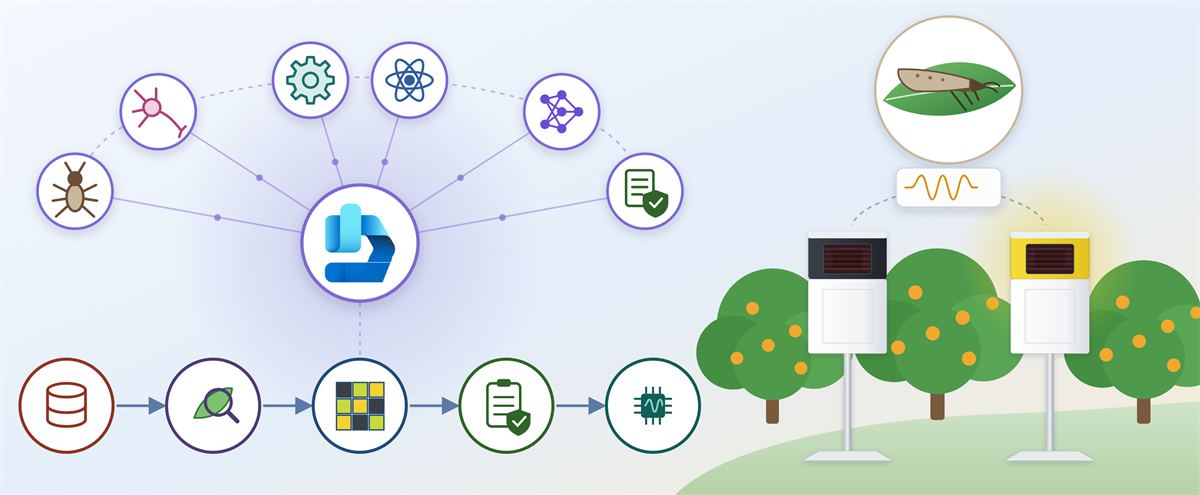
Creating a comprehensive biomonitoring plan would typically require several weeks of research and planning, drawing on expertise from biologists, engineers, and AI specialists. By enhancing our workplan with grounded agents, the effort to perform a literature review, develop an experimental design, review biocontainment permitting requirements, and develop synthetic ACP-specific classifiers was compressed into a few days. The approach I took to agentically adapt our biomonitoring platforms for ACP are as follows (Figure 3).
- Ground. I grounded the Discovery app on our actual systems by providing coding agents with read-only access to our engineering artifacts, manuals, and standard operating procedures (SOPs) for our biomonitoring platforms. These agents interpreted over 120 software projects and reference documents containing device firmware, data formats, real-world data sets, AI training logic, and data analysis toolkits, and then autonomously generated a compact set of agent skills, data taxonomies, data examples, and helper methods for use by the Discovery app.
- Research. I asked the Discovery app to perform a literature review of ACP ecology, co-occurring agricultural pests, co-occurring natural and (possibly) introduced predators of ACP, and other beneficial insects. The ecological focus was restricted to commercial citrus groves in the Southeastern U.S. where CGD is endemic. The intention of this research was to build a deep entomological picture of the expected deleterious and beneficial species that a biological monitoring system should track.
- Experimental Design. Based on an understanding of the mode-of-operation of BWS devices and a broad understanding of relevant species in the area, we collaborated with Discovery app to develop experimental designs to determine the optimal device configuration and deployment approaches to maximize ACP monitoring.
- Biocontainment Permitting. ACP is a regulated species because of the pathogens it can transmit. I provided the Discovery app with our existing biocontainment permits, SOPs, laboratory designs, and collaborated with the agent to develop new permit requests and SOPs for handling ACP in our facilities. The collaborative aspect of this was essential since the lab manager would be responsible for any mistakes in these documents.
- Classifier Development. Finally, since permitting can take a long time, I asked the Discovery app to analyze thousands of examples of pre-existing insect biometrics from other species, consider biomechanical models of ACP and related species, and then engineer a computational modeling pipeline to generate synthetic examples of ACP biometrics. These synthetic training data helped the team build an initial edge classifier for ACP, which could be tested in our labs under proper biocontainment once permitted to receive live ACP.
Figure 3. Microsoft Discovery app workflow to adapt the Premonition Biological Weather Station (BWS) biomonitoring platform to the Asian citrus psyllid (ACP), other citrus pests, biological controls, and beneficial insects.
I worked iteratively with the agent across a complex series of connected scientific questions: How is ACP normally detected? What is the best experimental design for optimizing biomonitoring? What biological or behavioral characteristics could affect detection by our systems? What are the most important lab experiments to run? What permits are needed to conduct the proposed experiments in the field?
The human-agent team changed the role of AI from a sophisticated search tool into something closer to a scientific collaborator. Agents in the Discovery app carried both deep engineering and entomological knowledge. I queried and challenged these agents and carefully refined and translated outputs into concrete experimental decisions. Importantly, I the scientist, remained in the loop throughout this process, deciding which questions mattered, evaluating the biological plausibility of suggestions, and determining which ideas were worth carrying forward.
Designing experiments. One of the earliest decisions was determining how to cost-effectively adapt BWSs to citrus groves by understanding the visual systems of both ACP and other harmful and beneficial species expected in those habitats (Figure 4). These results integrated research from diverse fields: insect ecology, neurophysiology, and olfaction. Additionally, because these agents are also engineers, they could directly reprogram our BWSs to support these experiments. With a human-agent team, I could go from concept to fully realizable and deeply rationalized experiments in matter of days for a major disease system. As an entomologist, I was trained in classical field methods where this speed of iteration was not previously feasible.
Figure 4. Outputs from Discovery app integrating insect ecology, neurophysiology, and olfaction to recommend cost-effective biomonitoring configurations and experiments.
Once we defined a new lure configuration to test, we collaboratively developed an experimental design based on our objectives, system constraints, proposed endpoints, and my scientific judgement (Figure 5). The study plan was a living document registering decisions and inputs that could be revisited and revised. The experimental design that was settled on was a replicated Latin square design, a well-established method for comparing insect monitoring in the field because it balances differences between sampling locations and sampling periods (Figure 6).
Working with real biology (permits). Given an experimental design, the next step would be to begin the process of importing ACP into our facilities to collect ACP biometrics and build new AI-enabled classifiers to recognize them. This is a serious step, which requires additional permitting from entities like the USDA. As the lead entomologist, I needed to fully understand any agent-assisted guidance on this process. Using the approach described above, I was able to ground Discovery’s agents on the mechanical design of our laboratories, software systems that operate it, and standard operating procedures. Within a few hours, I was able to draft content for a new permit request. I could inspect how this draft was derived based on our existing facilities and how it accounted for unique aspects of ACP biology and ecology. Almost everyone working in experimental biology using AI will need to balance AI-acceleration of their workflows with regulatory requirements. In my experience, transparent processes and human oversight are essential when working with agents.
Figure 5. Screenshot of an experimental plan for ACP monitoring based on our objectives, system constraints, proposed endpoints, and scientist-provided guidance.
Figure 6. Deeper refinement of the experimental plan into a Latin square for ACP monitoring based on our objectives, system constraints, proposed endpoints, and scientist-provided guidance.
Working with real biology (data). Working with real biology also means working with complex data formats and datasets generated from observing that biology. Through the course of the Premonition program, our lab has collected tens of millions of insect biometric examples for training AI, including many of the foremost mosquito species that transmit human and animal disease world-wide. In advance of obtaining permits to work with ACP, I wanted to build a preliminary AI classifier by combining our real-world data with physics-based biomechanical studies to generate simulated ACP biometrics. Empowered by an agent grounded in biology, engineering, AI training, and now physics, I reviewed published insect-flight literature, considered the optical properties of our sensor designs, and developed bioinformatics pipelines to read data formats and generate simulated ACP biometric signals. Within a few hours, I constructed a preliminary dataset to assess the false positive rate of an ACP classifier against other insect species (Figure 7). This gave me a sense of how often a biomonitoring system for ACP might trigger “false alarms,” and what biometric features might be most diagnostic for ACP.
Figure 7. Simulated Asian citrus psyllid (ACP) wingbeats compared with real wingbeat examples from labeled lab recordings on Premonition sensors. (A) One example of a normalized time-domain biometric signal per group. (B) Estimated fundamental wingbeat frequency f0 for each event; the shaded band is the published ACP range, 187±26 Hz.
To summarize, emerging pests and pathogens continually create new biomonitoring needs. However, building and deploying completely new monitoring systems for every threat is impractical. Existing systems need to be rapidly adapted to support new biomonitoring missions with an understanding of the biology and ecology of species to be monitored. As an entomologist who has worked with insects that transmit animal and human diseases, this goal often appears daunting. With each new disease system there are many biological unknowns and experiments that could be run, many distinct areas of scientific research that need to be combined to understand the disease system, followed by complex engineering. Many months of interdisciplinary work are often needed to organize the problem. In this project, we saw the speed at which a human-agent team can integrate engineering, multiple disciplines of biology, physics, and regulatory aspects to adapt biological monitoring designed for animal and human disease to a major agricultural pathogen. For me, the biggest takeaway is not the idea of a standalone AI scientist, but how human-agent collaboration can connect knowledge across disciplines to accelerate rigorous, traceable scientific reasoning and translate it into informed action.