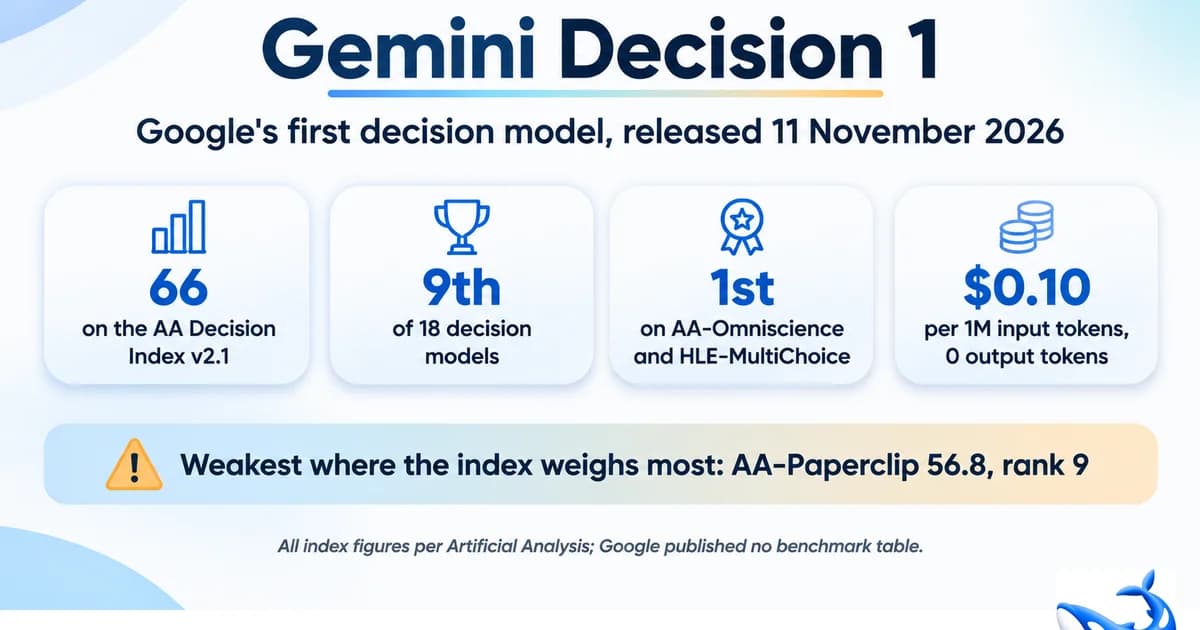
Sixty-six is a respectable score and a misleading headline. Gemini Decision 1, which Google released on 11 November 2026 behind a new Decisions API, lands at 66 on the Artificial Analysis Decision Index v2.1 — ninth of the eighteen decision models the board ranks, just above the field's median of 64. The other half of the launch claim is also true: the model is first, outright, on the index's knowledge and reasoning components. Both sentences survive checking, and they feel contradictory for a reason worth understanding. Those two components are worth 15% of the score each. The component worth 30% is the one where Gemini Decision 1 is weakest against its peers.
That distinction is not a quibble about leaderboard arithmetic. It tells you what this model was built to do, and it is not what most people will assume from the phrase "decision model from Google DeepMind".
What Google actually shipped
Gemini Decision 1 does not write. It is not a chat model with a JSON mode, and it cannot be called through the ordinary generate-content path. It runs on a separate endpoint, POST /v1beta/decisions, takes one block of shared input plus a map of typed questions, and returns one calibrated answer per question with zero output tokens. Every question is evaluated independently against the same input in a single pass, and the model never sees your question keys — only the instructions text you write.
Three question types cover the whole surface:
• Yes/no (noul) — returns a probability between 0.01 and 0.99 plus a confidence score. The bound is deliberate, and it means a threshold set above 0.99 will never fire.
• Choice — two to 255 named options, returning the top option, a probability for every option summing to one, and a confidence. Before scoring, the API sorts your option keys alphabetically in UTF-8 byte order, so JSON key order changes nothing and an exact tie breaks toward the alphabetically first key. That is why Google's own guidance says to name a catch-all option other rather than none_of_the_above, which sorts ahead of most real categories instead of after them.
• Score — two to 255 ordered rubric levels, two to ten recommended, returning a probability-weighted expected level. Because the expected value averages array indices, a scale of 1/10/100/1000 skews it, and Google says so in the docs.
The rest of the specification is unusually concrete for a launch-day model page:
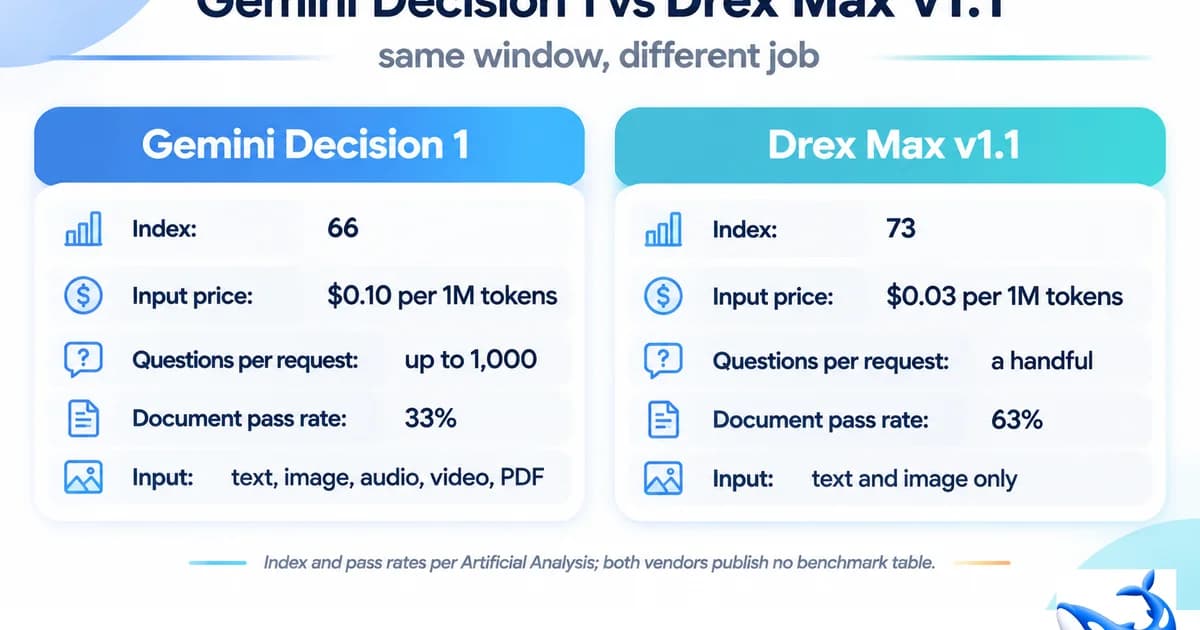
• Input — text, image, video, audio and PDF in one request, with a 262,144-token context covering the shared input and every question together.
• Scale — up to 1,000 questions per request, which is the number that separates this from a classifier. A support ticket can be checked against forty policy rules in one call, billed once for the shared input.
• Media — up to 100 MB of inline base64 per request, 50 MB for PDFs, 15 MB per external HTTPS URL. No YouTube links and no gs:// URIs; you pass a Files API reference, a signed URL, or bytes.
• Billing — $0.10 per million input tokens, output not applicable. No context caching, no Batch API, no Flex or Priority inference. Repeated input across requests is billed in full every time.
• Rate limits — a free tier at 200 requests per minute and 10,000 per day, Tier 1 at 1,500 per minute and 50,000 per day, and unlimited daily requests from Tier 2 up.
Two details in that list matter more than they look. The free tier is free of charge but listed as used to improve Google's products, which rules it out for anything sensitive. And the model is available on the Gemini Developer API only, at API version v1beta — there is no Vertex AI listing in the documentation Google shipped.
The arithmetic behind the 66
The Decision Index is not an accuracy table. It is a weighted average of six evaluations, and each one is scored as accuracy minus the Brier score of the probability the model attached to its answer. A model that answers wrongly but says so with low confidence is penalised less than one that answers wrongly and is sure. That design rewards abstention, and it is the single most important thing to hold in mind when reading any number on this board.
Here is where Gemini Decision 1 sits on each component, with its rank among the eighteen models:
• AA-Paperclip, 30% weight — 56.8, rank 9. This is the document-decision test: 1,500 private resumes, receipts, invoices and papers, each carrying five decisions and ten facts, scored as one document that only counts when all fifteen answers are right. Gemini Decision 1 passes 33% of documents outright. Drex Max v1.1 passes 63%.
• EvalSafe-O*NET-AA, 15% — 87.1, rank 8. Workplace-document judgement. This is a strong result, and it is the component where the whole field clusters tightest.
• When2Call, 10% — 80.5, rank 14. NVIDIA's tool-calling evaluation, and the weakest rank of the six. Drex Max v1.1 scores 95.3 here.
• AA-Omniscience-Decision v1.1, 15% — 66.3, rank 1. Knowledge and hallucination, where the "I don't know" option is worded ten different ways.
• HLE-MultiChoice v1.1, 15% — 48.7, rank 1. Humanity's Last Exam, multiple choice, with a decline option.
• AA-Symmetry v1.1, 15% — 70.5, rank 9. Whether an answer survives the same question reordered, relabelled and negated. Gemini Decision 1 holds its answer on 38.3% of question families; Mammoth 27B holds 88.2 on the same instrument.
Weight those and you get 65.98. The first and fourth rows do most of the work in opposite directions, and the reason is structural: Paperclip is worth twice as much as either knowledge test, and it is the evaluation that needs the model to read fifteen facts out of one document correctly and simultaneously.
The two firsts are real, and narrower than they sound
Being first on AA-Omniscience-Decision is a genuine result. Gemini Decision 1 scores 66.3 against 64.4 for d1-ultra and 60.9 for GLiDE v1.2, and its raw accuracy of 44.8% is the highest of the eighteen decision models on that test. On HLE-MultiChoice it is first again at 48.7, ahead of Mammoth 27B and d1-ultra at 47.4. That is what "leading in knowledge and reasoning" refers to, and the claim holds.
What the claim omits is the absolute level. Gemini Decision 1 gets 13.2% of Humanity's Last Exam questions right. The reason it still tops that component is that it declines rather than guesses: its non-hallucination rate on the same test is 35.7%, and the scoring formula pays for a low-probability answer that turns out wrong. Top of the field on calibration is not the same as top of the field on knowledge, and 13% accuracy is the number to carry into a capacity plan.
Google has published no benchmark table of its own for this model — the release notes announce the model and the API, and the documentation explains the request shape and the limits. Every performance figure above is Artificial Analysis, measured on the evaluators' own harness, and no vendor number exists to disagree with it. That is cleaner than most launches and worth saying plainly, because the alternative — a vendor table and no outside check — is the common case in this category.
What the price buys, and what it does not
At $345 per million tasks on the index, Gemini Decision 1 is the most expensive model in the top half of the board. Drex Max v1.1 runs the same million tasks for $103, Jev 1.14 for $156, Microsoft-Decision-1 for $143. The input rate explains it: $0.10 per million tokens against $0.03 for Drex Max v1.1, and a decision task reads a long document without ever generating a token to offset the cost. Artificial Analysis ranks it fifteenth of eighteen on cost and notes it is "particularly expensive".
Latency is unremarkable. At 211 milliseconds per task it is a hair slower than the field median of 209 and slower than Jev 1.14 at 92. For a routing decision behind a customer message, that is fine. For a frame-by-frame loop over live video, which the documentation explicitly lists as a use case, it is the argument for a smaller model rather than against this one.
The capability gaps are the ones the pricing page lists as unavailable rather than the ones a benchmark can show: no Batch API means no half-price overnight sweep of a million historical tickets, and no context caching means the same 40,000-token policy document is billed again on every request. If your decision pipeline re-reads a large shared context at volume, those two omissions cost more than the headline rate suggests, and neither is on a roadmap Google has published.
Where this fits if you already route models
OrcaRouter does not carry gemini-decision-1. A probabilities-only endpoint is not a chat-completions target, so it is not something a router in our shape can put behind one key — and saying otherwise would be the kind of availability claim that reads well and fails at the first request. What we do carry is TypeSafe's typesafe/jev-1.14, a decision model on the same 18-model board at 66.23, so the scoring half of a pipeline can sit on the same key as the writing half if that is the decision model you pick.
The writing half is the part we are actually for. A decision pipeline is nearly always two calls: something drafts the candidate answer or the rubric, and something scores it. The drafting call is where model choice is contested and where a second vendor contract hurts, and that is the call that runs across one endpoint with more than 200 models on it at provider list price passed through with 0% markup, so a vendor price change is live on our side the same day. Routing the drafting call through us and pointing the scoring call at Google's own endpoint is a two-line change, not an architecture.
What would change this read
Three things, in order of likelihood. A revision that lifts AA-Paperclip's 33% all-or-nothing pass rate would move the composite further than anything else this model could do, because that one component carries 30% of the score and a sixteen-point deficit to the leader. A Vertex AI listing would change the procurement conversation entirely — today the only way to call it is a Gemini API key, and enterprises that buy through Google Cloud contracts will notice. And a second independent board reproducing the 66 would turn a single-firm number into a consensus one.
Until one of those lands, the accurate description of Gemini Decision 1 is narrow and useful: a multimodal, 262,000-token, 1,000-question scorer that is the best-calibrated decision model on the board in the two places where knowing when to shut up is the skill being tested, and a mid-table one where the job is to read a dense document and get fifteen answers right at once. If your decisions look like the first kind, 66 understates it. If they look like the second, no amount of knowledge-benchmark leadership will save the pass rate.