The federal, state, local government, and education sectors are under growing cyber pressure, and the attack surface is shifting to where they now serve citizens most. According to Check Point’s 2026 Cyber Security Report, government organizations faced an average of 2,680 cyber-attacks per organization each week in 2025, a 17% increase from 2024, making government the second most targeted sector worldwide. As government organizations move services online, deploy citizen self-service portals, connect APIs, and integrate AI into mission-critical workflows, every new capability creates a new entry point. A successful attack doesn’t just disrupt IT-it can interrupt essential services, expose sensitive citizen records, compromise internal secrets, and undermine public trust.
The data reflects that reality. Verizon’s 2026 Data Breach Investigations Report recorded 3,634 public-sector incidents and 2,410 confirmed data disclosure breaches, with exploitation of vulnerabilities accounting for 40% of initial access, and personal data, internal data, and secrets among the most compromised. That makes runtime web application and API protection especially critical for government organizations running legacy systems, third-party applications, and public-facing services that cannot always be patched immediately.
Check Point has been addressing this risk inside government trust and compliance requirements since achieving FedRAMP Certification for its Check Point Platform for Government in 2025. Now Check Point is expanding its FedRAMP-Certified packages to include Check Point WAF, bringing prevention-first web application security, API protection, Bot mitigation, DDoS defence, CDN-integrated delivery, and GenAI application security into the same government-certified platform.
Government organizations no longer operate static websites. Today’s public sector runs digital citizen portals, API-driven benefit and payment systems, cloud-native applications, and AI-enabled interfaces that connect identity, records, contractors, and partner organizations across the public sector. This growing interconnection makes the application layer more dynamic, complex, and exposed.
AI is also transforming both the speed of attacks and the security model required to stop them. Frontier AI technologies demonstrate how vulnerabilities can be discovered and validated autonomously at unprecedented speed and scale. Attackers are already using AI-powered tools to generate payload variations and exploit weaknesses faster, making signature-based protection increasingly ineffective. As a result, pre-emptive, AI-driven prevention that can stop unknown attacks without signatures or emergency updates is becoming essential.
Modern Web Application and API Protection (WAAP) must secure far more than a single website or API endpoint. Government organizations need prevention-first protection across the entire application environment, including:
- Pre-emptively prevent known, unknown, and zero-day web and API attacks before they reach the application
- End-to-end API security with automated discovery, schema validation and authentication enforcement
- Availability of critical services with strong bot mitigation and DDoS protection against automated abuse and disruption
- Block GenAI application attacks including prompt injection, data leakage and harmful content
- Simplify operations with centralized management that reduces tool sprawl and complexity across the full application stack
Check Point WAF brings all these capabilities into a single consolidated platform, purpose-built for the modern application reality that government organizations face today. By adding it to the FedRAMP certified packages, federal organizations can now secure public-facing applications and APIs through the same government-certified platform they already trust with the prevention, visibility, and control needed to protect modern application environments without adding complexity or managing separate tools for every risk.
Why This Matters Now
The public-sector application attack surface is expanding quickly as government organizations modernize services, expose more APIs, and begin adopting AI-enabled workflows. At the same time, AI is accelerating the speed at which attackers find and exploit those weaknesses.
According to Check Point 2026 Cloud Security Report, 70% of organizations run GenAI workloads in production, yet visibility has not kept up. Only 5% of organizations have full visibility into how AI is used, and just 14% actively enforce and audit an AI security policy.
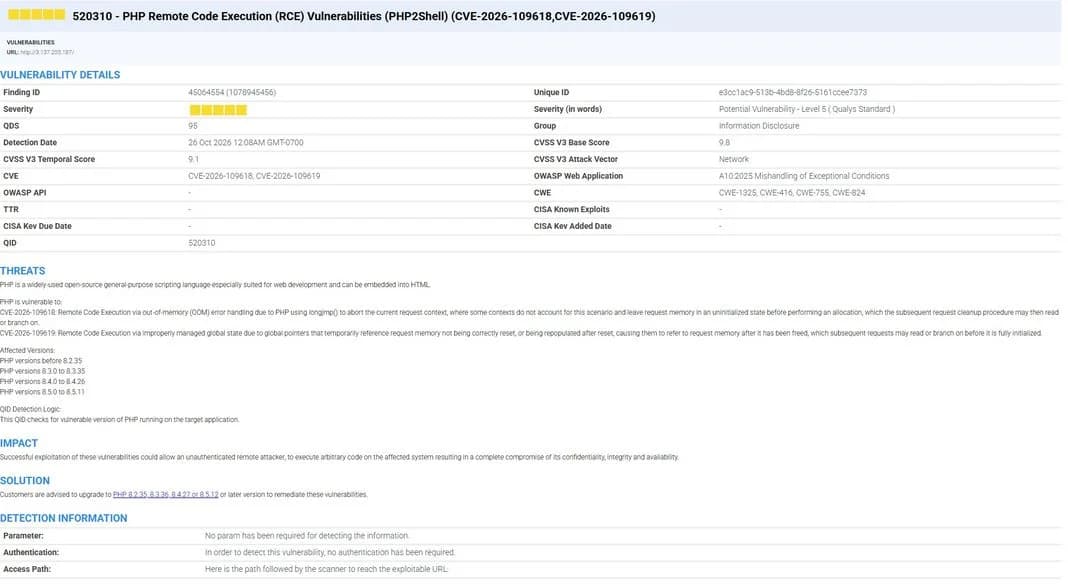
PHP2Shell shows how fast the window closes. Two critical PHP flaws, each rated 9.2 on the CVSS scale, let an attacker run code on a server with one crafted request, with no password, account, or user interaction. Attacks started before the patch landed on October 21, 2026, and government organizations took sites offline to cope. Check Point WAF preemptively blocked PHP2Shell with no signature, rule, or configuration change.
This is why expanding Check Point’s FedRAMP certification packages to include Check Point WAF matters. It is not just another security product. It is a way to help public-sector organizations protect the applications, APIs, and digital services that citizens, employees, contractors, and partners depend on every day.
Available Through the FedRAMP Marketplace
Check Point is listed on the FedRAMP Marketplace, with Check Point WAF included in the certification, making it easier for federal mission owners to discover, evaluate, and procure the solution.