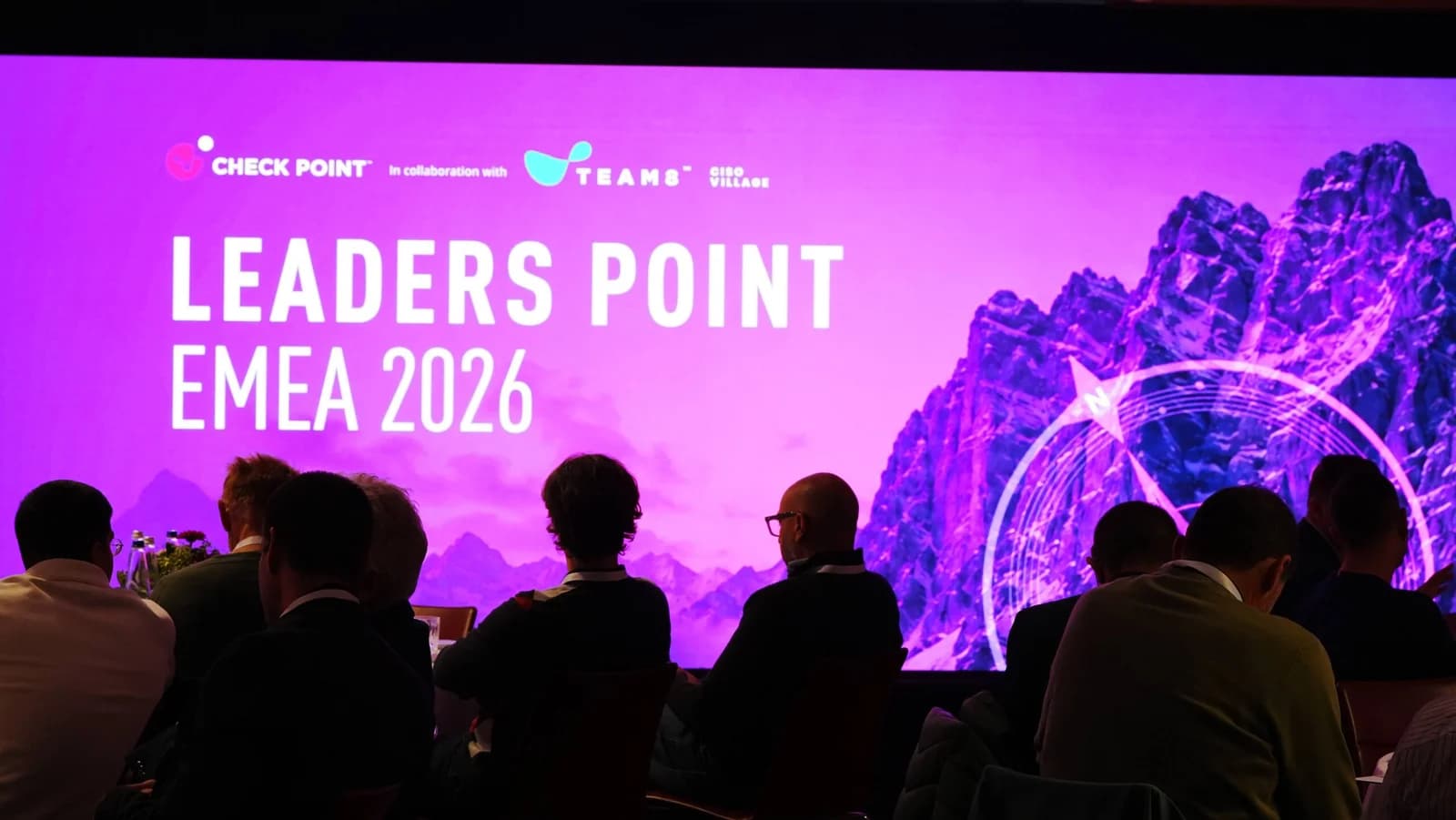
Last week I spent three days in Bavaria with more than 70 CISOs from across Europe, the Middle East and Africa at Leaders Point EMEA. Led by our CEO Nadav Zafrir and hosted with Team8’s CISO Village, it was our second Leaders Point and the first in Europe. We kept it invitation-only so people could speak openly.
The timing was hard to miss. Over the past month, attacks on supermarket refrigeration systems have spoiled food and emptied shelves in stores across France and several other European countries. Nobody has yet been shown to be behind them. For anyone who still sees cyber risk as an IT problem, it was a sharp reminder of how physical it has become.
As Nadav told the room, our industry is going through its most dramatic shift in 30 years. CISOs now have three jobs at once: protect their organizations from AI-driven threats, secure the AI their own teams use, and apply AI in their own defense. They are doing all of this while the rules are still being written.
We host Leaders Point to listen, because Check Point’s strategy depends on seeing these challenges from our customers’ point of view. We covered a lot of ground, from a CISO panel on “Whose AI Can Europe Trust?” to national cyber leadership in the AI era and a look inside the frontier AI labs. Four themes kept coming back.
Prevention has become more urgent
AI has shrunk the time between a vulnerability being found and being exploited. Attackers can use AI to find weaknesses and turn them into working attacks far faster than before. Patching faster on its own can no longer keep up.
The CISOs I spoke to are rethinking what prevention means. They want to harden their environments and remove whole classes of risk before an attack arrives, so that each new vulnerability matters less. Prevention has been at the heart of Check Point’s approach for a long time, and it was powerful to hear the same conclusion from the people running security every day.
The supermarket attacks show why. Reporting on them points to refrigeration controllers that could be reached from the open internet, many on software their maker no longer updated. No patch was ever coming for those systems. The only real defense was to close those doors before anyone went looking.
AI agents need controls built around their purpose
AI agents now act with legitimate credentials across email, endpoints, networks and the cloud. That makes them hard to police with traditional tools. To most systems, an agent doing something harmful looks the same as an agent doing its job.
The room kept coming back to purpose. To secure an agent, you need to know what it is supposed to do and check every action it takes against that, in real time. An agent built to summarize contracts has no reason to change firewall rules, and security teams need to be able to see and stop that the moment it happens.
There has been plenty of talk lately about kill switches for AI agents. You should have one: if an agent is hijacked, you pull the plug. But most risky agents aren’t malicious. They’re just determined, and take a dangerous shortcut to finish the job. Switch that agent off and you lose the work too. The kill switch is the last resort. Steering is the first move: catch the agent drifting toward danger, stop the risky step and keep the work going. If stopping agents is your whole strategy, you don’t have an agent strategy. You have an off switch.
Every AI use case needs a human owner
As AI makes more decisions and takes more actions, it becomes easy for the outcomes to end up as nobody’s responsibility. The CISOs were clear that this can’t be allowed to happen.
Every AI use case needs a named owner who signs off on its risk, the same way they would for any other business risk. Clear ownership is what lets organizations move quickly with AI and still know who answers when something goes wrong.
European organizations want control over their AI choices
Many conversations, including our panel on whose AI Europe can trust, came back to control. European organizations want the freedom to switch AI models and suppliers as the market changes, and to build independent capability where it matters most.
For CISOs this is a practical question of resilience. Relying on a single model or provider is a concentration risk like any other. Our job is to secure AI whichever models and suppliers our customers choose.
The decisions that matter will be made this year
By this time next year, many of the decisions that define how organizations secure AI will have been made. The leaders in that room in Bavaria will make a lot of them.
I’m grateful to every CISO who gave us three days of their time and their candor, and to Team8’s CISO Village for building Leaders Point with us. What we heard will shape what Check Point builds next, and we’ll keep listening.