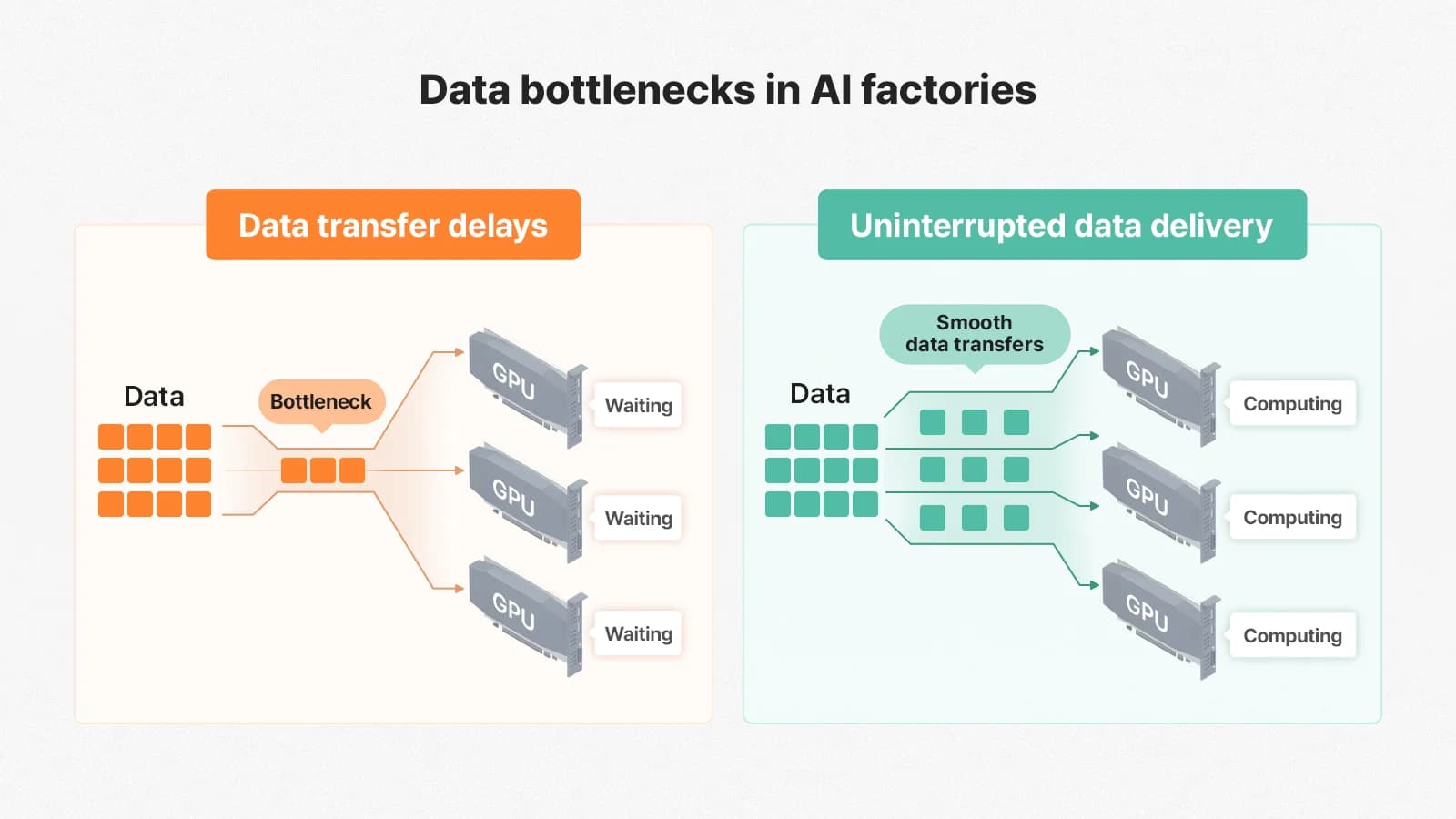
As the volume of data handled by AI continues to grow, memory technology for storing and processing that data efficiently is evolving ever faster. Going beyond simply storing data and retrieving it when needed, a range of ideas is taking concrete shape — such as tiering memory according to how frequently data is used, or grouping multiple servers into a single memory pool to improve transfer efficiency between storage and the system. Ongoing innovations in design and process technology continue to drive improvements in capacity and processing speed, while the industry is actively working to expand the role of memory by integrating computational functions.
SK hynix has devoted considerable effort to reading these fast-changing technology trends ahead of the curve and providing customers with optimal solutions. Supercomputing 2026, held from Nov 15th to 20th in Chicago, Illinois, in the United States, offered an opportunity to see the results of that effort firsthand.
Supercomputing 2026 is a global conference that brings together the latest technologies in high-performance computing(HPC) and AI. This year, around 10,000 people visited the exhibition and some 500 companies and institutions took part.
Throughout the event, SK hynix introduced its next-generation solutions in detail through live demonstrations and presented its technology vision for reshaping the AI ecosystem around memory. The company strengthened its collaborative relationships with global customers and partners while closely examining the latest technology trends in the next-generation computing market and exploring new business opportunities.
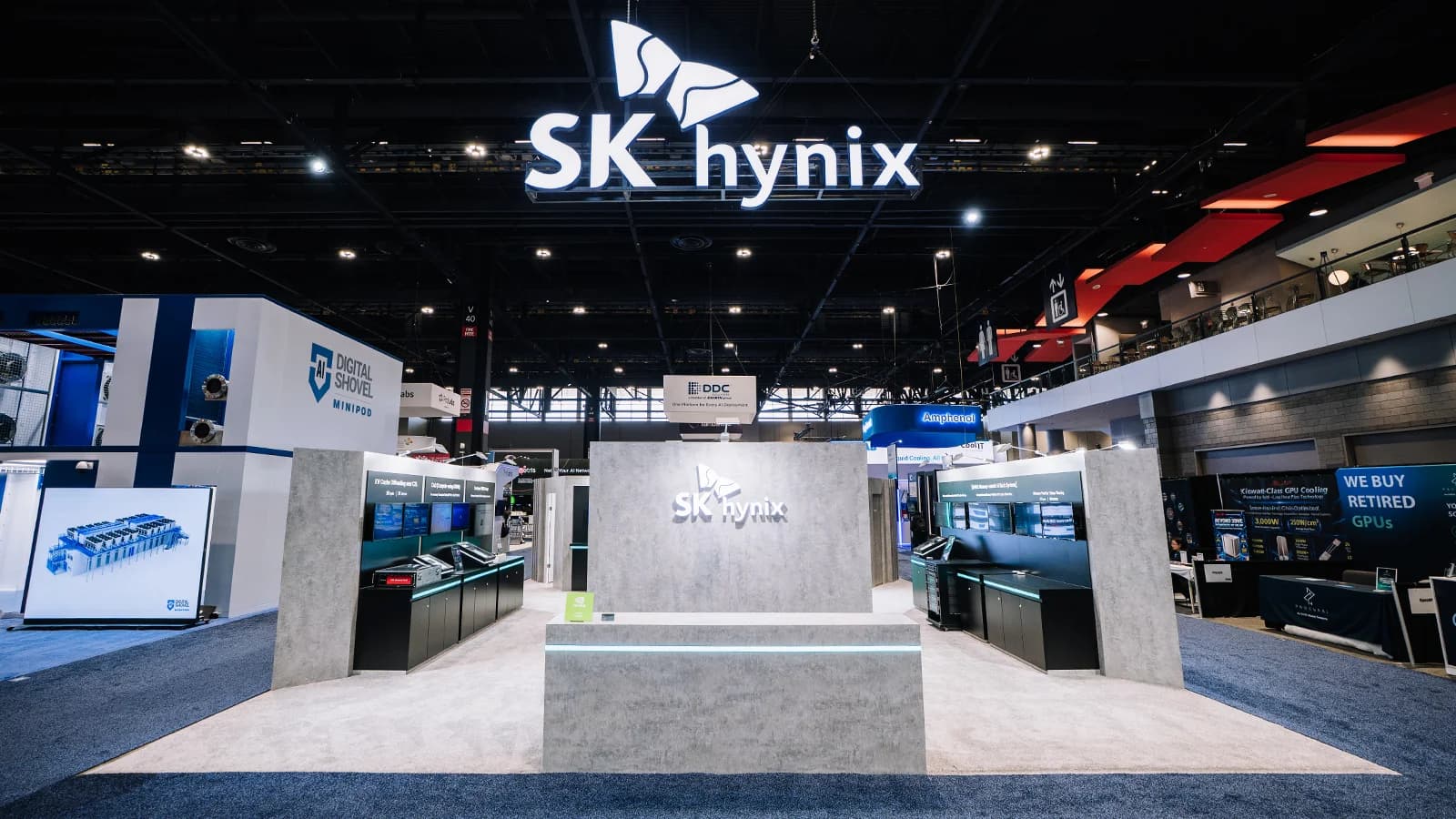
▲ SK hynix’s exhibition booth
With a striking booth design in which neon-blue light traced the contours of rough-textured gray walls, SK hynix gave visual form to the image of next-generation memory technology. The booth’s presence, standing out vividly even in the dim exhibition hall, caught the eyes of passing visitors.
▲ Visitors touring the MARS section
Stepping through the entrance and moving toward the wall on the right, visitors first encounter the MARS section. MARS(Memory-centric AI Rack System) is a next-generation system that maximizes efficiency by integrating partners’ solutions into a single rack*, with memory at its core. In the MARS section, SK hynix presented three related demos.
* Rack: A standard-sized frame used in data centers to stack servers, storage, network equipment, and other devices in layers. Because equipment is managed in rack units, the rack serves as the basic building block of data center infrastructure
▲ A demonstration of pooled memory sharing a KV cache at the rack level
In the first demo, SK hynix combined CXL* memory with CXL hybrid memory* to present a pooled memory* that shares a KV cache* at the rack level. The large-scale KV caches that are continuously generated are stored on the SSD within the CXL hybrid memory; when they are reused, the system predicts which KV caches will be needed based on prior conversation and task history and rapidly loads them into DRAM. This demonstrated that the solution can secure high-capacity storage for the vast amounts of information required to run AI while also delivering fast read performance.
* CXL(Compute eXpress Link): A next-generation interface that efficiently connects CPUs, GPUs, memory, and other components within a computing system to support large-capacity, ultra-high-speed computation * CXL Hybrid Memory: A CXL-based memory solution that goes a step beyond DRAM-based CXL memory by combining DRAM and SSD * KV Cache(Key Value Cache): Temporary memory that stores previously computed results when a large language model-based AI agent generates text. It grows exponentially as a conversation gets longer and more tasks need to be processed, so the ability to store and process it efficiently has a major impact on an AI agent’s performance * Pooled Memory: Technology that groups multiple CXL memory units into a pool and raises overall memory utilization by allowing several hosts to share its capacity
▲ A demonstration of AI agent serving technology using computational pooled memory
In the second demo, SK hynix demonstrated an AI agent serving system that improves efficiency by using a computational memory pool* to connect multiple servers and GPUs. This proved that selectively transferring or reusing a KV cache with CXL-based computational pooled memory can significantly improve system performance compared with conventional methods that rely on network communication.
* Computational Memory Pool: A memory solution that adds computational functions inside the memory pool so that simple computations can be performed before data is sent to the CPU or GPU
▲ A demonstration of token-sharing technology based on CXL pooled memory
In the third demo, SK hynix showed how it improves the performance of multimodal* AI services by having CPU servers connected through CXL pooled memory share the tokens they generate. For multimodal AI services, tokenization* time has a major impact on performance, because delays in CPU preprocessing increase GPU idle time and lower processing efficiency. By using CXL pooled memory to share request data and tokens across CPU servers, SK hynix reduced redundant processing, thereby streamlining CPU resource utilization and worker scheduling and improving preprocessing. As a result, GPU idle time was shortened and serving performance was further enhanced.
* Multimodal: AI technology that understands and processes together different forms of data, such as text, images, voice, and video * Tokenization: The process of breaking down data such as text or images into the smallest units, called tokens, so that an AI model can process them
On the opposite wall stood the system demo section. From left to right, three technologies — KV Cache Offloading over CXL, Compute-using-DRAM, and Custom HBM Array — were introduced in sequence, stopping visitors in their tracks.
▲ Visitors watching a demo video in the KV Cache Offloading over CXL zone
The KV Cache Offloading over CXL zone featured a video introducing the technology concept, a demo video, and a banner detailing the products that make up the solution. KV Cache Offloading over CXL is a new AI memory technology that helps AI data centers place and share memory efficiently according to demand. It adds a CXL memory pool to an AI memory hierarchy that previously consisted only of HBM* and DRAM: KV caches that will be used soon are placed first in HBM and DRAM, while KV caches to be recalled later are kept in the CXL memory pool. Because the storage location is determined by weighing factors such as reuse frequency, recency of use, size, and the cost of restoration, the approach can deliver benefits beyond a simple increase in capacity, and the memory pool can be used to reallocate resources in line with changing demand or to let multiple hosts share capacity. Together with SK Telecom, which is driving the AI data center business, SK hynix completed verification in a real LLM* inference environment, and at this exhibition it presented these efficiency gains in a demo video so visitors could grasp them at a glance.
* HBM(High Bandwidth Memory): A high-value-added, high-performance product that connects multiple DRAM chips vertically to increase capacity and dramatically raise data processing speed. HBM has been developed in the following order: 1st generation(HBM) – 2nd generation(HBM2) – 3rd generation(HBM2E) – 4th generation(HBM3) – 5th generation(HBM3E) – 6th generation(HBM4) * LLM(Large Language Model): An artificial intelligence model that learns from big data to understand human language and generate natural sentences
▲ Visitors examining a brochure introducing the Compute-using-DRAM solution
The Compute-using-DRAM zone consisted of a video introducing the technology concept, a demo video, and product and solution brochures placed beneath them. Compute-using-DRAM is a technology that performs computations inside the memory by leveraging the charge-sharing* behavior inherent in the DRAM cell array. Using the DRAM structure, which activates rows of thousands to tens of thousands of bits at once, it processes bit-level operations in parallel through row-to-row data copying and the simultaneous activation of multiple rows. Because it uses commercial DRAM as is, without adding a separate computation unit, it can raise both bandwidth and power efficiency while minimizing chip-area and capacity losses. In particular, it drew considerable attention as a next-generation solution for improving data transfer efficiency in AI systems, since it can perform simple operations — such as logic operations and the arithmetic and large-scale data comparisons built on them — directly inside the memory and transmit only the results, rather than moving the large volumes of data generated in AI computation into the computation unit’s cache hierarchy.
* Charge Sharing: The phenomenon in which the charge stored in a DRAM cell meets the bit line and changes the voltage — the basic principle by which DRAM reads data
▲ Visitors examining a structural model of Custom HBM Array
The Custom HBM Array zone featured a video introducing the technology concept alongside a product model and a solution brochure. Conventional GPU-based systems can connect only a set number of HBM units, which limits how far bandwidth can be expanded, and they also waste GPU resources when performing LLM decoding(Answer generation). Custom HBM Array overcomes these limitations with a structure that connects multiple cHBM* units equipped with computational functions. It is expected to deliver faster response times and higher energy efficiency than conventional GPU-based systems, while also easing data-movement bottlenecks. Visitors showed keen interest, examining the internal structure piece by piece in front of the product model, asking nearby staff their questions, and lingering for a long time.
* cHBM(Custom High-Bandwidth Memory): A customizable memory technology that can add various functions to conventional HBM. When computational functions are integrated, it can be designed to stack the memory and the computation unit vertically, reducing the distance data must travel and making use of high memory bandwidth
▲ SK hynix’s main HBM products
At the product portfolio section behind the booth, SK hynix introduced its core product lineup for AI infrastructure. In the HBM zone, the next-generation HBM4E and HBM4 were displayed side by side with HBM3E, which currently leads the HBM market.
In the server DRAM zone, SK hynix presented the ‘256GB 3DS* DDR5 RDIMM*’, which delivers the industry’s largest capacity for AI workloads, along with the high-bandwidth ‘128GB DDR5 MRDIMM*’ and the highly versatile ‘96GB DDR5 RDIMM’. Displayed alongside them was the ‘192GB SOCAMM*2’, which improves both power and space efficiency with a new form factor.
* 3DS(3D Stacked Memory): A technology that vertically stacks multiple DRAM chips and connects them with TSVs to increase capacity within a single package * RDIMM(Registered Dual In-line Memory Module): A DRAM module used in servers and workstations that improves stability by incorporating a register to relay signals * MRDIMM(Multiplexed Rank Dual In-line Memory Module): A server DRAM module that raises bandwidth by using two ranks simultaneously * SOCAMM(Small Outline Compression Attached Memory Module): A server module standard based on low-power DRAM, characterized by high power and space efficiency
In the eSSD zone, the ‘PEB210 E1.S’, which supports Direct Liquid Cooling(DLC), and the ‘PS1110 E3.S’, which delivers high capacity and low power consumption in line with the NVMe* E3.S standard, drew the most attention. The lineup was rounded out with the latest eSSD products — such as the ‘PS1010 U.2’ and the ‘PEB210 M.2 2280’ — that meet diverse customer needs across a range of uses.
* NVMe(Non-Volatile Memory Express): A communication standard for non-volatile memory based on the PCIe interface. Compared with the conventional SATA interface, it is suited to ultra-high-speed, high-capacity data processing.
▲ The company introduction section, presenting SK hynix’s history and vision along with its HBM development journey and latest product status
Behind the wall at the booth entrance was the company introduction section. Along the wall graphics, SK hynix’s history and vision unfolded, capturing at a glance its HBM development journey together with the latest product status across the HBM, DRAM, and NAND fields.
▲ Technical Leader Younghoon Min of AI System Infra delivering his presentation
In the presentation session, Technical Leader Younghoon Min of AI System Infra took the stage to present ‘Enabling Agentic AI Serving with Disaggregated Memory Pools’, introducing MARS, the memory-centric AI system architecture, in detail.
In particular, he presented the technologies at the core of the MARS architecture: KV cache sharing and reuse based on a CXL memory pool, and token sharing for the CPU rack. He explained that these technologies raise GPU and CPU utilization compared with conventional methods, significantly improving multi-turn agentic AI serving performance.
SK hynix noted that, as memory emerges as a decisive factor in the performance and efficiency of AI infrastructure, the exhibition allowed the company to clearly convey its technological competitiveness and its vision for AI memory. Going forward, as a core technology partner committed to advancing AI computing performance, SK hynix will continue to grow together with its customers.