There was a time when finding information meant flipping through the Yellow Pages and calling a long list of phone numbers to find the services you needed. Then came search engines, where a few typed words returned a long list of relevant links to browse. Today, a growing number of people skip the search engine entirely and go straight to an AI chat to ask questions, get specific answers, and keep the conversation going until they’re satisfied.
Each of these shifts did more than change how we look things up. It changed what we expect from every organization we deal with, from our bank to the stores we shop at. Once people get used to a faster, more direct way of getting answers, they expect it everywhere, and education is no exception.
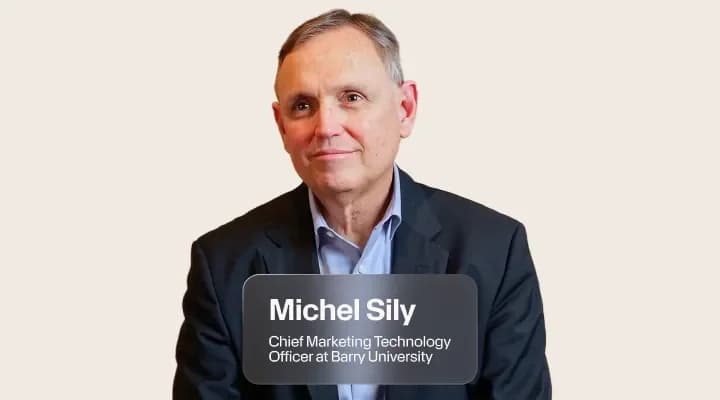
For Michel Sily, Chief Marketing Technology Officer at Barry University, that shift is reshaping how universities need to show up for prospective students. Barry is a private university in Miami, Florida, serving around 6,000 students across more than 100 undergraduate, graduate, and professional programs. Sily leads the university’s student experience, and in his view, students’ daily interactions with AI now set the expectations they bring to their enrollment journey, and the university needs to meet them there.
Choosing a college is rarely a solo decision. Students and families typically research together, and in recent years both arrive with habits formed by conversational AI tools. They are used to asking a question in plain language, getting a direct and relevant answer, and often acting on it right away.
That changes who universities are really competing with. “They’re not comparing us with other schools. They’re comparing us to what they’re used to, and how they get their answers,” says Sily.
The bar, in other words, isn’t set by peer institutions’ websites. It’s set by the experiences students have everywhere else. If a family can get a fast, accurate answer about their travel plans, delivery statuses, banking information, and more, they expect the same when they ask about admissions, programs, or financial aid. Matching that level of service is now the baseline, not the differentiator.
The challenge grows as touchpoints multiply. A prospective student might tour campus, call admissions, meet with a counselor, attend an event, send an SMS, or start a chat through Apple’s Messages app or an AI assistant. According to Sily, they expect the university to know who they are at every step and to pick up the conversation where it left off.
They expect us to understand every conversation they’ve had with us so far and to continue it. It’s not a question of which channel they prefer, or whether it’s the student or the parent. We need to understand what we’ve talked about, what they’re looking for, and provide that service.
They expect us to understand every conversation they’ve had with us so far and to continue it. It’s not a question of which channel they prefer, or whether it’s the student or the parent. We need to understand what we’ve talked about, what they’re looking for, and provide that service.
Michel Sily
Chief Marketing Technology Officer at Barry University
Timing matters just as much, because enrollment is not a nine-to-five operation. A question might surface at 11 p.m., prompted by something a student just saw online, and they want the answer instantly, along with an easy way to take the next step, whether that’s registering, scheduling an appointment, or something else entirely.
This is where agentic AI can change the entire experience for students. Rule-based chatbots could answer pre-scripted questions, and newer AI chatbots can engage users in a natural conversation while retrieving information. But an agentic agent can take it one step further and complete actions.
When a prospective student first reaches out with questions, the conversation itself can create their record and capture what they care about. As Sily describes it, the AI gathers information as the conversation unfolds, checks whether the right service was delivered, and learns from each interaction, improving the experience for that student and for those who follow.
That context then shapes everything else. If a student’s next step is to apply for housing or complete their financial aid, Barry’s website recognizes the user and adapts the page to their needs, taking them directly to the next natural task. Sily says this type of hyper-personalization is what gives each student a unique and tailored journey, as two students visiting the same site can see completely different content, each built around where they are in their journey with Barry University.
AI and education can be an uneasy pairing, and Sily doesn’t shy away from that. He acknowledges that AI can be used for good, but that risks like hallucinations are real. Barry’s response is to build guardrails into the system itself, including AI agents that monitor conversations and the behavior of other AI agents to make sure students receive accurate, appropriate information.
For Sily, the stakes are higher for a university than for most organizations. “We are a university. We have to set the example. We have to be extremely ethical,” he says.
That responsibility spans everything from security to AI ethics, and it isn’t treated as a one-time review. It is part of the everyday conversation, considered in every implementation and every change. The goal is technology that gives people a good experience without creating problems for the university, its students, or anyone else involved.
Selecting a university is a monumental decision in the life of an undergrad. It determines where they’ll live for the next four years and shapes what they’ll do with their life. Families are deeply involved and often bring very different questions to the process. Used well, Sily believes, AI can help them find the right college.
In that sense, students and universities share the same goal in determining whether there’s a genuine fit. When the match is right for both sides, everyone succeeds. When it isn’t, a student may enroll and later realize it wasn’t what they wanted, or miss the chance to engage with a program aligned to the career they’re pursuing.
That’s why Sily stresses that universities carry responsibility here too. Barry and its peers are, in effect, among the sources these AI tools draw on. Being careful, ethical, and correct about the information they provide benefits students, families, and institutions alike.
These tools can help them make the right decision, but they have to be used right. We, and other universities, are in a certain way providing that information. So, we have to be very careful how we do this, so we can give the right information. Be ethical, be correct. And if all of us do this, everybody’s going to win.
These tools can help them make the right decision, but they have to be used right. We, and other universities, are in a certain way providing that information. So, we have to be very careful how we do this, so we can give the right information. Be ethical, be correct. And if all of us do this, everybody’s going to win.
Michel Sily
Chief Marketing Technology Officer at Barry University
Barry hasn’t approached AI as a finished product to buy off the shelf. The university was already using chatbots before generative AI arrived, and it launched an AI chatbot with Infobip just a few months after ChatGPT was released. Since then, it has kept adopting new capabilities as they emerge.
According to Sily, the hardest part of this work is that much of it hasn’t been done before. Barry is often implementing and testing ideas for the first time, and sometimes asks for capabilities that are still in development or that begin as new ideas in conversation. That makes the choice of partner critical. Sily emphasizes the need for a partner that is flexible, at the cutting edge, and connected to the major technology companies shaping the field.
He points out that Infobip understands that what Barry builds today will likely serve other organizations tomorrow, and that both sides are moving in the same direction as the technology evolves. For an institution working at the frontier, that shared direction is what turns a vendor into a partner.
For university leaders just beginning to explore AI-driven enrollment strategies, Sily’s advice is direct: get started. The learning that comes from putting these tools in front of students and families outweighs almost anything else.
Once conversational channels are live, students and families can easily ask questions, and those questions often reveal where the university’s own service needs to improve. Sily notes that this feedback loop happens almost in real time. If something isn’t working for a webinar that starts in a few minutes, the team can spot it and fix it before it begins.
He is also seeing students and families rely more and more on engagement channels such as chat, WhatsApp, and RCS as they become more familiar with them. In his view, there is no shortcut to that maturity. Institutions have to start, learn what works for them, improve, and keep going.
The faster you start, the faster you’re going to learn, and the faster you’re going to provide the best service.
The faster you start, the faster you’re going to learn, and the faster you’re going to provide the best service.
Michel Sily
Chief Marketing Technology Officer at Barry University
With every advance in the technology, Sily expects Barry to be able to do more with less effort: more services, better experiences, and less friction for students and families, including on mobile, where getting the experience right is far harder than on desktop. The institutions that thrive, his perspective suggests, will be those that treat AI as an ongoing practice rather than a one-time project, pairing ambition with the ethical rigor students and families deserve.
“AI is driving the change, and it’s changing rapidly. Where we’re going to land, we don’t know yet,” says Sily. “For us, this is the beginning of a journey, not the end.”