Key Takeaways
- ARTEX, an AI-driven penetration-testing framework released in July 2026, doesn’t exploit new kinds of vulnerabilities. It automates the discovery, chaining, and retrying of existing weaknesses, often across many targets at once.
- In observed campaigns, attackers using ARTEX went from first targeting an organization to privileged access in under three hours, while the median time for customers to fix critical vulnerabilities is 7 days.
- In most AI attack tools of this kind, the limits are set by prompts or by user-adjustable settings, so organizations should identify and approve these tools and question any pentest provider that runs them.
- To keep pace, vulnerability programs need to detect exposures at disclosure, rank them by confirmed exploitability, and make automatic patching the default, with hours-long deadlines for internet-facing systems.
ARTEX, an AI-driven penetration-testing framework, didn’t change what gets exploited. It changed how long you have, and how many of your weak points get tried at once. Frameworks like ARTEX don’t need a new class of vulnerability. They automate the work of finding, chaining, and retrying existing weaknesses, often across many targets in parallel. Observed campaigns show that some intrusions reach privileged access within hours. That strengthens the case for faster remediation and mitigation, and for ensuring that a single unpatched system, exposed credential, or excessive permission doesn’t become a much larger intrusion.
ARTEX was released as an open-source penetration-testing framework in July 2026. You give it a target and a goal. It scans, picks a way in, uses what it finds there to reach the next system, and keeps going until it reaches the goal or runs out of routes. It was published in July as a research and testing tool. By October, it was turning up in incident reports.
For vulnerability and risk management teams, the implication is direct: every hour an exposure remains open gives attackers more time to find and exploit a path through your environment. When they can pursue several paths at once, the question is how quickly you can close the exposures that put critical systems within reach.
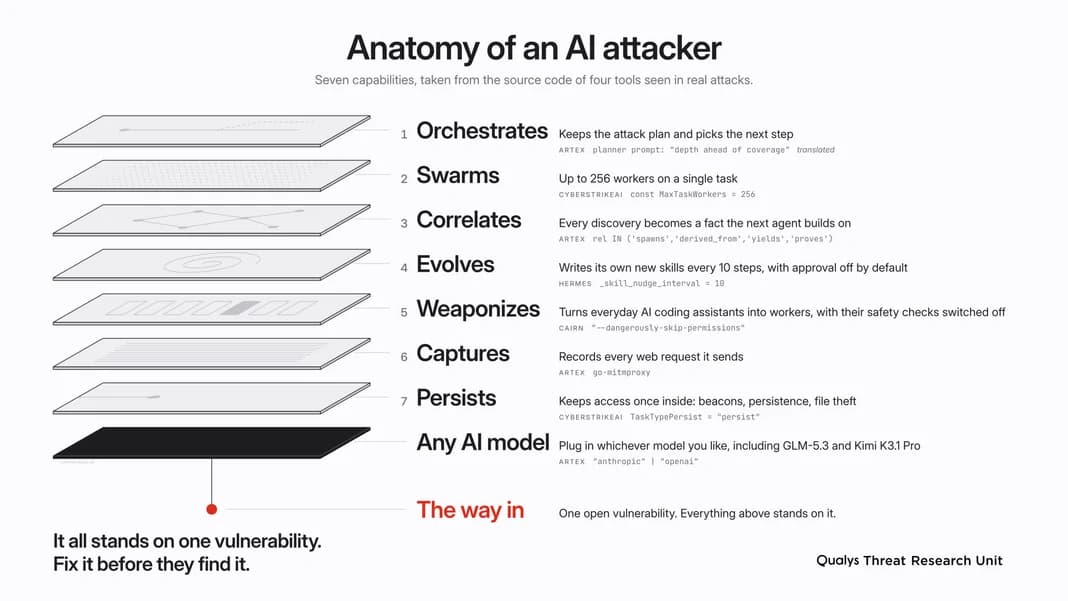
We read its source code. The simplest description is a project manager for a break-in. A planning agent takes the goal and keeps an ordered to-do list. The example in ARTEX’s own documentation is the familiar one: find an injection point, take the credentials, move sideways, raise privileges. Worker agents carry out the steps, several at a time, with the same ordinary tools a human tester would use. Each one writes down what it learned, and the planner reads those notes and decides what to try next. A person can watch and redirect it from a web console, and it runs on whichever language model you connect to it.
None of that is new to a penetration tester. Scanners have found weaknesses quickly for 20 years. The slow, skilled part of an intrusion was joining those weaknesses into a route, keeping track of what worked, and carrying a stolen credential from one machine to the next, and that is the part ARTEX does. ARTEX did not ship without an authorization-scope mechanism. It shipped with one removed, and the comment saying so is still in the source. The gates that replaced it are seeded as ordinary settings, and a user can disable or delete them.
What The Reports Say
The public evidence comes mainly from Microsoft and CrowdStrike, and it is more measured than the headlines. Microsoft watched one group use ARTEX to attempt sign-ins at more than 2,250 tenants. Most attempts failed, but in several cases the group went from targeting an organization to gaining privileged access in under three hours. CrowdStrike saw another group turn it on more than 200 organizations in 11 days and confirmed follow-on activity at nine, with a human operator steering at the decision points. The agents ran on a cheap, open-weight model, not a premium one. In a separate case, Microsoft timed an agent at 5 minutes from searching GitHub for leaked secrets to pulling data from a cloud key vault.
That is the evidence.
ARTEX Has Relatives
ARTEX has the name, but your team is as likely to meet one of its relatives. We also read the code and documentation for five of them.
The pattern repeats. In most of these tools, the limits are written in prompts, or in settings that someone can change. One platform in the table turns on exactly one rule out of the box: its tool filter blocks government domains, and nothing else. When that rule fires, the message to the agent tells it to pick an authorized non-government target instead.
In another case, it goes further. While the agent is writing its reply, a second copy of the conversation runs in the background, writing new skills for it. The approval gate for those writes is off unless you switch it on, and once written, a skill becomes part of its instructions in every session that follows. The tool you approve and the tool that runs next month are not guaranteed to be the same tool.
Two Additions to The Asset Inventory
The first is everything you forgot. These agents work many targets at once and have no reason to skip the dull ones, so the unowned server gets the same attention as your front door. Gaps in the inventory were tolerable when an attacker had to choose where to spend a week. Now the inventory has to be complete and current, which is what Qualys CyberSecurity Asset Management (CSAM) is built for.
The second is the tools themselves. Sooner or later someone in your organization, or at one of your suppliers, will run one of these with good intentions. Each install holds the findings and credentials from every test it has run. One popular mirror’s source was clean, but its installer pulled a Docker image with a backdoor in the login page. The image had been pulled 7,946 times before researchers disclosed it. Treat them like any other software: find them, then approve or remove them.
Before your team or your pentest provider runs one
Ask five questions, and ask your provider the same ones
- When a safety check errors out or times out, does the tool stop or carry on? By default, ARTEX carries on.
- Is scope enforced by the software, or requested in a prompt?
- What counts as a finding, and what evidence comes with it?
- Can you show that the build you are running matches source code someone has reviewed?
- Is every action logged in a way you can tie back to your own test?
Seven Days Against Three Hours
Most vulnerability programs rest on an assumption that rarely gets written down, which is that attackers are short on time. It is why a critical vulnerability on an internet-facing server can be given 30 days, why a privilege escalation bug that needs local access waits behind the remote ones, and why risk exceptions get signed when exploitation looks complicated. ARTEX makes attacker time cheap, and the assumption goes with it. An attacker who can get from first contact to privileged access in under three hours is not going to wait for your change window.
Defenders are getting faster too. We are seeing customers fix critical vulnerabilities in a median of 7 days, down from 9 last year, even as volumes rise. More to fix and less time taken to fix it tells you teams are treating this as urgent, and a count alone would never show that. We also see 12% to 16% of our customers fix vulnerabilities before the Cybersecurity and Infrastructure Security Agency (CISA) adds them to its Known Exploited Vulnerabilities catalog. They are acting on their threat-risk signals rather than waiting for the government to tell them. Our Threat Research Unit’s five-year analysis covered more than 1.5 billion critical vulnerability instances, and approximately 173 million of them were remediated before the vulnerability entered that catalog.
Seven days is real progress, and it is still 168 hours against an attacker who needs three. The speed is not even across the environment, either. It shows up where the fix arrives on its own and deployment can be done automatically, and the network edge is still where it lags. The edge is also where a tool like ARTEX starts.
So the patch window measured in weeks is finished, and policy should say so. If a fix can be deployed automatically, it goes on the same day, and people approve the exceptions instead of the rule. An internet-facing system that cannot be patched within hours gets a mitigation or comes off the internet until it can. Every risk exception signed because exploitation was hard, needed prior access, or seemed unlikely gets reopened, because in risk-register terms the impact column is where it was and the likelihood column has moved.
Break The Chain at Machine Speed
In ARTEX’s source, the pause between one step landing and the next step being assigned is a constant set to 800 milliseconds. That is the cadence your change window is racing. The design that makes ARTEX fast also gives you something to aim at. It works in order, and each step depends on what the previous one produced, so removing one link stops everything behind it on that route. Its planner is instructed to put depth ahead of coverage, which means it pushes a promising route all the way through instead of testing everything lightly. To a tool built that way, two medium findings on the same route are worth more than a critical on a server that leads nowhere, and a queue sorted by severity alone will keep fixing the wrong one first.
The defense is to reach the link before the agent does. A program that scans on a schedule and patches on a calendar is working by the week against an attacker working by the hour, so three things have to happen without waiting for a person.
The first is finding the exposure, and that has gone from weeks to minutes. Qualys InstaScan detects newly disclosed vulnerabilities on customer systems a median of 14 minutes after disclosure, with 96% detection coverage across supported vendors. Where we can compare head to head, it finds the exposure about a day before a scheduled scan would, and for a quarter of them, close to a week earlier. As AI shortens the time from disclosure to exploit, every hour of early warning counts.
The second is knowing which exposures are real. Across approximately 9 million exploit validations through Qualys TruConfirm, just 11% confirmed exploitability. That turns a queue of 9 million into a queue of about 1 million, and it puts proof where a severity score used to be. Validate again after the fix, because an installed patch does not prove the route is closed.
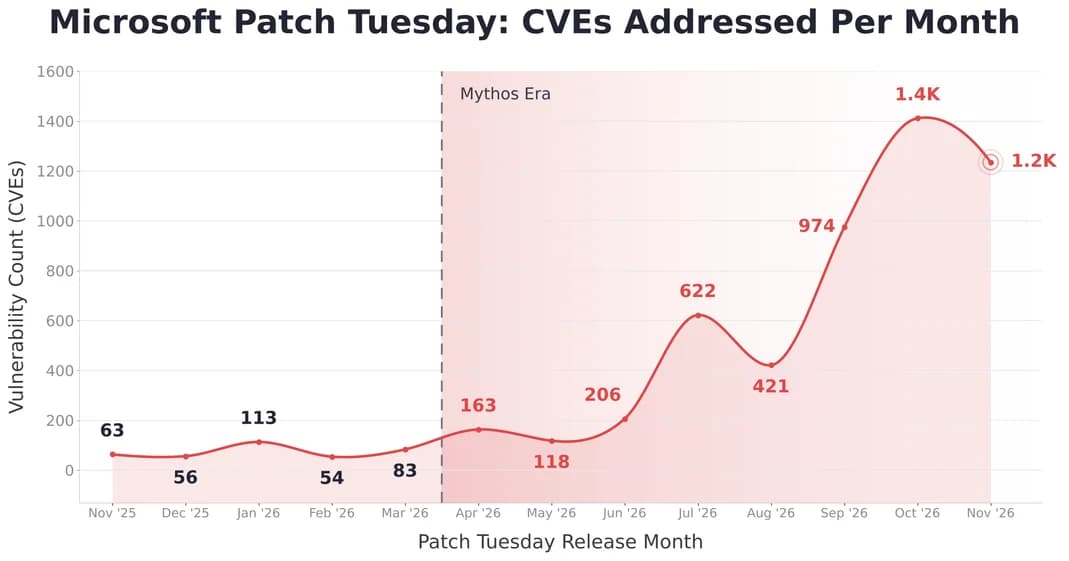
The third is fixing them without a person in the loop. Over the last 12 months, our customers deployed more than 180 million patches with Qualys Patch Management. Since frontier AI models like Mythos arrived in mid-2026, our customers have been patching 47% more each month, and the share of patches running fully automated has doubled, from about 30% last September to about 60% this September. The usual objection to automatic patching is that it breaks things. Fewer than 1 in 8,000 patches deployed through Qualys needed a rollback, and that reliability is what lets customers move at machine speed. It also frees people for the network edge, where the fix still needs hands.
Not every link is a missing patch. The second step in ARTEX’s own example is credentials, and a reused admin password, an over-privileged service account, or an access key left in a public code repository will carry an attacker further than most Common Vulnerabilities and Exposures (CVEs). Put those in the program too, with owners and deadlines.
What We Would Do
This Week:
- List every internet-facing system with an open critical vulnerability or a known, exploited vulnerability, then fix it, apply mitigations, or take it offline.
- Search your environment for these tools, including the tomicdd/artex and congdonglinux/artex container images.
- Rotate any secret that was ever committed to a public repository. Deleting it from the repository is not enough.
This Quarter:
- Move from scheduled scans to detection at disclosure wherever it is supported.
- Make automatic patching the default, and set the deadline for internet-facing systems in hours.
- Rank what is left by confirmed exploitability.
- Reopen the risk acceptances that were justified by attacker effort.
- Put credentials and exposed secrets into the vulnerability program, with owners and deadlines.
- Set a policy on who may run AI pentest tools, including suppliers.
If you report one number upward, make it how long weaknesses on internet-facing systems stay open, because that is the number these tools are racing against.
Attackers now measure time in hours. See how Qualys Enterprise TruRisk Management (ETM) helps you find, prioritize, and close exposures at machine speed.