- Amazon Leo
Leo Vulcan 1 (LV-01) will carry the largest batch of Leo satellites to orbit yet and kick off a 38-launch partnership with ULA.
Written by Amazon Staff
Key takeaways
- Amazon Leo’s first Vulcan mission will carry 40 satellites to orbit.
- Vulcan will launch 1,500+ first generation Leo satellites across 38 missions—more than any other rocket in the program.
- Amazon’s investment in Cape Canaveral infrastructure will allow LV-02 to launch within weeks of LV-01.
Amazon completed its 1,000th satellite in early September, a milestone that makes Leo one of the largest, most advanced satellite production operations in the world. The program now has hundreds of flight-ready satellites ready for launch, and its next mission, Leo Vulcan 1 (LV-01), is targeting liftoff on November 13, 2026, from SLC-41 at Cape Canaveral Space Force Station.
LV-01 is Amazon Leo’s first launch aboard ULA’s Vulcan rocket, and it will carry 40 satellites to low Earth orbit, the largest Leo payload delivered to date. It is the first of 38 launches Amazon has on contract with ULA, one of several providers in a launch portfolio that also includes Arianespace, Blue Origin, and SpaceX. Leo launches with multiple providers by design, which gives the program the diversity and scale to keep deploying as vehicles come online.
Vulcan rockets will deliver peak performance and efficiency for Amazon Leo
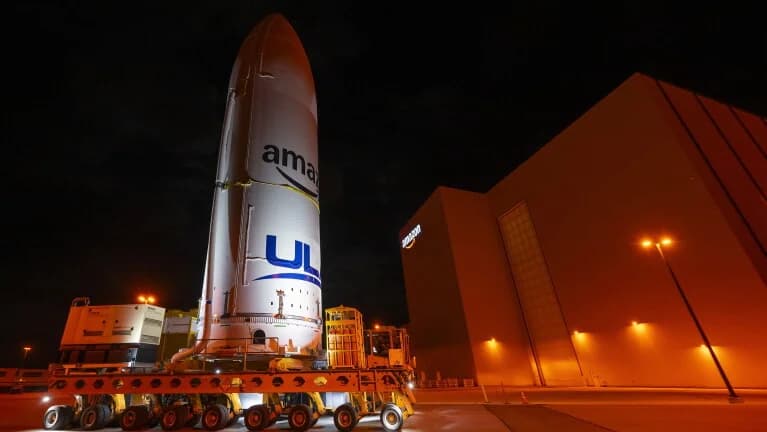
40 encapsulated Leo satellites are stacked atop the Vulcan rocket inside Amazon’s dedicated vertical integration facility (VIF-A).
Vulcan has flown several missions to date for other ULA customers, and this inaugural launch for Amazon Leo includes several upgrades: It will be the first mission to fly a shorter, optimized version of ULA’s Centaur V upper stage, enabling Vulcan to carry more satellites to low Earth orbit. It’s also the first mission to fly in Vulcan’s powerful six-booster configuration, providing maximum performance for Leo missions.
The first several Leo-Vulcan missions will each debut new flight hardware as the vehicle matures. As each upgrade adds performance, our mission team adjusts the satellite count to reflect capabilities of each individual rocket. Initial missions will carry 40 satellites, and we’re already planning larger configurations for subsequent missions.
“Larger rockets and more frequent launches are critical to scaling our constellation and getting service to customers, and the Vulcan program is designed to deliver on both dimensions,” said Melissa Wuerl, director of launch systems for Amazon Leo. “Vulcan will launch close to half our first-generation constellation, making it our primary workhorse over the next several years, and we’re looking forward to kicking off the sprint with our partners at ULA.”
Amazon’s investments at Cape Canaveral: Vertical Integration Facility and mobile launch platform
Vulcan begins launch preparations at Amazon’s dedicated vertical integration facility (VIF-A) in Cape Canaveral, Florida.
In addition to the vehicle itself, LV-01 is also the first ULA mission to leverage new Amazon-funded infrastructure at Cape Canaveral, including a dedicated Vertical Integration Facility, VIF-A, and a new mobile launch platform for Leo missions. These new assets allow ULA to prepare two Vulcan missions simultaneously and reduce turnaround time between launches to days or weeks. LV-02 is already being prepared in VIF-G while LV-01 heads to the pad, and is expected to launch within weeks of a nominal LV-01 mission.
Those investments reach beyond Amazon’s own missions. Amazon’s joint investments with ULA are funding infrastructure and service upgrades at Cape Canaveral that also benefit other commercial and government customers who launch from the range, part of a broader commitment that supports thousands of jobs and suppliers across the U.S.
What’s next for Amazon Leo: the broader launch strategy
Vulcan is Amazon’s second heavy-lift launch vehicle to come online, after Ariane 6, and the program is preparing its next flights on both rockets. The next Arianespace mission, Leo Europe 4 (LE-04), is targeting no earlier than November 23 from Europe’s Spaceport in Kourou, French Guiana. Each launch adds coverage and capacity to the network, and with a manifest of more than 100 missions ahead, we expect to quickly expand service to more customers following an initial service rollout later this year.
To learn more about Amazon Leo, visit leo.amazon.com.
More Amazon News
1 / 1