Most modern organizations run their business across two estates. The operational estate handles a business's day-to-day needs: databases, microservices, real-time applications, and event streams like Kafka. The analytical estate runs complex, large-scale aggregations across historical data, typically stored in a data warehouse or lakehouse.
The Streamhouse sits between the operational and analytical estates, addressing the inefficiencies inherent in each. In this post, we will compare the Streamhouse to the lakehouse: what each one does, where they differ and how they complement each other. We will refer to a real Streamhouse use case to ground the conversation in concrete terms. By the end, you will know when to reach for the Streamhouse, the lakehouse, or both.
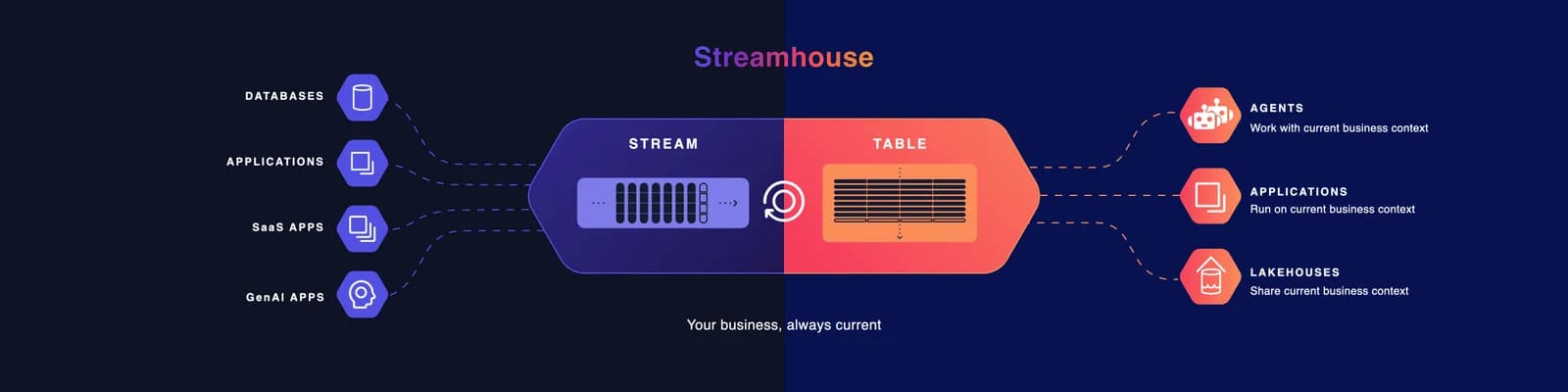
A Streamhouse continually captures, processes, and serves the current state of a business.
What Defines a Streamhouse?
A Streamhouse is an architecture that continually captures, processes, and serves the current state of a business. This ensures that applications, AI agents, and analytics work from the most up-to-date governed data as opposed to each system holding its own stale copy.
Three properties define a Streamhouse:
- Always Current: Data is available to query as soon as the event that produced it is captured. Validation and enrichment happen on the way in, so by the time an application or agent reads a record, that work is already done.
Always Current: Data is available to query as soon as the event that produced it is captured. Validation and enrichment happen on the way in, so by the time an application or agent reads a record, that work is already done.
- Mission Critical: Applications and agents read from the Streamhouse to do their jobs, so it has to meet the same uptime targets as the production systems around it. An outage in a Streamhouse stops orders from being processed. An outage in a lakehouse usually means a late report.
Mission Critical: Applications and agents read from the Streamhouse to do their jobs, so it has to meet the same uptime targets as the production systems around it. An outage in a Streamhouse stops orders from being processed. An outage in a lakehouse usually means a late report.
- Decentralized: Each change is captured once and delivered to every system that needs it, in the format that system expects. A microservice might read a Kafka topic while an analytics team reads an Iceberg table, and both see the same data. No one builds a separate pipeline for each consumer.
Decentralized: Each change is captured once and delivered to every system that needs it, in the format that system expects. A microservice might read a Kafka topic while an analytics team reads an Iceberg table, and both see the same data. No one builds a separate pipeline for each consumer.
What Defines a Lakehouse?
A lakehouse is an architecture that stores data as files in object storage like Amazon S3 and adds a metadata layer on top to make the files into queryable tables like a database. Within the lakehouse, you can run large, historical queries against the storage instead of loading the data into a separate warehouse first.
Three properties define a lakehouse:
- Open table format: Files are stored in a columnar data format like Parquet in object storage. Open table formats like Iceberg or Delta Lake sit on top to track the schema and versioning.
Open table format: Files are stored in a columnar data format like Parquet in object storage. Open table formats like Iceberg or Delta Lake sit on top to track the schema and versioning.
- ACID transactions: The metadata layer gives ACID transactions and schema enforcement. Concurrent writes and schema changes do not corrupt the data files or impact consumers.
ACID transactions: The metadata layer gives ACID transactions and schema enforcement. Concurrent writes and schema changes do not corrupt the data files or impact consumers.
- Batch processing: Data follows the medallion architecture of bronze, silver, and gold layers, moving from raw to cleansed and business-ready data. These batch processes run across large amounts of data on an interval, anywhere from every minute to once a month, instead of reacting in real time.
Batch processing: Data follows the medallion architecture of bronze, silver, and gold layers, moving from raw to cleansed and business-ready data. These batch processes run across large amounts of data on an interval, anywhere from every minute to once a month, instead of reacting in real time.
Where They Differ
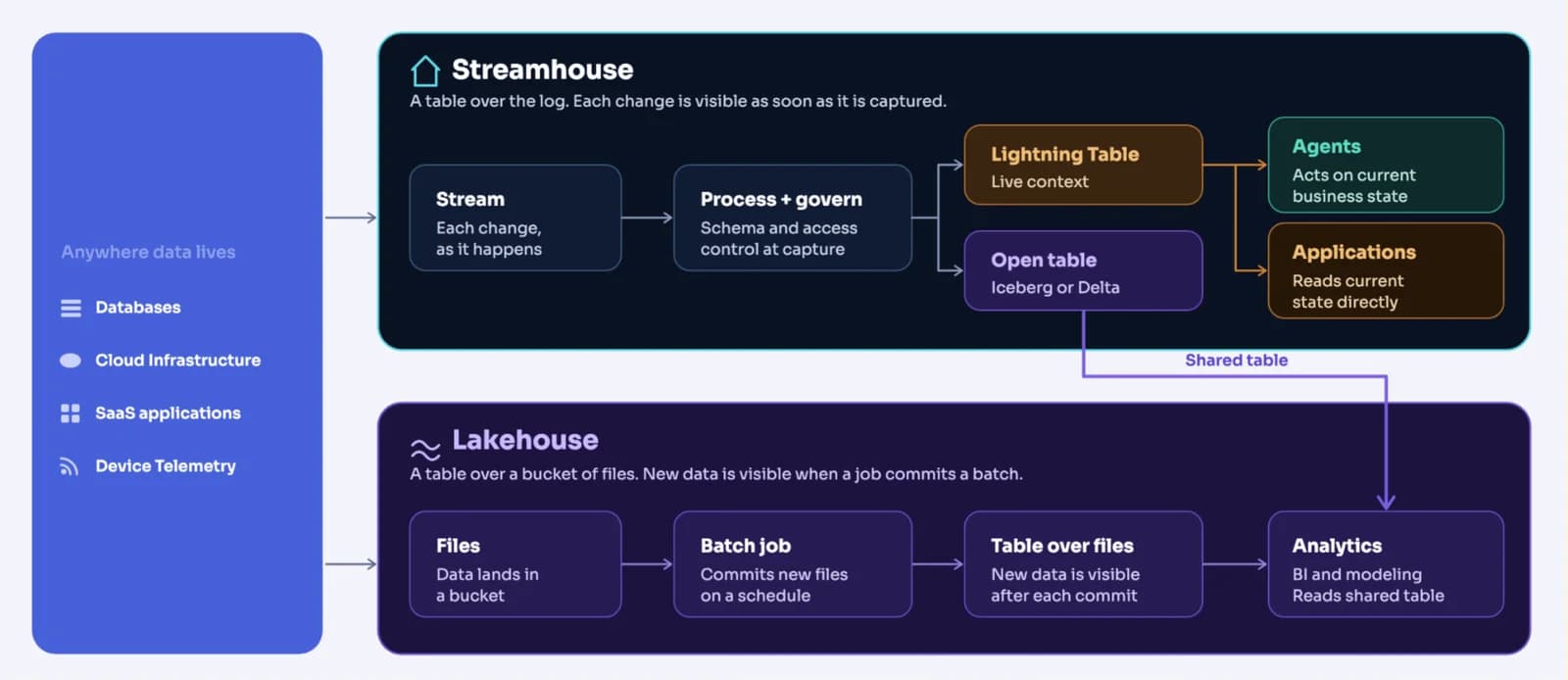
A Streamhouse builds a table over the log. Each change is captured, processed and governed as it happens. A lakehouse builds a table over a bucket of files.
The most obvious differences between the Streamhouse and the lakehouse have to do with latency and data processing. The Streamhouse records each change as it happens and pushes it to the systems that need it, while the lakehouse pulls updates on a fixed schedule of batch jobs. Micro-batching can shorten that schedule, but the lakehouse is still pulling changes after the fact, and it processes larger amounts of data at once.
A more nuanced difference is how the Streamhouse works compared to the lakehouse. The lakehouse is a destination. Data funnels in from all different locations and lands in the lakehouse. The Streamhouse does not store data long-term. It instead propagates changes to every system that needs it, in the format that it expects.
Failure modes of the different architectures also carry different weights. When the lakehouse fails, dashboards don’t get updated, reports are not generated, and AI models grow stale. The Streamhouse, conversely, must meet production reliability targets, because applications and AI agents run mission critical use cases that businesses rely on.
How They Complement Each Other
A Streamhouse uses a table over the log, with each change visible as soon as it's captured. A lakehouse uses a table over a bucket of files, with new data visible when a job commits a batch.
The Streamhouse serves production applications and the agents that run the business. The lakehouse serves internal analysis and modeling.
Both architectures rely on open table formats, which makes them composable. The Streamhouse cleans and governs data as it arrives, then materializes it as tables for agents and applications (Lightning Tables) and as open Iceberg or Delta tables to share with the lakehouse. The lakehouse reads that shared table instead of building its own ingestion job.
Both architectures require governance. The Streamhouse enforces schema and access control at the source. The lakehouse enforces its own rules later, at the table layer, through its own catalog.
While lakehouse data ingestion speeds have gotten faster, in some cases approaching real time, this is not the same as the current, trustworthy, queryable state a Streamhouse maintains. This is especially true given the medallion architecture, which takes multiple iterations of processing before business-ready data is available.
There are proper use cases for the Streamhouse, the lakehouse, or both, which we will explore in the next section.
What Problems Each Solves and Falls Short of
The lakehouse is built for large volumes of historical data. Training a model on years of historical data, or running a query that scans terabytes at once is what it was designed to do. It also gives an organization one copy of its history to run business intelligence against.
The lakehouse falls short when an answer needs to be in real time. Flagging a fraudulent transaction or serving a customer a personalized insight has to happen while the customer is still there, and a daily batch job cannot do that. Some lakehouses offer micro-batching for real-time needs, but it is extremely cost inefficient. Most teams end up running a database or cache next to the lakehouse to get fast access to the same data.
The Streamhouse solves this problem. An application or an agent that needs an answer right now can query the Streamhouse directly. The lakehouse can read that same data as Iceberg or Delta tables instead of building its own ingestion job.
The Streamhouse is not built for the other side of the job. Scanning years of history or running the kind of ad hoc analysis a lakehouse handles easily is not what a Streamhouse is built for, and it was never meant to replace a lakehouse's role in business intelligence.
Customer 360
The difference between the two architectures becomes apparent when we apply the lens to a use case we see across many industries: building a customer360 view. Organizations have data existing across different business systems across different lines of the business, but still need one overarching view of a customer to provide a complete experience for the consumer, meet regulatory requirements, and manage resources and inventory.
This might require building out an architecture that captures updates in a CRM, application activity in a clickstream, transactions on a system of record, and market data like foreign exchange rates from external sources, all sourced from different areas of the business.
The half-life of the data as it is produced in these systems varies massively depending on what type of question you are trying to ask of the data. To find the “next best customer,” we might want to look at multidimensional data across 100s of different sources and many years of activity, fine tuning along the way and being driven by a need to find a “why” amongst all our data points. This is the domain where the data lake makes the most sense. Business intelligence teams could tolerate if this data was 10 minutes old because for many questions, we are asking for days, weeks, or years of context while asking them, while balancing the importance of not interrupting business activity.
Not every question about a customer is a complex “why.” Some are simple “what” questions that need a fast answer you can trust, because the customer is waiting on it. What went wrong in the app when a customer raises a ticket? Is the card payment that just came in fraudulent, given the rest of the activity on that account? How are weather and traffic affecting this delivery? Each of these needs the event that just happened and the history behind it, and the data has to be accurate when it arrives.
This is where the customer360 experience of the Streamhouse becomes most relevant. A virtual shopping assistant might need to be able to simultaneously query against a particular customer’s shopping history—stored in open table formats—while joining on their current browsing activity as a real time feed. This way it can recognize what products they are likely to be interested in buying so a dynamic deal can be served for them. This agentic virtual shopper needs live context just the same way an assistant would pay attention on a shop floor. The Streamhouse not only serves the context, but drives enrichment in that context pipeline to save the agent having to waste tokens on extra discovery, such as adding a customer name and loyalty score in flight to the event from the decentralized sources. Enforcing governance prior to serving the context further helps our virtual shopper, meaning any data issues are insured against and can be reconciled immediately when our context serving layer doesn’t have the luxury of being able to rerun a batch job if a data field is poorly defined.
This model ends up providing a pattern where we can benefit every estate. The operational estate has customer activity captured, transported and multicast without impacting their ability to serve their platform. The agentic estate gets an enriched and governed source of business telemetry to build a holistic and continuous context layer around what is going on and how it can assist. Analytics and business intelligence benefit too, with their domain receiving data that is curated closer to the source and integrates directly into their catalog by being delivered to them in a way that is consumable for their existing table formats and query layers, without having to worry about another pipeline.
Confluent's Data Streaming Platform helps build a Streamhouse that serves customer 360 context as one governed copy.
When to Use One, the Other, or Both
Three things decide which architecture you need: speed, scope, and intent.
Streamhouse
Lakehouse
Speed
Data is available as soon as an event is captured
Batch jobs on a schedule, from every minute to once a month
Scope
The current state of the business
Years of history and queries that scan terabytes
Intent
Operational decisions for microservices, agents and applications, such as screening a payment for fraud as it arrives
Business intelligence, data science and model training, such as training a model on three years of transactions
Choose the Streamhouse when microservices, agents or applications need to react to changes as they happen. This matters most when several decentralized systems consume the same data, because each one needs the same state in its own format.
Choose the lakehouse when you need one repository for large volumes and long histories of structured and unstructured data. Typical uses are ad hoc business intelligence, training models on massive data sets and producing the gold-level insights that appear in dashboards and reports.
Every enterprise needs both. The Streamhouse handles the operational side: It captures data at the source and enforces governance early, so real-time consumers can use it immediately. The lakehouse handles historical analytics. The Streamhouse shares its data as open tables, so the lakehouse needs no ingestion pipelines of its own and analytics teams get fresh, curated data without affecting operational performance.
Build Your Streamhouse on Confluent
You can assemble a Streamhouse from open source tools or from separate cloud services. Most teams that try find that the real cost is in the joins between the pieces: separate security models, no end-to-end lineage and nobody responsible for uptime across the whole pipeline. That matters more for a Streamhouse than for a lakehouse, because applications and agents depend on it to run.
Confluent Data Streaming Platform (DSP) is the best way to build a Streamhouse. Kafka, Flink, schema governance, and Tableflow work together in one platform, so data is captured, processed, and governed once. It then reaches applications, agents, and the lakehouse in the format each one expects, including Iceberg and Delta tables. The platform carries a 99.99% uptime SLA and runs on AWS, Azure, and Google Cloud as well as in private data centers.
Next steps
To begin implementing a Streamhouse architecture with Confluent:
- Join the webinar:Streamhouse: The Data Architecture that Powers AI at Machine Speed
Join the webinar:Streamhouse: The Data Architecture that Powers AI at Machine Speed
- Explore what it looks like when an organization uses a Streamhouse: Download the solution brief
Explore what it looks like when an organization uses a Streamhouse: Download the solution brief
- Read the eBook:Your Business Keeps Changing. Can Your AI Keep Up?
Read the eBook:Your Business Keeps Changing. Can Your AI Keep Up?
- Try it yourself: Start a free Confluent Cloud trial
Try it yourself: Start a free Confluent Cloud trial
- Talk it through: Book time with a Confluent Streamhouse specialist
Talk it through: Book time with a Confluent Streamhouse specialist
The preceding outlines our general product direction and is not a commitment to deliver any material, code, or functionality. The development, release, timing, and pricing of any features or functionality described may change. Customers should make their purchase decisions based on services, features, and functions that are currently available.
Confluent and associated marks are trademarks or registered trademarks of Confluent, Inc.
Apache®, Apache Kafka®, Kafka®, Apache Flink®, Flink®, Apache IcebergTM , IcebergTM , Apache ParquetTM , and ParquetTM are either registered trademarks or trademarks of the Apache Software Foundation in the United States and/or other countries. No endorsement by the Apache Software Foundation is implied by using these marks. All other trademarks are the property of their respective owners.