We have entered into the age of intelligence. This will impact everything. It will impact knowledge work, and knowledge workers, first.
We have lived through technology shifts before: PC, internet, mobile, social, cloud. They were all massive. This shift will be bigger. It will change the role of the firm and the very role that humans play in the production process.
Intelligence, in order to be maximally useful, must be combined with tools and data. Intelligence without tools and data is a brain in a vat: useful, but very limited.
We call intelligence plus tools and data an agent. Agents can have goals, ask and answer questions, and perform actions. Agents can do work.
Agents are already quite good at many forms of knowledge work. They tend to excel in domains where context is readily available and outcomes are verifiable. Software engineering is a perfect example of a domain that meets both of these criteria, and agents are almost astonishingly proficient at software development.
Some tasks require a lot of data
Ask an agent to do a contract review and you need to give it the contract, the redline history, any email back-and-forth, and the organization’s contracting guidelines. This task has real economic value, requires a high level of accuracy and specialization, but only a modest amount of data.
Consider another task. Imagine you are a top 5 US healthcare provider and you’re seeing billings decline year-over-year in a certain segment of your customer population. You ask an agent: why is this happening and what should we do about it?
This task, data analysis and interpretation, has a completely different profile. It is verifiable (you can write evals for it), but the scope of data required to adequately address it is massive. In addition to all of the relevant structured data, things like departmental OKRs, meeting notes, current initiatives, and more may present invaluable clues to improve the answer quality.
The level of complexity required is daunting.
Time is the great constraint
There are never enough human cycles to sufficiently investigate complex questions like this. Human analysts might have 30 seconds to give their opinion in a conversation, or a few hours/days to conduct research. But the amount of work a human can do in investigating something important, even in a few days, is rather limited relative to the potential complexity. There are always avenues left unexplored, the ultimate answer given is vulnerable to the streetlight effect.
Maybe worse, most questions go unasked: there is always significant latent demand inside of organizations for access to the time of a data analyst. When shipping agents to their teams, organizations have unlocked 50x more question / answer loops.
Agents can solve both problems. They have essentially unbounded time, and they can be on call, immediately, to everyone. We just have to give them access to the data they need.
Bootstrapping agents on existing infrastructure
Agents are bootstrapped on existing infrastructure. Compute, networking, languages, APIs, and more that were already in use by humans have been picked up by agents. This is one of the reasons for the speed of the agentic explosion: agents are riding on rails that we’ve been laying for a long time.
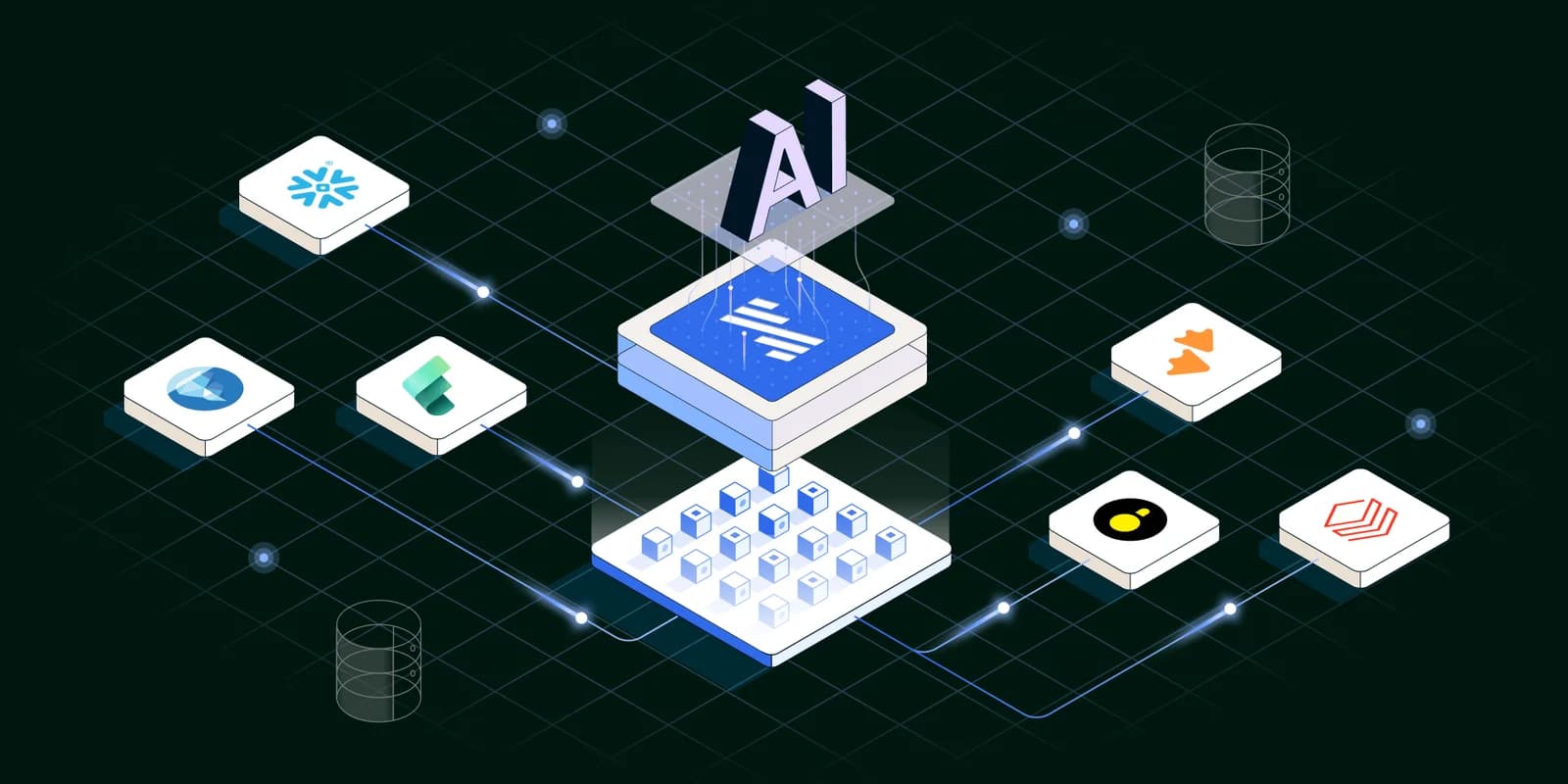
Data teams have rails to help agents get access to the data they need as well. The existing data infrastructure we’ve been building for decades is what agents will run on.
But unlocking AI’s full promise will take infrastructure that either does not exist yet or is early. Evals. Background memory formation. More. This “agent stack” will give agents a lasting, shared picture of the business, so every task starts from what the company already knows, and each new discovery adds to a continual learning loop.
Agents learn best from the business itself
Most tools build a mental model of the business by reading what humans write, in documents, chats and email threads. It’s sort of like trying to understand politics by exclusively watching cable news, but never speaking to voters. Every data point has been filtered before you get it; nothing is direct. An agent that learns an organization from what its people write is learning from the talking points.
There is a better source. Connect agents to the systems where the business actually happens, and give them the definitions, logic, and evals that say what the data means. That’s how an agent builds a trustworthy mental model of the business itself, what enables it to make decisions and take actions with confidence.
From augmentation to autonomy
Our near-term vision is that agents will supercharge knowledge workers: humans getting more done with AI. Fivetran is already powering that world today for many customers.
We also recognize that we're moving quickly beyond this model. AI-native companies are reshaping how work gets done by creating autonomous agents that take ownership of business processes end-to-end. This is the future.
Take customer support. Originally, the goal was “reduce the number of human support agents I need” and the process was completely unchanged—just augmented by AI. The autonomous version has become: help resolve the ticket, but also monitor the customer’s account to make sure they continue to be in a good state afterwards, reach out if not, and make sure to file any tickets directly with the software engineering agent so that they can be fixed for other customers. This not only creates excellent customer outcomes, it improves the system as a whole.
Agent engineers
The DNA of the people building these autonomous agents is the same DNA as the people who have joined data teams over the past decade: curious, outcome-focused, fast learners, technical enough. You have a lot of these folks on your data team, but also in other areas of the business: ops, finance, and more.
These are the agent engineers of the future.
An agent engineer is responsible for four discrete things:
- Process engineering: Understand an existing business process, identify opportunities to automate it, and redesign it around agents.
- Systems engineering: Give agents access to the tools, data, context, and instructions required to perform the work.
- Evaluation and operations: Define success, monitor agent behavior, diagnose failures, and continuously improve outcomes.
- Change management: Build trust, secure organizational buy-in, redesign human responsibilities, and manage the transition from human-executed to agent-executed work.
Companies that create space for agent engineers to run are those that will see the biggest impact from AI.
It won’t work unless it’s open
Over time, your autonomous agents become how your business runs. And tying your business to a single technology vendor makes you strategically vulnerable. A firm that owns its data and governance, and can seamlessly swap its models and compute, owns its own future.
This is why open source, open standards, and cross-platform portability matter more than ever.
It is also why we are completely committed to building the entire Fivetran platform around Open Data Infrastructure principles.
Stay Human
Analytics agents are here. Autonomous agents are coming. We are building the infrastructure they need.
We have, throughout our decade plus history, always invested in and advocated for the humans doing the work, and we will continue to. One of Fivetran’s four core values is “Stay Human.” To quote from its text:
“To be human is to be heir to hundreds of millions of years of evolutionary learning—an inheritance of almost unimaginable proportion.”
Even as AI and agents get more capable, the traits that make us uniquely human—empathy, goal-setting, innovation, and many more—become even more valuable. We intend to continue to invest in the incredible human practitioners who will build our agentic future, and we encourage you to embrace that future with open arms, in partnership with us and each other.
There is always more to build.