Speed alone doesn’t win championships.
At the highest level of competition, every movement and ability starts with an input. Players spend thousands of hours refining their mechanics building muscle memory, so when the pressure is on, their keyboard needs to respond exactly as expected.
When we set out to develop the Razer Huntsman line, our goal was simple: build the best keyboard possible for competitive play. But achieving that standard required more than reducing latency or increasing responsiveness. Competitive players needed a keyboard that could deliver precise, predictable inputs under the demands of high-level play.
Why the Sensing Method Matters
The result was a switch technology built around two principles: analog control and optical sensing.
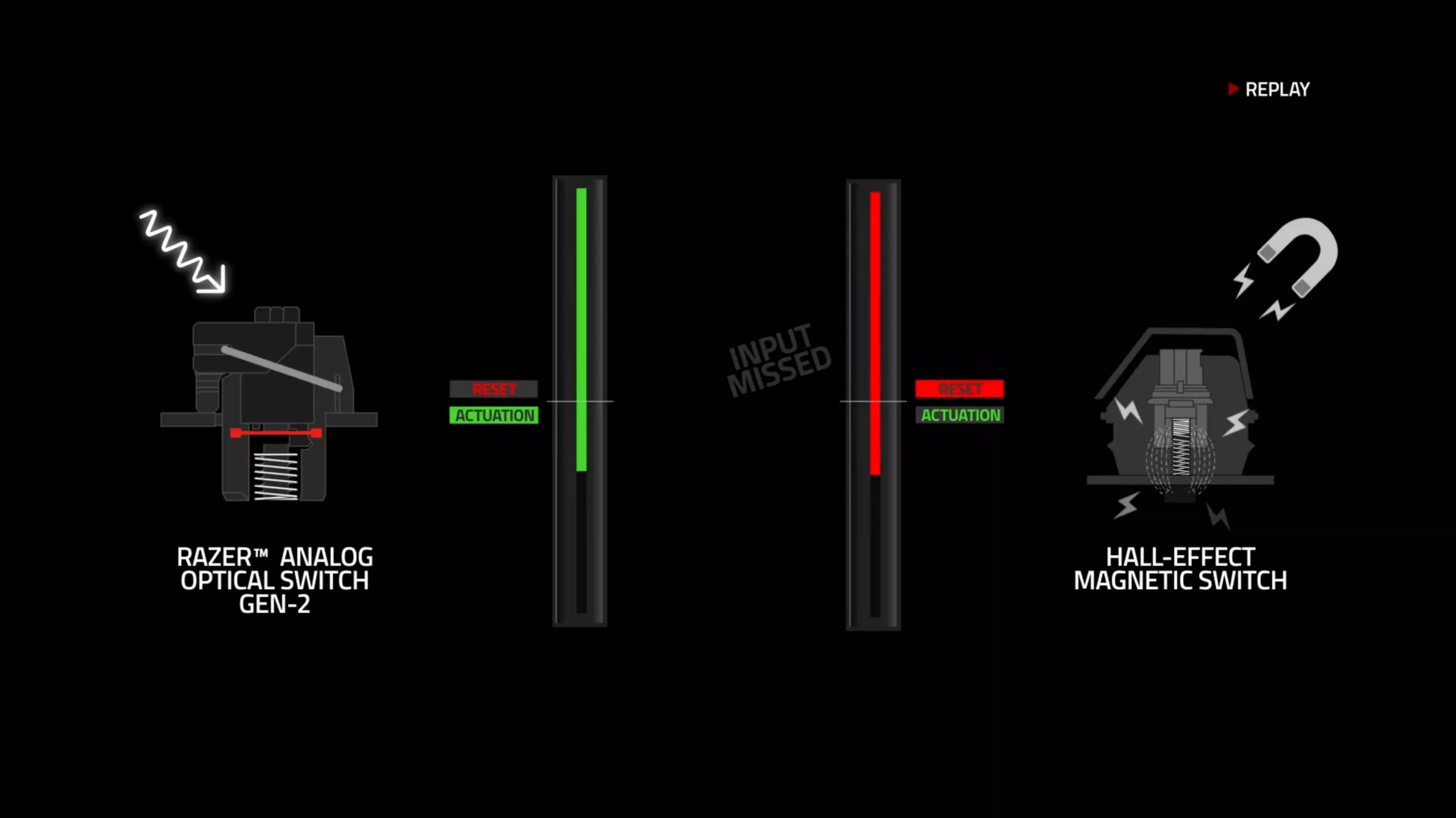
At its core, the Razer Analog Optical switch continuously tracks key travel throughout the entire keystroke. This analog input enables advanced competitive features such as adjustable actuation and Rapid Trigger, giving players greater control over how and when every key responds.
Just as importantly, the movement is measured using light. Unlikely technologies that rely on magnetic measurements, Razer Analog Optical Switches use optical sensing to track key movement with exceptional precision. This light-based sensing forms the foundation of the Huntsman line’s responsiveness while providing the consistency competitive players demand.
Hall Effect switches on the other hand, determine key position through changes in a magnetic field. As with any system that relies on magnetic measurements, external environmental variables may have the potential to influence those readings.
Recent reports in professional esports have also brought renewed attention to something that can be easy to overlook: the environment around a peripheral can affect how it performs. Materials in the desk, nearby equipment, and other parts of a tournament setup can introduce variables that players may not encounter in their usual practice environment.
Tournament setups can vary from venue to venue, from the desks players compete on to the equipment surrounding them. For players who have spent thousands of hours building muscle memory, those variables reinforce why competitive hardware needs to behave predictably wherever they play.
By measuring actuation optically, Razer Analog Optical Switches do not rely on magnetic-field measurements around the keyboard. This gives the switch a light-based method of tracking key movement while supporting the analog functionality competitive players increasingly expect.
Built for Changing Competitive Environments
Competitive environments are rarely identical.
Players move between home setups, practice rooms, boot camps, tournament stages, and different desk configurations throughout a season. Many of those conditions sit outside their control, but the way their keyboard interprets an input still needs to remain predictable.
Razer Analog Optical Switches detect key movement through an optical signal for exceptional precision. Adjustable actuation lets players choose how far a key needs to travel before an input registers, while Rapid Trigger allows a key to reset dynamically based on movement rather than waiting for a fixed reset point.
Together, these features give players more control over how each key responds to their movement and playstyle.
The goal is to give players a keyboard that behaves the way they expect when they need it most, without asking them to think about what is happening underneath every key.
More Than Raw Speed
Low latency remains an important part of competitive keyboard performance, but it is only one part of the experience.
A keyboard used for esports also has to support long practice sessions, travel, tournament setups, and high-pressure matches. When a player has repeated the same movement thousands of times, predictable input behavior matters just as much as how quickly that input reaches the game.
That principle continues to shape the Razer Huntsman line today.
Razer Analog Optical Switches combine light-based sensing with adjustable actuation, Rapid Trigger, and the responsiveness required for modern competitive play. Each of those features gives players greater control over how their keyboard responds while keeping the underlying sensing method consistent.
When every input matters, the technology behind it should give players one less thing to think about.