Home
Blog
AI Agents & Orchestration
AI Governance & Security
Brad Griffith
Nov 5, 2026
The steps in an agentic workflow that should be deterministic are the ones that write to a system of record, move money, change access, or must behave identically every time. The steps that can stay agentic are the ones that interpret language, choose among options, and summarize. The rule of thumb is simple: the agent decides, and a governed skill executes. Workato Enterprise Skills implement the executing side with deterministic output and errors handled inside the skill.
We’ve seen firsthand the real cost of getting this wrong. One example of many: A Fortune 100 customer running 39 MCP servers in production reported cutting LLM token consumption 93% by moving execution from model improvisation to the Workato platform.
What does “deterministic” mean in an agentic workflow?
A deterministic step produces the same output for the same input every time, with no model reasoning in the execution path. A recipe that posts an invoice to NetSuite with a fixed sequence of calls is deterministic. A model that decides at run time which API calls to make to post that invoice is not.
Determinism matters because models vary. The same prompt can produce different tool sequences on different days. For a read-only lookup that variance is tolerable. For a payment it is not.
Why not let the agent do everything?
An agent doing everything is expensive, slow, and hard to audit. When an agent assembles a business process from raw APIs, it spends model tokens on orchestration logic and rebuilds that logic for every use case. Workato’s Control and Execution Plane argument is that this work belongs in the platform, not in the model.
The cost shows up in tool calls. In a Workato-run test on one Jira scenario, the same model needed 3 tool calls, 164,000 tokens, and a 142 KB payload through Atlassian’s hosted MCP server, and 1 call, 31,000 tokens, and 6 KB through a Workato server.
What is the four-question test for each step?
Ask four questions of each step, and any “yes” points to deterministic. Does this step write to a system of record? Would a different result on the next run cause harm or a compliance question? Does it need to run the same way for every team? Will an auditor ask exactly what happened?
A step that fails all four can stay agentic. Summarizing a ticket thread, classifying a request, or drafting a reply passes the test as agentic work.
Which steps usually stay agentic?
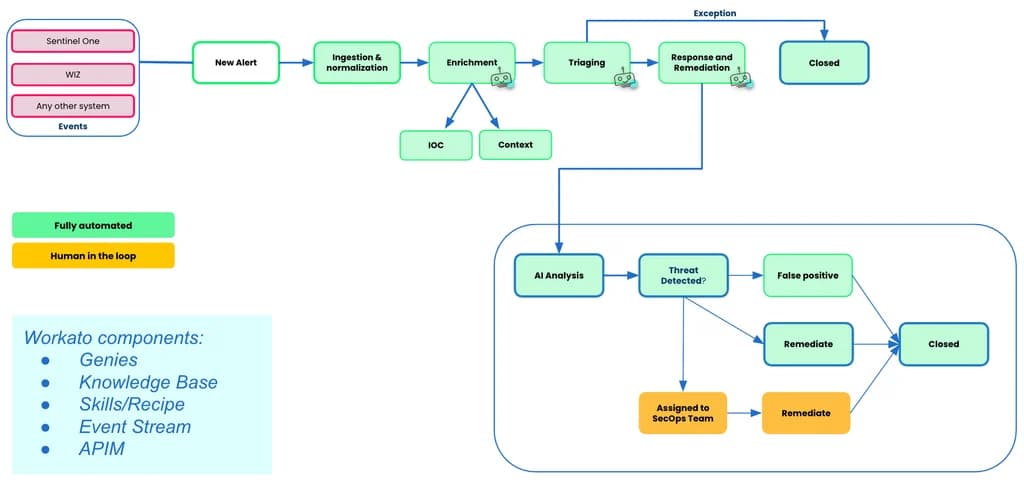
Interpretation, routing, drafting, and summarization usually stay agentic. These steps turn unstructured language into a decision, which is what models do well. In Workato, a Genie reads the request, decides which skill applies, and drafts the response, and then the skill performs the action.
Watch the boundary. A drafting step that sends the email itself has moved from agentic into execution, and the send needs the same controls as any other write.
Which steps should be deterministic?
Writes, approvals, payments, access changes, and anything with a compliance record should be deterministic. Creating a quote, onboarding an employee, resetting a password, and processing a refund all qualify.
Workato Enterprise Skills package each of these as one governed action with deterministic output. Errors are handled inside the skill, so the agent receives a clean response, and each invocation carries a job history of who asked and what was retrieved. A skill can include a require-confirmation setting and a human approval step. Skills also have their own version control and a development, test, and production lifecycle.
Where do approvals belong?
Approvals belong immediately before the consequential write. The agent proposes, a person confirms, and the deterministic step executes. Workato shows this pattern with a skill that sends an invoice over $10,000 to Slack for approval and resumes the Genie after the answer.
Workato recommends a staged rollout: review every item at first, then relax review according to false-positive and false-negative rates. That turns the approval from a permanent bottleneck into a dial.
How do you handle failure at a deterministic step?
You handle failure inside the step, not in the prompt. Workato’s recipe monitor block can retry or escalate, and error handling can match errors such as 401, 429, and 504 to a retry or an incident. Job history shows each step.
What does the split look like in practice?
The split looks like a short agentic front and a deterministic back. In an employee onboarding workflow, the Genie interprets the request and gathers missing details. A skill creates the accounts, assigns the groups, and files the HR record, and another approval step handles exceptions.
The agent carries the judgment. The skill carries the guarantee. Workato’s Verified User Access runs each skill under the end user’s own connection, so the log shows the real person.
Summary: Which Steps Should Be Deterministic?
The gist is this: Make writes deterministic and leave interpretation agentic. Apply the four-question test to every step, and package each deterministic step as an Enterprise Skill with its own versions and job history. Put human approval immediately before consequential writes, handle errors inside the skill and not in the prompt, and measure the token cost of letting the agent assemble the process itself.
FAQ
Why do agentic workflows need deterministic steps?
Models vary run to run. Deterministic steps guarantee the same behavior for writes, payments, and access changes.
What is the difference between an agent and a skill?
An agent decides what to do. A skill is a governed, repeatable business action the agent invokes.
Can an agent call APIs directly?
It can, but it then assembles the process from raw calls, which costs more tokens and creates one-off logic per team.
Where does human approval fit?
Just before the consequential step. The agent proposes, a person approves, and the skill executes.
How do I test a skill?
Use the development, test, and production lifecycle and review job history after each run.
About the Author
More on AI Agents & Orchestration, AI Governance & Security
Discover the latest product updates and features
What Is an AI Gateway?
Nov 5, 2026
Why Do AI Bills Rise When Token Prices Fall?
Nov 5, 2026
What Is an AI Governance Platform?
Nov 5, 2026
Table of Contents