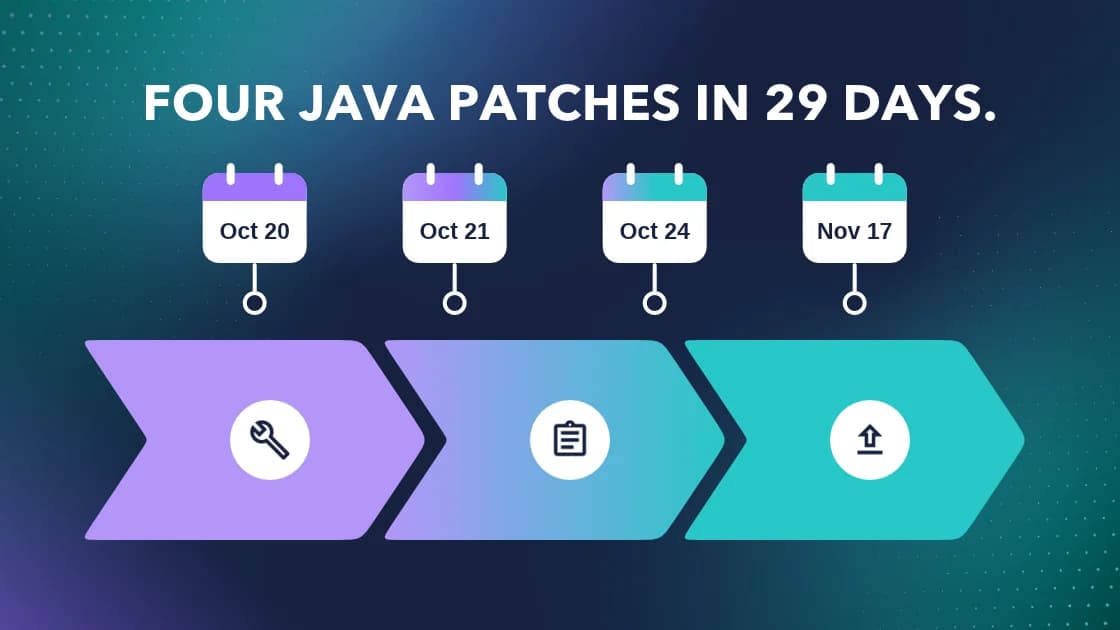
Between October 20 and November 17, Java teams absorbed four runtime updates, and two of them weren’t on anyone’s calendar. The latest, Java4Shell (CVE-2026-114938), arrived on November 17. For what it is, who is affected, and which builds fix it, see my colleague Pavel Petroshenko’s Java4Shell post.
Last month, after the eMudhra Intermediate CA Certificates Compromise, I wrote about patching Java at incident speed. This is the follow-up: what the past month says about the year ahead, how teams are changing their pipelines in response, and what to change in your own approach, starting now.
The emergency is now the cadence
If your path from “vendor ships a JDK” to “every JVM in production runs it” takes weeks, four updates in a month means the queue grows faster than you keep up.
Nor is this a one-off month. Java has had a security update every month since July. According to Azul’s CVE History Tool, the 118 Java CVEs fixed so far in 2026 are more than in any full year since at least 2014, and more than 2024 and 2025 combined. AI is part of the reason: Calif reports that researcher Quang Luong found Java4Shell with an AI coding assistant in about an hour. As the Cloud Security Alliance (CSA) puts it in a November white paper, discovery is no longer the scarce resource; the bottleneck has moved to the stages that still run at human speed: triage, testing, and deployment.
Many teams already feel it. In our 2026 AI Vulnerability Gap Report, 85% of security leaders at Java-heavy organizations said they had had an incident, a suspected incident, or a near miss tied to slow patching, and only 19% keep at least 90% of their production Java runtimes on the latest security patch. The answer isn’t more heroics. It’s making runtime patching a routine, automated path.
Sources: Azul CVE History Tool (as of Nov. 17, 2026); Azul 2026 AI Vulnerability Gap Report (survey of 300 U.S. security leaders)
A published fix now starts the clock
The day before Java4Shell went public, Google’s Threat Intelligence Group reported attackers using a framework it calls exploit_agent to compare application code before and after a security patch, then write and run exploits without a human in the loop.
Google’s reasoning is worth noting for anyone who patches Java. A freshly patched flaw is a well-defined target: two versions of the code, release notes, and any published proof of concept. That makes flaws that are fixed but not yet deployed (“n-day” vulnerabilities) easier to weaponize than true zero-days.
Many of our customers treated Java4Shell as urgent, contacting support for the fix almost as soon as the news broke, and they were right to. We treated it with the same urgency. Exploiting it takes work specific to each application, and as of November 18, no exploitation in the wild had been reported. Waiting for that to change would have been the wrong call. You can no longer count on a comfortable window between a fix shipping and attackers building an exploit from it. The published fix is when the clock starts.
Speed has a cost, though. A full JDK update carries the security fixes alongside many unrelated changes, and pushing that into production under emergency pressure, several times a month, is a recipe for instability. Too many teams end up choosing between staying secure and staying stable. The goal is to stop having to choose: make each runtime update small, tested, and routine enough to ship fast without surprises.
How teams are adapting CI/CD and DevSecOps
The teams that handled the last month well didn’t work harder. They changed how a runtime update moves through their system. Across the customers I speak with, and the guidance published this year, the same shifts keep coming up:
The first two rows are about how you prioritize and measure. CISA’s Binding Operational Directive (BOD) 26-04 moved US federal agencies from severity-and-calendar patching to a risk model, with the highest-risk vulnerabilities fixed within three days, and the CSA recommends a similar fast lane for everyone else, with a 72-hour target for internet-facing systems. The CSA’s November white paper calls the second idea patch consumption capacity: if new applicable vulnerabilities outpace closed ones month after month, your backlog is growing, however good your median looks.
The other four rows are engineering work, and the recommendations below cover them.
Changing how you patch
These recommendations don’t depend on any particular CVE. The aim is a patch process that treats the next runtime update, whatever it fixes, as routine.
- Know every JVM you run. Keep a live inventory of the version, vendor, and build of every running JVM, including inside containers, vendor appliances, and commercial products that bundle their own JDK. Ask those vendors how quickly they ship runtime fixes.
- Standardize on one golden JDK base image per Java version. Pin it by digest and have every service inherit from it, so a runtime change is a single pull request, not hundreds.
- Rebuild on release, automatically. When your JDK vendor ships a security update, the base image rebuilds, downstream images rebuild, scans run, and pull requests open without anyone filing a ticket.
- Keep a runtime regression suite that can certify a JDK in a day. Startup, smoke tests, TLS and crypto paths, and a performance baseline.
- Roll out progressively, with automatic rollback. Canary a runtime the same way you’d canary code, with health checks that decide whether it goes wider.
- Have a mitigation path ready. When a fix can’t go out immediately, keep a tested way to push a JVM option or configuration change across the fleet in minutes, with an owner and a deadline for every system still waiting.
- Define “done” as verified in the running JVM. A patched package on disk does nothing until the process restarts. Close the ticket when the live version is confirmed.
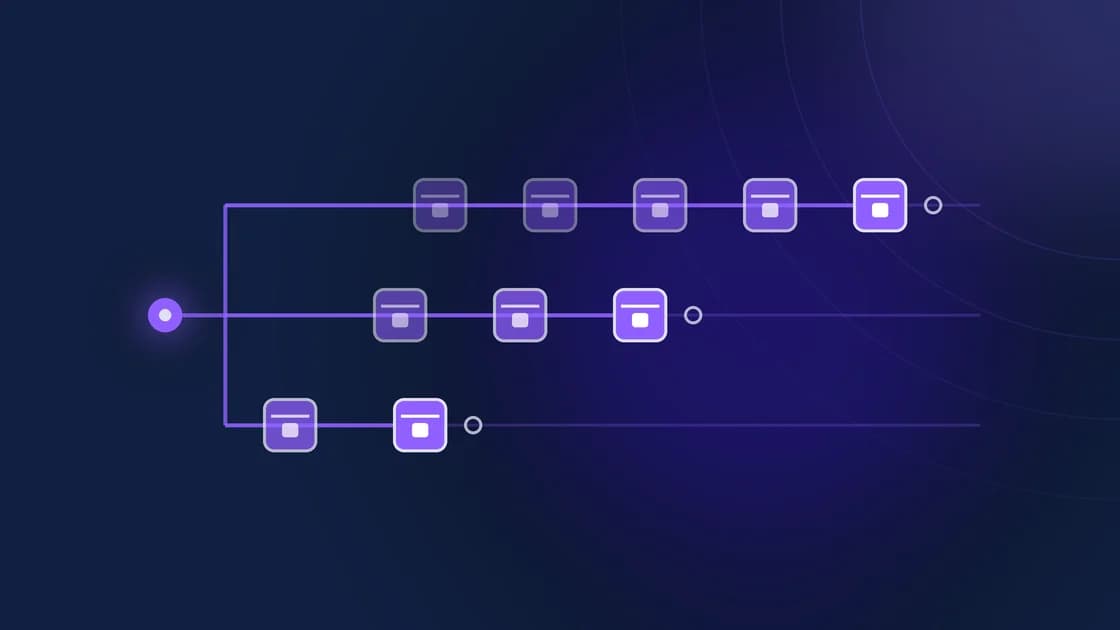
Put together, the steps form a loop: every runtime fix flows through the same automated path, and each release leaves the pipeline ready for the next.
Where Azul fits
Most of this is yours to build. Two pieces depend on your runtime vendor: how quickly a fix exists, and whether you can deploy it as soon as it does. A third piece is you can’t patch what you can’t see – so you need an inventory of JVMs and their patch levels; most JDK vendors leave this to you.
How quickly a fix exists. On November 17, our Critical Security Patch Update for Azul Core and Azul Prime shipped within an hour of the coordinated release. In October we shipped the eMudhra out-of-band update in under 24 hours, and the follow-up re-spin about 12 hours after the decision to rebuild. We shipped our Security-only, Stability-first™ update which addressed an all-time high of 53 CVEs disclosed in the October 20 OpenJDK quarterly release within one hour of disclosure.
Whether you can deploy it. Full OpenJDK updates bundle the security fixes with hundreds of non-security changes, so a regression in any of them can hold the security fix back. Azul’s review of 26 quarterly OpenJDK updates over more than six years found six with a serious regression (2026 AI Vulnerability Gap Report). Our Security-only, Stability-first™ updates (quarterly, monthly, and out-of-cycle) apply only the security fixes to the previous quarter’s full update already proven in production, so a regression in unrelated changes is far less likely to hold back the fix.
You can’t patch what you can’t see. To see what is running, Azul Runtime Inventory shows which Java runtimes are in production and whether each is on the latest security update. It also flags JVMs with CVEs in CISA’s Known Exploited Vulnerabilities (KEV) catalog, along with the CVEs that have the highest CVSS severity scores, so you patch the highest-risk JVMs first.
Java patching isn’t an occasional fire drill anymore; it’s a production process. So here’s this month’s question: if your JDK vendor shipped a critical fix at 9am tomorrow, how much of your fleet would be running it by 9am the day after?
If the honest answer is “not much,” let’s talk.
Sources
- Java4Shell (CVE-2026-114938): What It Is, Who Is Affected, and What to Do Now (Azul, Nov 18, 2026)
- Java Patching at Incident Speed: Lessons from the eMudhra CA Compromise (Azul, Oct 27, 2026)
- (SecurityWeek, Nov 18, 2026)
- Critical Java4Shell flaw allows RCE attacks on major Java applications (BleepingComputer, Nov 17, 2026)
- (SiliconANGLE, Nov 16, 2026)
- (Cloud Security Alliance, Nov 6, 2026)
- (CISA, Jun 10, 2026)
- (Cloud Security Alliance, Jun 2026)
- 2026 AI Vulnerability Gap Report (Azul)
- CVE History Tool (Azul, data as of Nov 17, 2026)
FAQ
Why patch a Java vulnerability quickly if no exploitation has been reported?
Because the gap between a fix shipping and an exploit appearing has narrowed. In November 2026, Google’s Threat Intelligence Group reported attackers using an AI framework, exploit_agent, to compare code before and after a patch and write exploits without human involvement. The security firm Calif reported finding Java4Shell (CVE-2026-114938) with an AI coding assistant in about an hour. Plan to patch in days, not months.
How are organizations changing CI/CD and DevSecOps practices for Java runtime patching?
They are making patching automatic and risk-based. Common changes are a fast lane for the highest-risk vulnerabilities (the Cloud Security Alliance suggests 72 hours for internet-facing systems when a flaw is KEV-listed or has a high EPSS score), golden base images that rebuild when a Java security update ships; tested JVM mitigations ready to push fleet-wide, and verification against the running process rather than the installed package. Many teams also assign an owner and a deadline to every system still waiting on a vendor build.
What is the best metric for tracking how fast an organization patches Java?
Track the time from a vendor’s Java runtime security release to full coverage of the production fleet, split by risk tier. Pair it with the ratio of new to closed vulnerabilities: a ratio above one means the backlog is growing, even if individual patches are fast. Measuring coverage requires an inventory of running JVMs, which Azul Runtime Inventory provides by showing which Java runtimes run in production and whether each is on the latest security update.
How do security-only Java updates speed up patching in a CI/CD pipeline?
Security-only updates ship the security fixes without the hundreds of non-security changes in a full OpenJDK update, so unrelated changes can’t block deployment of the fix. Azul Core and Azul Prime offer Security-only, Stability-first™ updates (quarterly, monthly, and out-of-cycle) that apply only the security fixes to the previous quarter’s full update which is already proven in production. Azul’s November 17, 2026 monthly Critical Security Patch Update, which fixed Java4Shell, was available within an hour of the coordinated release.
Can frequent emergency Java patches increase the risk of production instability?
They can. A full OpenJDK update delivers the security fixes together with many non-security changes, so rushing it into production under time pressure means taking on change that hasn’t been tested in your environment. Azul’s review of 26 quarterly OpenJDK updates over more than six years found that six caused a serious regression. Azul Core and Azul Prime reduce that risk with Security-only, Stability-first™ updates, which apply only the security fixes to a baseline already proven in production, so teams can patch quickly without taking on unrelated changes. Learn more at azul.com/get-patched.