Keeping an application server running smoothly isn’t so much about new features, but more about predictability and consistency. Software ages, frameworks shift, dependencies evolve and new Java releases reshape the ecosystem. Knowing how long your tools will be supported is therefore key to keeping enterprise systems stable through those transitions
Let’s walk through what that really means for enterprise Java middleware and how Payara Platform Enterprise delivers long-term, predictable support.
A Lifecycle Built Around Real-World Needs
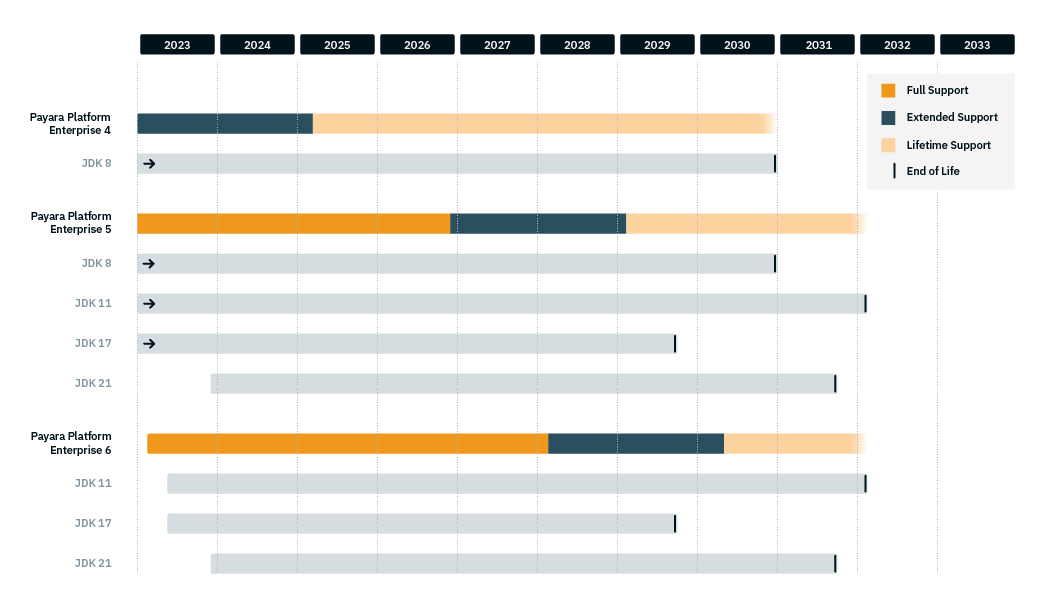
Payara’s support policy follows a linear, phased design ensuring consistency and simple planning. Payara Platform Enterprise lifecycle runs through three key phases: Full Support, Extended Support, and Lifetime Support.
Full Support lasts at least five years from the first Enterprise release of a major version. During this period, Payara delivers monthly updates that cover bug fixes, security updates, new features and improvements. You can expect compatibility across JDK versions (via Azul), certified Jakarta EE and MicroProfile standards as well as the option to request hotfixes when something needs an immediate fix.
By contrast, other application server providers provide less frequent releases in such phase. Also, they typically reduce feature updates in less than five years, typically after three years. Instead, Payara extends that horizon, giving Java teams the ability to plan long-term. In practice, this means more time before needing to plan major migrations or rushing into complex modernization projects.
When Stability Takes Priority: Extended Support
After approximately five years, Payara Platform Enterprise versions shift into Extended Support. The focus changes from feature updates to long-term maintenance. Security patches remain available, and bug fixes can still be requested, but the frequency of releases reduces.
This period is ideal for teams running production systems that don’t change often. It keeps systems secure without forcing unnecessary upgrades. Other application server vendors offer similar extended phases, but they often require higher-tier contracts or limit fixes and updates. Payara’s approach offer a more comprehensive and stable solution.
Maintaining Stability while Planning for the Future: Lifetime Support
For organisations that need to run legacy environments long past standard timelines, Lifetime Support provides peace of mind. It’s renewable each year, reviewed annually, includes security and critical fixes. It doesn’t add new features and no component upgrades occur by default, but it ensures that systems relying on older Payara Platform Enterprise versions remain stable, protected and maintainable while the team behind them prepares for modernization. This service is withdrawn only after one year’s notice or when all underlying JDK versions for that platform reach end-of-life.
If you’ve ever tried to keep an older installation alive with other middleware technologies, you’ll know how challenging it can be to get ongoing support once they are declared end-of-support. Payara’s model avoids that cliff-edge. With Lifetime Support, customers can continue using the runtime version for as long as Payara or the JDK provider maintains the service.
Why This Matters: A Practical Edge Over Other Servers
Developers thrive on stability, as CI/CD pipelines, automated tests and deployment workflows all depend on predictable environments. Every professional who manages enterprise workloads understands the cost of premature migration. Application validation cycles, environment re-testing and certification rework consume time.
Payara Platform Enterprise was designed with this reality in mind. Its lifecycle gives developers a long runway of support, clarity on updates, and options for those who need to keep systems stable for years.
Payara’s model aims to minimize disruption through:
- Long-term patch stability: predictable monthly builds keep the platform up-to-date, and frequent releases in extended support phases maximize support.
- Reduced migration frequency: multi-year coverage means fewer system rebuilds.
- Sustained Java compatibility: versions follow LTS updates synchronously with JDK lifecycles.
- Controlled end-of-life transitions: one-year termination notice ensures no abrupt support loss.
Predictable, consistent, long-term support means fewer unknowns. Rather than nudging its users toward faster upgrades, Payara takes a steadier, more considerate path. In effect, Payara Platform Enterprise stands out by offering one of the longest and most comprehensive lifecycles in the enterprise Java ecosystem. As a result, developers can benefit from reliability as much as innovation.