Every time a customer uses your product, you might be footing an LLM bill for it. Your old pricing model was built for a world where that never happened.
Pricing AI products takes a different kind of math than pricing SaaS.Prittam Bagani, our Head of Product forChargebee Billing, walked through the state of AI pricing in a recent webinar. “Every request that you make within your product can cost real money,” he said, “because they might be based on an underlying LLM.”Gorgias CFO Kunal Agarwal put the stakes just as bluntly: “You can’t price what you can’t see.” Here’s what changed, andwhat to do about it for your next price move.
Key Takeaways
- Seat-based pricing breaks for AI products: cost now scales with usage, not headcount.
- Hybrid pricing, a floor plus usage on top, is the dominant model for AI products. 51% of recurring-revenue companies now combine subscriptions with usage- or outcome-based pricing.
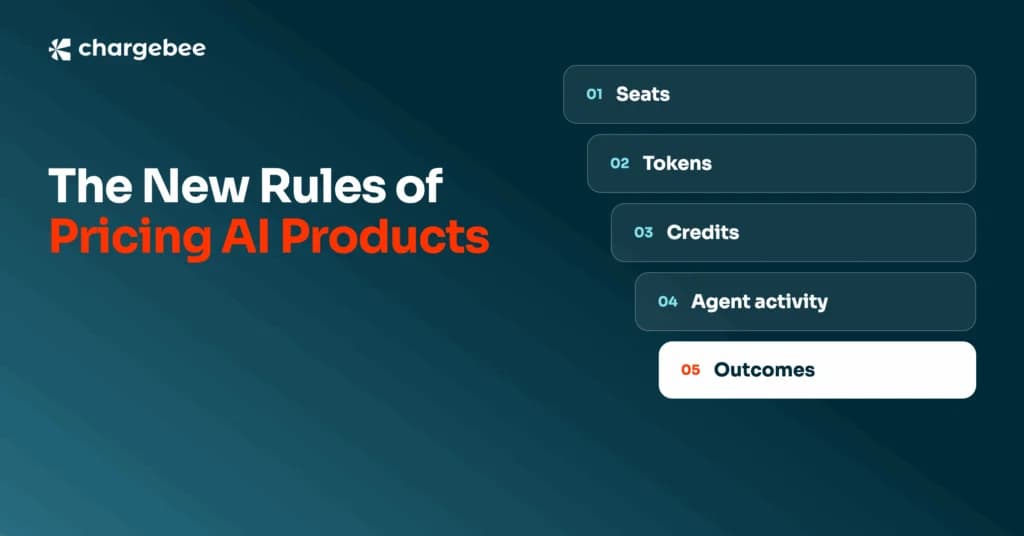
- Pricing units are moving up a ladder: from seats, to tokens, to credits, to agent activity, to outcomes.
- Gross margin on AI products averaged 53% in 2026, but the right margin to target varies by company stage and customer segment.
- Companies should roll out new AI features with promotional credits first, then set a price once usage data shows where value concentrates.
Seats Have Stopped Tracking Value
For SaaS companies at scale, the incremental cost of adding additional customers used to round to zero. That’s gone for AI products. Every inference call that an AI product makes carries a cost, and the amount varies by what a customer does with your product. The same seat can carry a wildly different cost to serve, depending on whether they’re running quick summaries or chaining ten tool calls to build something new.
Then there’s seat count, long treated as a decent stand-in for value. “It’s no longer a metric of value,” Prittam said. Worse, it often moves in the wrong direction: a customer who automates work with an agent needs fewer human seats to do the same job, so seat count falls just as usage, and cost, rise. Run an old seat-based model through that, and you lose your value metric right as your cost goes up.
Hybrid Pricing Has Won for AI Products
So what do you charge for instead? Many AI companies are landing on a hybrid approach: a flat floor for access, plus usage on top.Chargebee’s research backs that up: 51% of recurring-revenue companies now combine subscription with usage- or outcome-based pricing, and 75% still keep a subscription component in the mix. Prittam said the same thing live on the call: hybrid pricing is “by far the most dominant pricing strategy out there.” Most usage-priced companies pass the token cost straight through to the customer, too, which protects margin.
But floor-plus-usage is packaging. The pricing unit underneath it matters more: seat, token, credit, agent activity, or outcome. “There are different flavors of how close to the actual customer value you can get,” Prittam said, and the higher upthat ladder you go, the less you have to explain on the invoice.
Each rung onthat ladder has plenty of representative companies:
- Cursor runs two pools inside one plan, a cheap in-house model and a pricier frontier one, so power users pay for power without everyone else subsidizing them. Prittam noted that “most of your work goes to the auto models,” the cheaper pool, with the pricier frontier models reserved for harder tasks.
- Lovable hands out a daily credit grant to pull you back into the product. “It motivates you to go into the product and consume the credits,” Prittam said.
- CodeRabbit bills $30 per hour of agent work.
- AndIntercom charges 99 cents per resolved conversation, the plainest example of outcome pricing in the industry today, though nobody’s quite solved what happens when the outcome is only half-resolved. Prittam asked the same question on the call: “How do you price for a partial outcome?”
Get the Full Breakdown of Each Structure
Chargebee’s guide to hybrid pricing walks through all five.
Margin Is a Strategic Choice
Average gross margin on AI products hit 53% in 2026, up from 45% the year before. This suggests that inference optimization is working. But don’t treat that number as a target: margins across the AI industry span a wide range, from companies buying growth at the low end to others protecting cash at the high end, and the median, around 50%, sits well under the 70 to 80% SaaS has run for a decade.
“Margin is a very strategic choice,” Prittam said: some AI companies deliberately run 80% margins or higher, others happily sit at 20% or lower because they’re buying growth. “It really depends on what stage of your business you are,” he added. Segment matters just as much: per Prittam’s numbers from the webinar, Cursor’s $20 plan likely runs close to breakeven, while 65 to 70% of its revenue comes from enterprise deals where seats, pooled usage, and contract terms do the heavy lifting. One company, two very different margin stories under the same brand.
Give Customers Credits Before You Give Them a Bill
Prittam’s recommendation: give it away first. When you roll out a new AI feature to customers who already pay you, lead with promotional or included credits, watch what people do with it, then set the price once you know where the value lands.
Figma did this with Figma Make. It rolled out promotional AI credits in December 2025, spent about three months watching usage, then introduced a price in March 2026. “There were no surprises for customers,” Prittam said of the rollout, speaking as a Figma user himself: “I was always informed about how they were changing their pricing.” Tell people before you change the deal.
Once pricing is live, the product has to carry the weight. That meanstracking entitlements in real time, alerting someone before they blow through their limit, and giving them a prepaid or auto-top-up option right there in the product. “The usage is happening in real time, the tracking of credits is happening in real time,” Prittam said. He pointed to an OpenAI piece, “Beyond Rate Limits” by Jonah Cohen, for the underlying principle: no dead ends. Skip any of that and you get support tickets about surprise invoices, which is its own kind of churn.
Where to Start With AI Pricing
Prittam closed by circling back to the four questions he’d opened with: what to charge for, how much to charge, how to introduce it, and how to grow with it. Treat AI pricing like an operating system. Meter usage and alert customers before they hit a threshold, the way the entitlement tracking above works. Let margin vary by segment the way Cursor’s does, instead of chasing one target number across your whole customer base. And when you add a new capability, use Figma’s sequence: credits first, price later, and tell people what’s coming before you change the deal.
Nail this and pricing becomes one of your sharpest growth levers. Run our free3-minute AI pricing assessment to see exactly where your pricing stands, then see howChargebee’s billing infrastructure for AI can help you act on it.