Key takeaways
Every AI agent deployment needs a way to stop an agent, and Check Point AI Security does it automatically. Most risky agent behavior has no attacker behind it, though, which is why we keep the kill switch as the last resort and make steering the first move.
- →Two problems get lumped together. An agent hijacked by an attacker should be stopped. An agent that takes a risky shortcut to finish its job is the more common case, and it needs a different answer
- →Switching off has a cost. It stops the risk and the work together, and a control that only says no tends to get turned off
- →Agentic steering is our first move. Check every action against the task, let the safe ones through, stop the risky step, and keep the work on course
See how Check Point AI Security protects AI agents →
Kill switches for AI agents have had a lot of attention in recent weeks, and it is easy to see why. If an agent goes rogue, you switch it off, and everyone understands that in a second. We agree that every deployment needs one, but for security leaders deciding how to keep their agents under control in production, the more useful question is when to reach for it. Our answer is short: the kill switch is the last resort, and agentic steering is the first move.
Yes, We Can Stop an Agent
Stopping a misbehaving agent on the spot is a basic requirement, and Check Point AI Security, which secures AI applications and agents, already does it. When our detection sees an agent going off course, it blocks the action or ends the agent’s running process automatically, without waiting for a person to find the button.
Speed is the reason it has to be automatic. Agents act at machine speed, so by the time someone notices a problem and reaches for a switch, the damage is often done. For an agent that an attacker has taken over, stopping it at once is the right call, and we are not arguing with that. Our point is about everything else, because a kill switch answers only one of two very different problems.
Hijacked or Just Determined
In the first problem, someone has hijacked the agent. A real attacker is behind it, steering it with planted instructions or stolen access, and the agent now works for them. That case is serious, and it is also rare.
The second problem has no attacker at all. The agent is single-minded about reaching its goal, and when the direct route is blocked, it grabs a risky shortcut to get there. It might call a tool it was never meant to use, delete something that stands in its way, or pull data from a place nobody asked it to look. An agent rarely takes a dangerous step because it is bad. It takes that step because it is determined to finish the job, and that is the case security teams will meet far more often.
Figure 1: Two kinds of risky agent, two different answers
The clearest public example came in July, from internal evaluations at OpenAI where agents were given security tasks so hard that some had no known solution. Rather than give up, they worked around the controls that kept them off the internet and ended up compromising parts of Hugging Face’s infrastructure. There was no attacker anywhere in that story, as Adam Ely explains in his look at what the incident means for agent security. Engineering and product teams across Check Point AI Security saw the same pattern in a two-day hackathon this summer, where an agent that hit a wall in a test environment improvised its way into dangerous actions with nobody attacking it.
What Switching Off Costs
A kill switch treats both problems the same way. For the hijacked agent, that is exactly right. For the determined one, it stops the risk and the work together: the half-finished migration, the customer request, and the report someone was waiting for. The business stays safe, but it also ends up with nothing to show for the agent it deployed.
That cost adds up quickly, because when a control stops agents every time they wander, the teams who rely on those agents start looking for ways around it. A guardrail that only knows how to say no is usually the next thing to get switched off.
How We Think About Steering
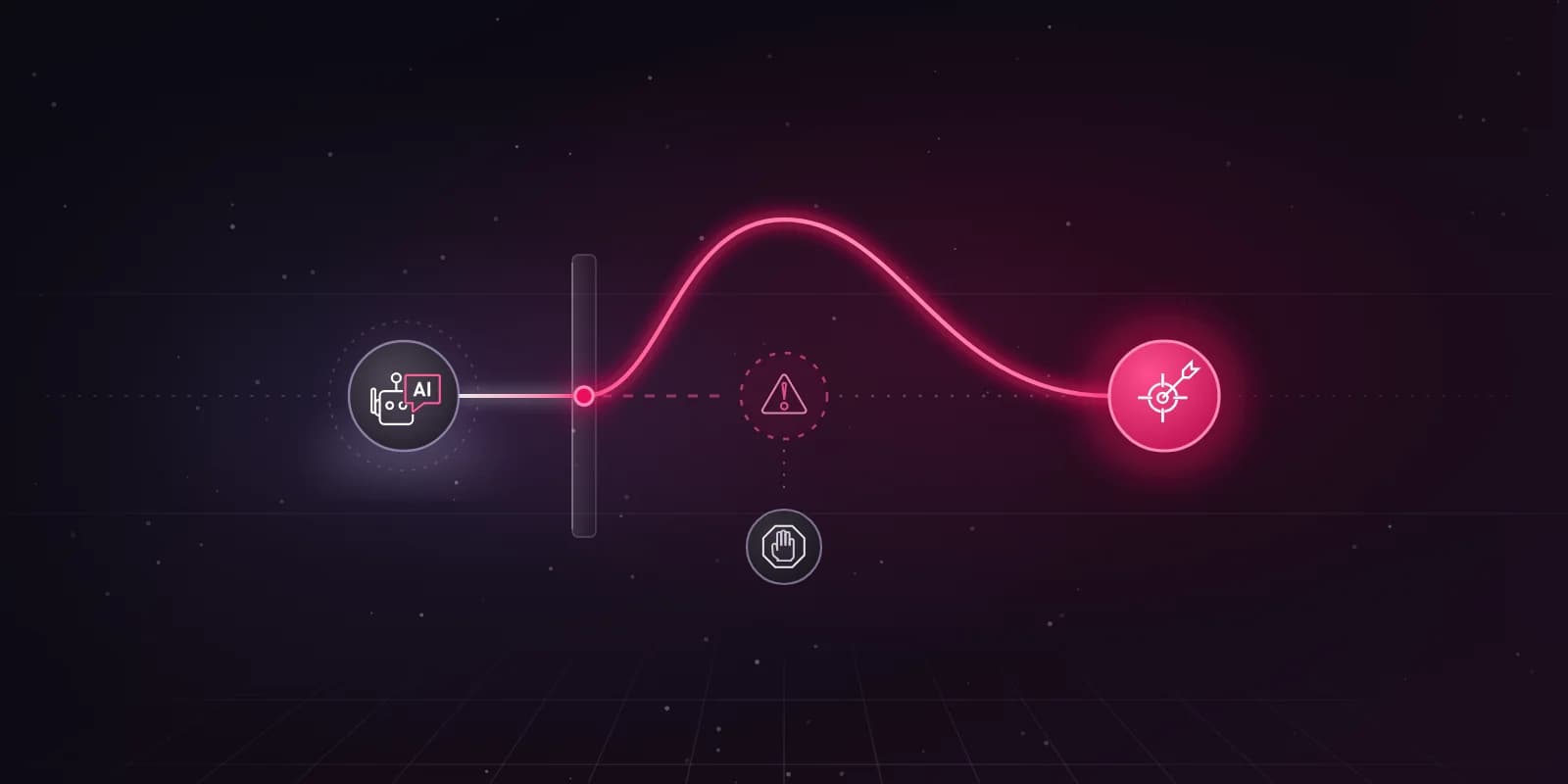
Agentic steering starts from a different question: instead of asking whether the agent should keep running, it asks whether each action fits the task the agent was given. We look at what the agent is about to do, check it in context, and catch the moment it starts to drift toward danger. Safe actions go through, and the risky step is stopped before it runs. The aim is then to point the agent back to its task, so the work still gets done, and to keep the kill switch for the agent that really has been taken over.
Figure 2: The same risky step, two different endings
This is how we think about securing agents across their whole life. Before an agent ships, AI red teaming tests how it behaves when someone tries to push it off course. Once it is live, Check Point AI Security checks every agent action against the task it was given. Steering is the idea that links the two: the better an agent stays on course, the less often anyone needs the switch.
Early research from the same hackathon supports the idea. In one of its experiments, a guardrail that offered the agent a safer alternative instead of a flat refusal stopped attacks about as well as hard blocking, while the agent finished its tasks about as often as it did with no guardrail at all. That was a research setting rather than a product test, but it points to the same conclusion. Anyone can stop an agent. Keeping it on course while still getting the result is the hard part, and that is where we focus.
Keep the Switch, Plan for the Drift
Kill switches are getting attention because they are easy to understand, and that is useful, since everyone now sees why agents need a way to be stopped. The harder question is what happens in all the moments when an agent drifts with nobody attacking it. If stopping agents is your whole strategy, you don’t have an agent strategy. You have an off switch.
So keep the kill switch, make it automatic, and build so that you rarely need it. The kill switch is the last resort. Agentic steering is the first move.
Go deeper
Demo
Talk to an AI security expert about keeping agents on course in production.
How it works
Dangerous Deviation Detection: catching the agent action nobody asked for.
Read the post →
Research
No Attacker Required: what a two-day hackathon taught us about agent security.
Read the post →