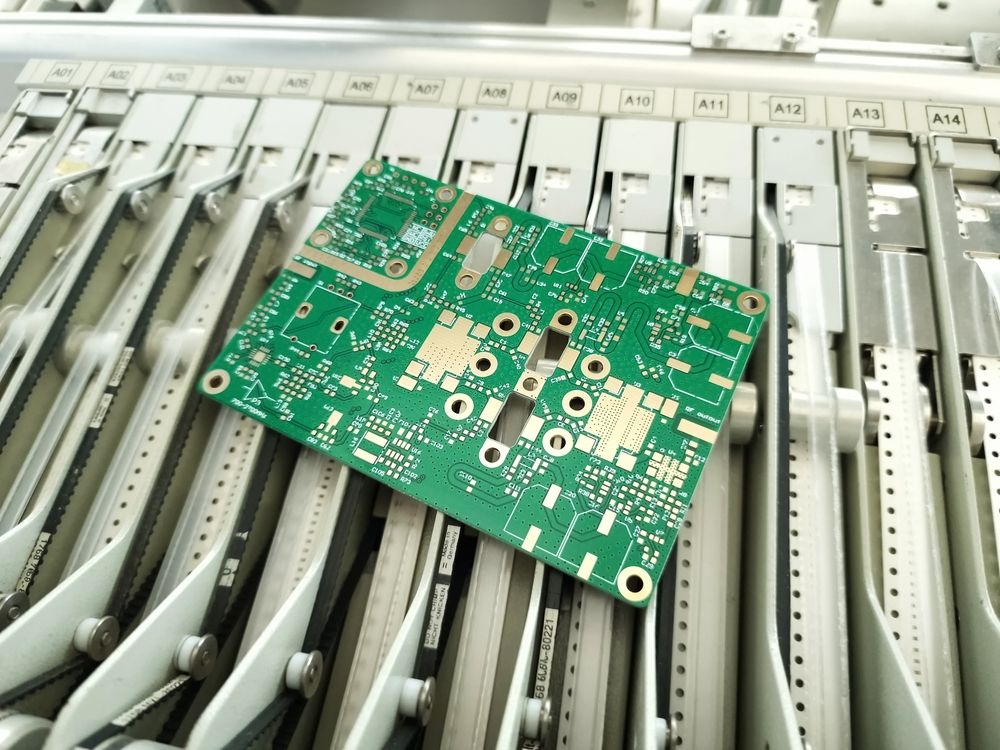
The radio passed design review. Every part had authorized stock, every datasheet checked out, and the BOM froze on schedule. Eighteen months later, the gallium arsenide (GaAs) wafers behind the power amplifier are still in China.
The circuit stayed qualified, but the parts could not ship because the required export permit was never approved.
This scenario demonstrates a growing problem. RF front ends rely on trade-sensitive materials, specialized semiconductor processes, and concentrated supply paths. Tariffs can raise landed costs, while a licensing problem can stop shipments altogether. For GaAs and gallium nitride (GaN) devices, that exposure begins upstream with gallium.
The first two articles in this series, 6G Has a Date Now – Your RF Front End Has a Deadline and Who Still Makes RF Power? The 2027 Supplier Map, covered the front ends that 7 GHz spectrum will require and the suppliers positioned to build them. This one asks whether those parts can ship.
Key Takeaways
- China produces about 99 percent of the world’s primary gallium. Its U.S.-specific export prohibition is currently suspended through November 27, 2026.
- High-power, high-frequency RF stages often have no drop-in silicon substitute, so a gallium supply disruption can force a redesign and requalification.
- Many covered Chinese-origin semiconductors already carry an additional 50 percent Section 301 duty, and another semiconductor tariff action is scheduled for June 23, 2027.
- Screen RF parts early for single-source, single-region, and single-channel exposure. Then verify classification, origin, and manufacturing information while alternates can still be qualified.
Gallium is the Constraint Behind RF Parts
Gallium is usually recovered as a byproduct of bauxite and zinc processing, which makes supply slow to respond to price or policy changes. According to the U.S. Geological Survey, China accounts for about 99 percent of global primary gallium production, and the United States has recovered no primary gallium since 1987.
China’s controls arrived in stages. Export licensing took effect in August 2023. In December 2024, China imposed a U.S.-specific prohibition on gallium and other dual-use materials, which it then suspended in November 2025, effective through November 27, 2026. Still, the broader export-licensing framework remains in place, and restrictions involving U.S. military end users and end uses were not removed.
The Suspension Did Not Restore Supply
A May 2026 CSIS analysis reported that China’s unwrought gallium exports fell 94 percent in 2025 and that U.S. imports from China all but stopped after March 2025. By April 2026, spot gallium prices outside China had reached about $1,850 per kilogram. S&P Global’s August 2026 market report put domestic Chinese prices at about $300.
The licensing bottleneck is visible at the substrate level. AXT, whose Chinese subsidiary produces GaAs and indium phosphide substrates, reported that no GaAs export permits for U.S. customers had been approved, even as permits were obtained for customers in Asia and Europe.
Alternative supply is emerging, but slowly. Alcoa broke ground in August 2026 on its Wagerup gallium project in Western Australia, while Rio Tinto is building a pilot plant in Quebec expected to operate in 2027. These projects will diversify the future supply base, but they do little to change the exposure of RF designs currently being qualified.
Why a Gallium Disruption Can Force a Radio Redesign
GaAs devices carry gallium in the wafer itself, while GaN devices use gallium in the epitaxial layers, whether those layers are grown on silicon carbide (SiC) or silicon. Silicon overlaps with both in some applications, but many high-power, high-frequency RF stages have no drop-in silicon replacement that preserves the same frequency range, bandwidth, efficiency, power density, and thermal design. Switching device technology can therefore reopen matching, bias, thermal design, layout, linearity, digital predistortion, production testing, and qualification.
On its May 2026 earnings call, MACOM said opportunities created by a competitor’s RF-power exit would not contribute revenue in 2026, with the second half of 2027 seen as the best-case as customers move new platforms through design and qualification. A permit denial or a price spike arrives in weeks; redesigning, qualifying, and ramping an alternate takes months, and production absorbs the difference.
Where the Front End Meets the Control List
Export classification can independently determine whether an RF device requires a license. The Export Administration Regulations (EAR) control certain microwave devices under Export Control Classification Number (ECCN) 3A001.b in the Commerce Control List, based on device type, frequency, output power, and, for some categories, fractional bandwidth.
Whether 3A001.b.2 applies to a given monolithic microwave integrated circuit (MMIC) amplifier depends on more than one parameter:
- Frequency. For parts rated above 6.8 GHz up to and including 8.5 GHz, the relevant paragraph is 3A001.b.2.b.1. The 7 GHz candidate bands fall inside that range.
- Output power and bandwidth. The threshold is peak saturated output power above 10 W when the fractional bandwidth exceeds 10 percent.
- Design intent. A note to the entry addresses MMICs specially designed for other applications, including telecommunications.
- Destination, end user, and end use. License requirements differ, including for items exported for civil telecommunications use.
The datasheet supplies the frequency and power numbers, while the entry's notes and the destination determine whether a license is required.
Tariffs Depend on Classification and Origin
Specified Chinese-origin semiconductor products already carry an additional 50 percent Section 301 duty. A second Section 301 action applies to the same 18 Harmonized Tariff Schedule of the United States (HTSUS) subheadings, most of them within headings 8541 and 8542. It is set at zero percent for now and is scheduled to rise on June 23, 2027, to a rate not yet announced.
The rate depends in part on where the product legally originates. To determine origin, U.S. Customs and Border Protection (CBP) applies a fact-specific substantial-transformation analysis. In a 2025 ruling involving RF front-end modules, CBP found U.S. origin where front-end wafer processing in the United States created the semiconductor die, and later Chinese processing did not substantially transform it. Origin is therefore a design-stage sourcing field.
Record the Data While the Design Is Still Open
For RF parts with concentrated sourcing, record three things in the BOM or PLM system:
- Classification. Record the ECCN and HTSUS code, along with the source and verification date.
- Origin and fabrication. Record the known country of origin, fabrication location, and specific fab when disclosed. When a supplier builds the same part at more than one site, the same MPN can carry different exposure from one site or lot to the next.
- Channel. Record the authorized sourcing paths available for the part and whether any alternate has completed engineering qualification.
Use Octopart to Screen for Concentration
Octopart can provide the first screen. Check the RF front end for parts tied to one manufacturer, fabrication region, or authorized channel, using inventory, lifecycle, country-of-origin, ECCN, and HTS information where available. Several distributor listings may still trace back to one manufacturer, one fab, and one upstream material source.
The workflow is Screen → Verify → Qualify.
- Screen to identify concentrated parts.
- Verify classification, origin, and manufacturing information with the manufacturer, authorized distributor, the Bureau of Industry and Security (BIS), CBP, the Office of the U.S. Trade Representative (USTR), or the applicable authority.
- Qualify an alternate whose supply path reduces the concentration while the design can still accommodate it.
Trade Exposure Continues After the BOM Freeze
Two dates belong on your RF sourcing calendar:
- November 27, 2026: China’s U.S.-specific gallium suspension is scheduled to expire. An extension is possible under another trade agreement, but nobody should plan a 2027 RF supply chain assuming one will be issued.
- June 23, 2027: A second U.S. semiconductor Section 301 action is scheduled to add a tariff rate that has not yet been announced.
A frozen BOM can still depend on one material source, fabrication site, country, or licensing regime. The radio in the opening scenario passed every check its team ran, because classification, origin, and channel were never on the checklist. Put those three items on your checklist while the supplier and qualification plan can still change.