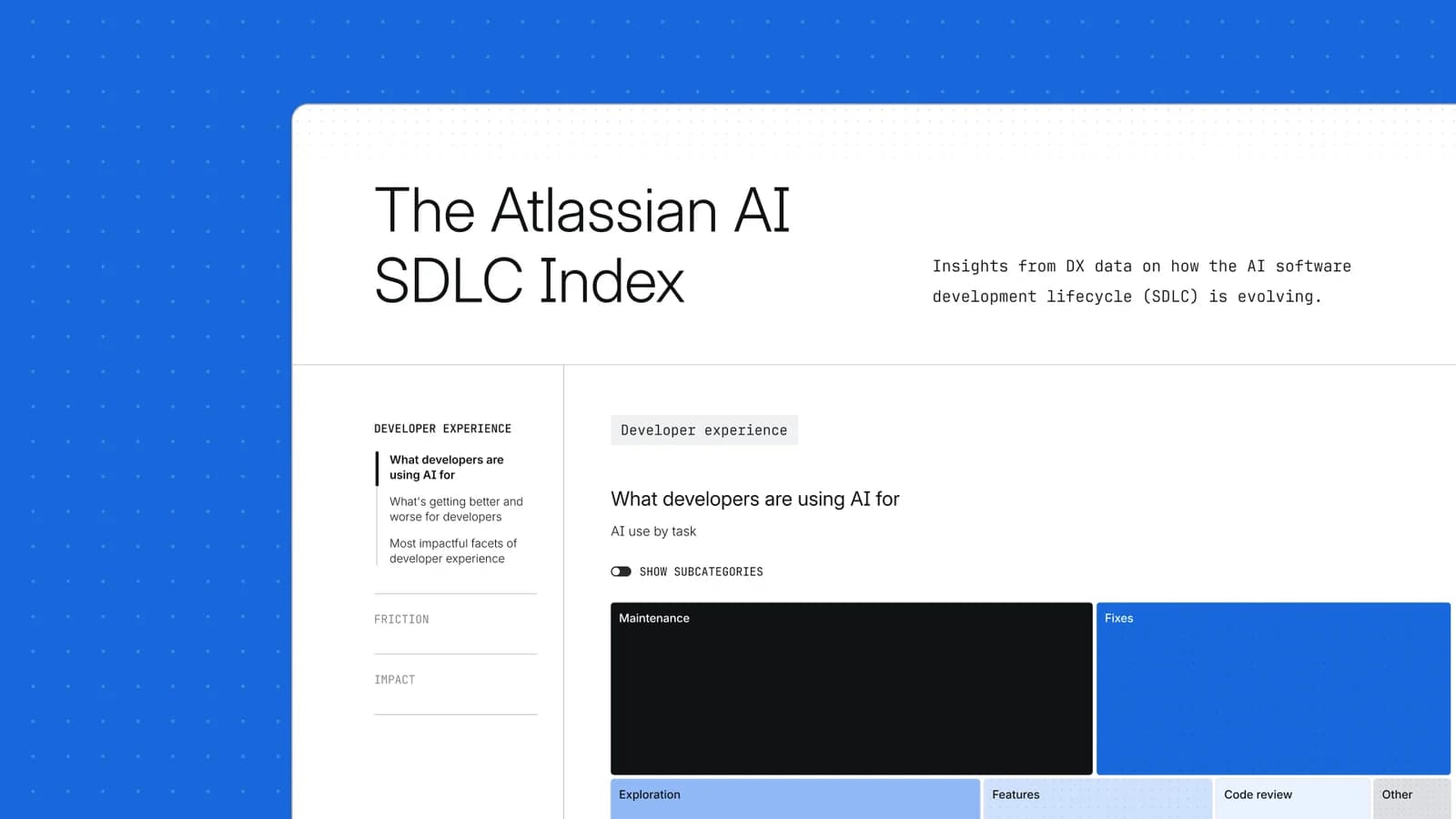
Insights from DX data on how the AI software development lifecycle (SDLC) is evolving. Latest update 11.18.26
Developer experience
What developers are using AI for
AI use by task
Show subcategories
What’s changing for developers
Change in the share of developers rating each aspect of their work favorably
Most impactful drivers of developer experience
Elements of a developer’s day-to-day work that drive the highest impact across key outcomes (Speed, Quality, Ease of Delivery, and Ease of Release) and how developers rate them today
High impact, low favorability
- Build and test
- Documentation
- Production debugging
High impact, high favorability
- Incident handling
- Change confidence
- Dev environment
- Local iteration speed
August–October 2026 (n = 385 companies). Scores vary slightly from the previous chart due to varying sample sizes.”
Friction
What’s slowing developers down
Time lost to friction
20%
Developers lose one in five (20%) workdays to friction. That’s equivalent to about 10 work weeks per year.
- Time lost to friction
- Other work time
Hours lost per year, by source
State of PR reviews
Minutes to first review, by share of code that is AI-authored
Review load per developer over time
Impact
Time spent on innovation
- Time spent on innovation
- Time spent on all other tasks
Over time
Trending percent of AI-authored code and survivorship
AI spend and automation
AI spend per unit of output over time
Methodology
DX is an engineering intelligence platform designed to help engineering organizations measure and improve software health, developer productivity, and AI-human collaboration for a truly AI-first SDLC.
The dataset represents a sample of more than 340,000 engineers at 500+ engineering organizations that use the DX platform. Companies range in size from fewer than 50 to over 10,000 employees, represent a wide geographic spread from Europe to Asia to North America, and encompass many industries, including finance, retail/e-commerce, and healthcare. All self-reported and telemetry data are aggregated at the company level, which means that team-level variation within organizations is not captured.