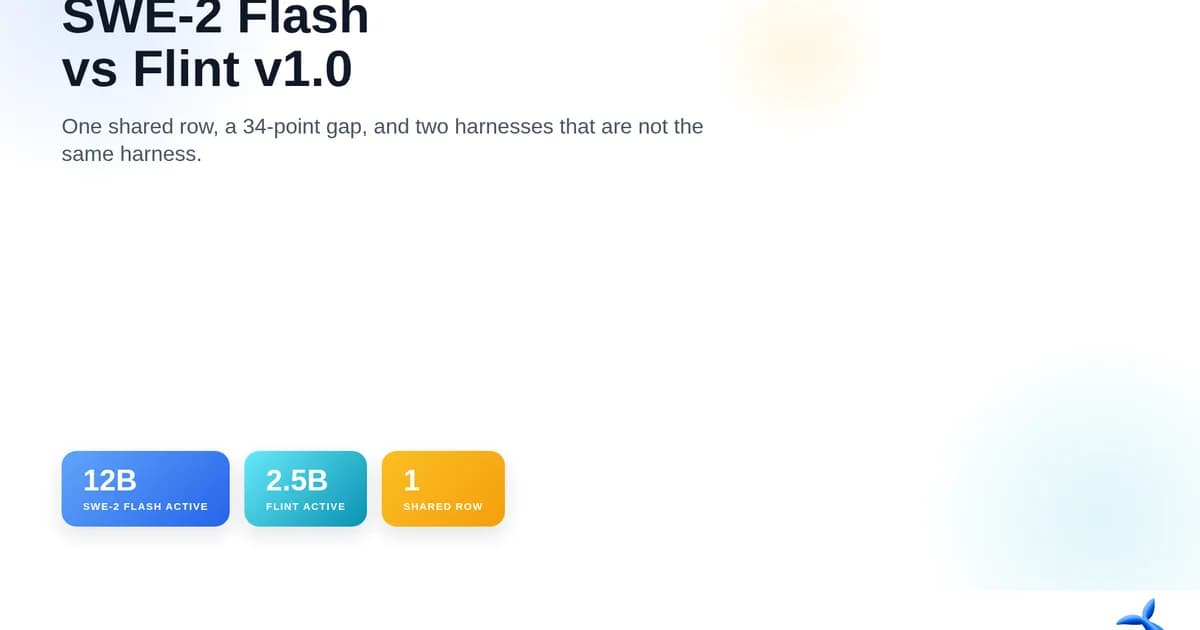
Two small-active mixture-of-experts coding models, released fifteen days apart, both claiming the same tier of performance at a fraction of flagship cost. SWE-2 Flash, from Cognition on 4 November 2026, is 276B total parameters with 12B active. Flint v1.0, from Recursive on 21 October 2026, is 39.8B total with roughly 2.5B active. They are the same architectural bet at very different scales — and the honest way to compare them is to admit up front that their published tables overlap on exactly one row.
That row is Terminal-Bench 2.1: 89.2 for SWE-2 Flash against 54.9 for Flint v1.0. It is a 34-point gap, it is the single strongest number either company has produced in this matchup, and it comes with two caveats large enough to change how you read it. Everything else you might be tempted to compare is either a different benchmark version or a different subset of the same benchmark.
Same bet, opposite licence
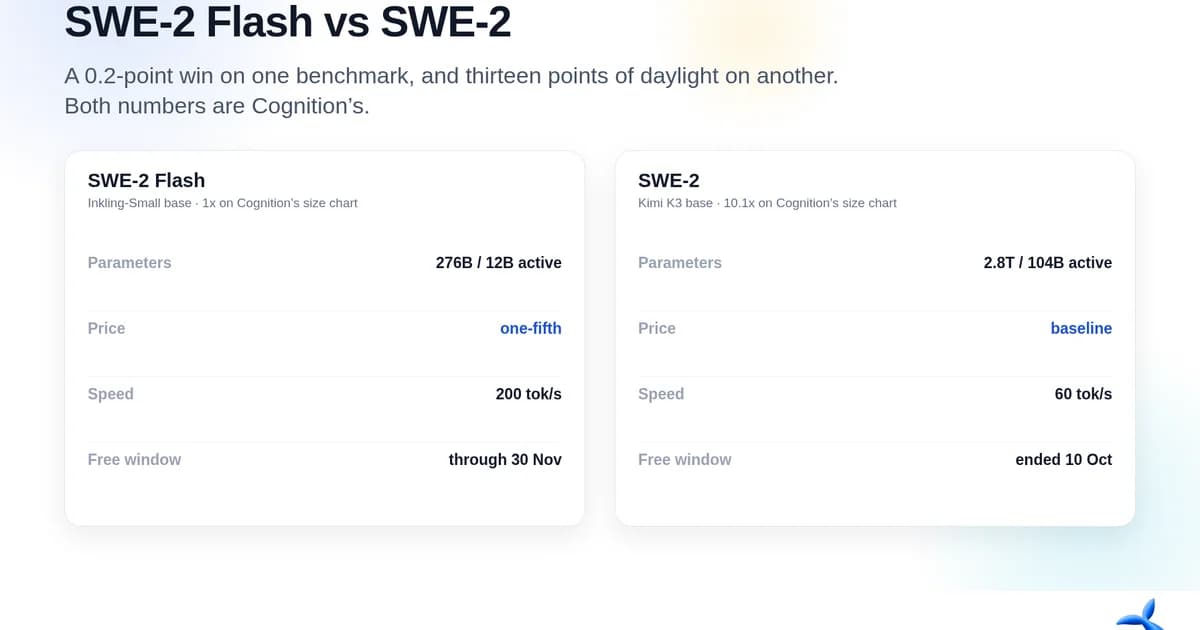
The shared thesis is that active parameters, not total parameters, drive inference cost — so you can build a large sparse model and only pay for the slice that fires. Flint puts 6 of 256 routed experts plus a shared expert to work per token, across 49 layers, 35 of them sliding-window with a 513-token window and 14 full attention. SWE-2 Flash inherits that structure from its Inkling-Small base: 276B total, 12B active, post-trained with a mid-training stage Cognition had not used before.
The difference that matters more than any architecture detail is what you are allowed to do with the output:
• Weights — Flint v1.0 is Apache 2.0 on Hugging Face in BF16, FP8 and quantised forms. SWE-2 Flash is withheld entirely, with a partner-sharing programme promised but not yet specified.
• Distribution — Flint runs under llama.cpp, Ollama, LM Studio, vLLM and SGLang on hardware you own. SWE-2 Flash runs inside Devin Desktop and the Devin CLI and nowhere else.
• Price — Flint's marginal cost is your GPU. SWE-2 Flash is free through 30 November 2026 and has no published per-token rate after that.
• Context — Flint publishes 262,144 tokens, configurable to roughly 512K. SWE-2 Flash publishes nothing.
That is not a small difference in posture. One is an artefact you can inspect, quantise, fine-tune and run on a laptop. The other is a product with a free month.
The one row you can compare
Terminal-Bench 2.1 is the only benchmark where both companies report a number on the same version. Flint's 54.9 was produced through Terminus 2, with pass@1 averaged over at least five attempts. SWE-2 Flash's 89.2 was produced on a harness Cognition does not name, at an effort setting it does not disclose, from a launch post that omits the methodology appendix its September predecessor carried.
So the 34-point gap is real in the sense that both numbers were reported on the same task set, and soft in the sense that one side told you how it got there and the other did not. A model scored inside a co-designed agent scaffold — which is what Devin is — will generally beat the same model scored through a generic harness. Flint's number is the conservative one precisely because Recursive published the method.
If you want a single sentence: on the only shared row, SWE-2 Flash is far ahead, and neither company has given an independent party the ability to check.
The two Pro scores that look identical and aren't
This is the trap in this matchup, and it is worth slowing down for. Recursive reports Flint v1.0 at 89.7 on SWE-bench Pro v2. Cognition reports SWE-2 Flash at 89.9 on SWE-Bench Pro v2 Hard. Two numbers, 0.2 points apart, sitting next to each other in every aggregation you will find.
They are not the same measurement. "Hard" is a subset — a filtered slice of the task set, not the whole of it. Flint's figure is the full Pro v2 run under mini-swe-agent, with web-retrieved solutions counted as failures, which is a stricter scoring convention than most vendors adopt. Putting 89.9 next to 89.7 and calling it a tie is the kind of comparison that produces confident, wrong conclusions.
The same caution applies to a row neither table shares. Flint reports SWE-bench Verified at 74.2. SWE-2 Flash does not report Verified at all — it reports Pro v2 Hard, DeepSWE 1.1 and SWE-Atlas QA instead. So the benchmark that most teams have intuition for is unavailable for the newer model, which makes "Flint is behind on SWE-bench" an unsupported claim rather than a finding.
Context is the spec that decides
For agentic coding, context window is not a footnote — it determines whether a model can hold a repository's relevant surface in one planning step or has to be fed it in pieces. Flint publishes 262,144 tokens. SWE-2 Flash publishes nothing, and after three days of coverage no outlet has established it.
Flint's context comes with a caveat of its own. Community measurements show throughput collapsing at long context — roughly 110 tokens per second at short prompts falling toward 9 tokens per second near 115,000 tokens. A 262K window that runs at 9 tok/s is a window you use deliberately, for a single large read, not one you leave open across a long session. Quantisation softens the compute cost but not that curve.
SWE-2 Flash's unpublished window is the larger unknown, because Devin is a long-session product. If you are choosing between them on the assumption that the closed model handles bigger repositories better, you are choosing on a number nobody has published.
Speed you can verify against speed you cannot
Cognition says SWE-2 Flash runs at about 200 tokens per second against SWE-2's 60. The figure comes from replaying shortened session transcripts at simulated rates, not from timing a live endpoint. It is a demonstration, not a measurement, and there is currently no way for anyone outside Cognition to check it.
Flint's throughput claims are modest by comparison and much easier to falsify: roughly 125 to 131 tokens per second on an M4 Pro MacBook Pro, above 150 on an RTX Spark with 64 GB. Those were measured on hardware you can buy, by people who published the configuration. The NVFP4 quantised build is reported to land within about 0.7 points of BF16 on the benchmarks, which is the sort of claim a community can and will test.
One real wart to know about: the GGUF path has had a chat-template bug in llama.cpp, and the model has a thin community track record compared to anything from a major lab. Early adopters are doing the debugging.
What each option actually costs you
Flint v1.0 is free to download and costs whatever your inference costs. A 39.8B model at 2.5B active will run on a well-specced laptop at usable speed, which is the entire point of the architecture. The cost of adoption is operational: you own the serving stack, the quantisation choice and the failure modes.
SWE-2 Flash costs nothing until 30 November 2026 and then costs an unknown amount, because Cognition published a ratio — one fifth the price of SWE-2 — rather than a rate. If your team's planning process needs a number to put in a spreadsheet, that is the blocking issue, not the benchmark gap.
Neither model is in the OrcaRouter catalogue today, and we are not going to suggest otherwise. What is useful in this matchup is not routing between these two but benchmarking the field around them: more than 200 models sit behind one OrcaRouter key at 0% markup over provider list price, which makes running the same repository task through a dozen candidates a matter of changing one string. When you are deciding between two models where one side has published its harness and the other has not, your own eval is worth more than either vendor's table.
Who should pick which
Pick Flint v1.0 if you need the weights. If your constraint is data residency, offline operation, fine-tuning, or a per-token cost that does not depend on another company's pricing decision, the 34-point Terminal-Bench gap is a price you may well be willing to pay — and Flint's 262K context and published harness give you a model you can reason about rather than a black box.
Pick SWE-2 Flash if you are already inside Devin and the free window is enough to answer your question. It is the better-performing model on the one row both companies measured, by a wide margin, and it costs nothing to try until the end of November.
What nobody should do is pick either on the strength of the SWE-bench Pro numbers. 89.7 and 89.9 are not the same test, and the difference between them is smaller than the difference between either number and what your repository will actually produce.