SuperCLUE’s results released on November 5, 2026 show why model selection benefits from a category-level view. GPT-6.1-Sol has the highest displayed scores in agentic coding and mathematical and scientific reasoning, while Gemini-4-Argon leads in hallucination control and ultra-long context. They share the highest score in precise instruction following.
Among models labeled open in the source, the leaders vary by task: DeepSeek-V4.1-Flash-1017 leads in coding, Darwin-180B-RSI-R3 in mathematical and scientific reasoning, and Kimi-K3.1-Pro in the other three categories. Kimi also has the highest overall score among those open models, placing third across all 19 entries and No. 1 in SuperCLUE’s numbered ranking.
The leaderboard displays all 19 models in descending order of overall score, including international models. Darwin places ninth overall by score and first among open models in mathematical and scientific reasoning. This article examines the five categories, then brings them together in the full overall table.
Scope and interpretation
The published table contains 19 models: 12 labeled open and seven labeled closed. Here, “overall leader” means the highest displayed score among those 19 models, and “open-model leader” means the highest among the 12 labeled open. Neither term implies a ranking of every model available worldwide.
The open/closed labels follow SuperCLUE’s classification. They are not an independent assessment of license terms, training-data disclosure, code availability, or eligibility for commercial use. For deployment, check each model’s repository, model card, license, and usage conditions separately.
SuperCLUE uses a separate policy for the numbered rank column: “International models and some domestic models are excluded from ranking and shown for reference only.” International models outside China are therefore omitted from the numbered ranks as a class. This is why Gemini, GPT, Grok, and Darwin carry a dash in that column; it is a ranking-policy convention, not a performance judgment or a missing evaluation. Their published scores still determine where they appear in the descending table.
The distinction is straightforward: Gemini is first by overall score, GPT second, Kimi third, and Darwin ninth among the 19 evaluated entries. Kimi’s “1” in the source’s rank column refers to SuperCLUE’s policy-defined numbered ranking. The source also groups models within a one-point difference into tied ranks. All category comparisons in this article include international entries on the same basis as the other evaluated models.
Category leaders at a glance
Category leaders are selected from all 19 models, including the 12 labeled open. Scores and differences are in benchmark points.
1. Agentic coding: DeepSeek matches Gemini’s displayed score
GPT-6.1-Sol leads at 69.23; DeepSeek-V4.1-Flash-1017 is the open-model leader at 65.38.
DeepSeek matches Gemini and trails GPT by 3.85 points. It leads the next-highest open model, Kimi, by 7.69 points. This makes DeepSeek a relevant candidate for coding-focused evaluation, even though Kimi has the higher overall score.
The reversal matters: a model’s position in an aggregate benchmark need not match its position on the task a developer actually needs. GLM-5.3 provides another open-model comparison point, with a coding score of 53.85.
For coding-focused deployment, a useful follow-up is to compare models on the same repositories, tests, tool permissions, and retry budgets, measuring correctness and execution cost. Single-turn code generation and multi-step tool use should be assessed separately.
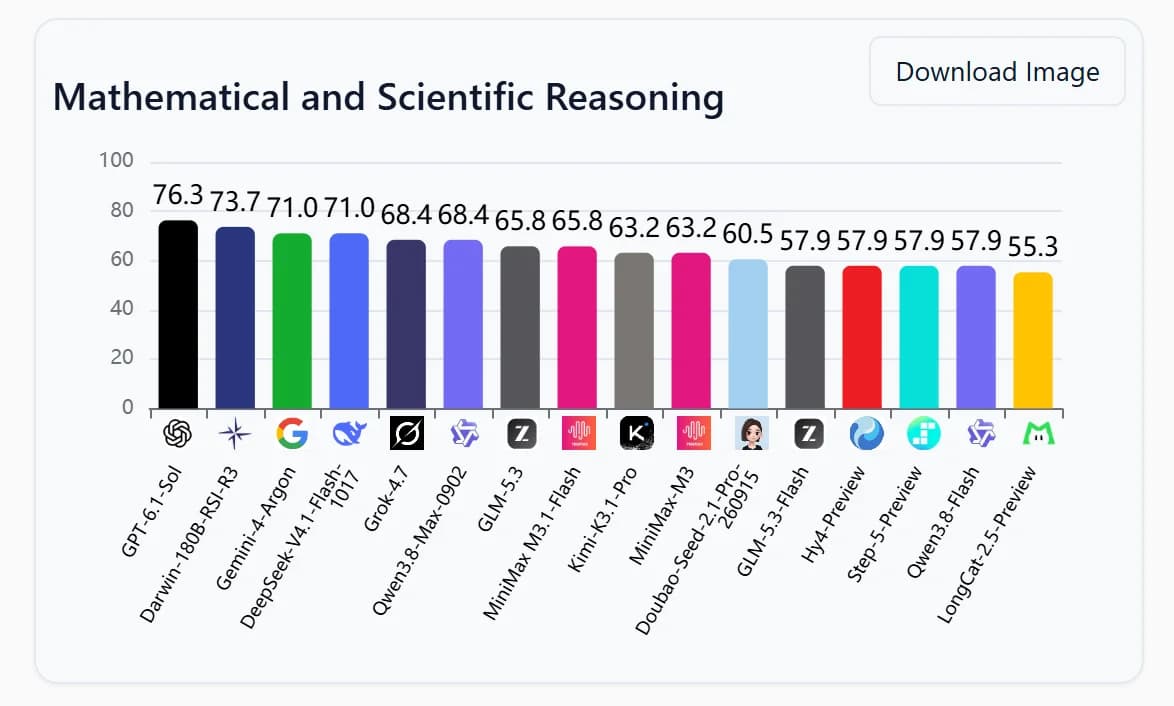
2. Mathematical and scientific reasoning: Darwin leads the open models
GPT-6.1-Sol leads at 76.32; Darwin-180B-RSI-R3 ranks second across all 19 models and first among open models at 73.68.
All models tied at the table’s lowest included score are shown.
Darwin is 2.64 points below GPT and 2.63 points above Gemini and DeepSeek. Mathematical and scientific reasoning is Darwin’s clearest strength in this evaluation: it outperforms every other open model in the category and all closed models except GPT.
Other results reinforce the value of category-level analysis. Spark-X2.6 scores 68.42 in reasoning, but 26.92 in coding and 12.07 in precise instruction following. Strong performance on one evaluation does not carry over automatically to the others. These figures also should not be divided to express ratios of underlying ability: the categories may have different task distributions and scoring methods.
Useful follow-up tests would separate mathematics from science, assess final-answer correctness alongside the validity of the reasoning, and control inference-token budgets and tool access.
3. Hallucination control: Gemini leads, with Kimi ahead of the other open models
Gemini-4-Argon leads at 83.19; Kimi-K3.1-Pro is the open-model leader at 67.78.
Gemini leads Kimi by 15.41 points. Kimi scores 4.17 points above GPT and 18.89 points above the next-highest open model, GLM-5.3-Flash.
Within the GLM family, Flash’s 48.89 exceeds GLM-5.3’s 43.61, despite GLM-5.3 having the higher overall score. Model naming and aggregate placement are therefore insufficient guides to performance on this category.
These scores are not hallucination rates. A score of 83.19 cannot be converted into either an 83.19% hallucination rate or a 16.81% error rate. Without the task definitions and scoring protocol, it also cannot be translated into a factual-error rate for a deployed service.
For document question answering or retrieval-augmented generation, follow-up evaluation should distinguish supported answers, appropriate abstention when evidence is missing, and correction of false premises. A system that avoids errors by declining nearly every question may still be unhelpful. Both answer quality and abstention behavior matter.
4. Precise instruction following: a shared lead for Gemini and GPT
Gemini-4-Argon and GPT-6.1-Sol share the highest score at 68.97; Kimi-K3.1-Pro leads the open models at 44.83.
The difference between the highest displayed score and the open-model leader is 24.14 points, the largest numerical difference of that kind across the five categories. Because category difficulty and scoring may differ, this should not be interpreted as the largest real-world capability gap.
Kimi and DeepSeek are relatively close, separated by 1.73 points. Choosing between them requires testing the constraints of the intended workflow rather than treating this difference as decisive.
GLM-5.3 illustrates another distinction: it scores 53.85 in coding and 77.60 in ultra-long context, but 17.24 in precise instruction following. Processing complex inputs and satisfying detailed output constraints warrant separate checks.
For automation, useful tests include JSON-schema compliance, missing required fields, unwanted explanatory text, and simultaneous satisfaction of multiple constraints. These are proposed follow-up tests, not a verified description of SuperCLUE’s task set. Format compliance should also be assessed independently from factual correctness.
5. Ultra-long context: Gemini leads, while Kimi is close to GPT
Gemini-4-Argon leads at 95.63; Kimi-K3.1-Pro is the open-model leader at 87.25.
Gemini leads GPT by 7.49 points and Kimi by 8.38. The GPT–Kimi difference is only 0.89 points. That small margin makes Kimi particularly relevant to long-context comparisons with GPT, with workload-specific testing needed to choose between them.
Among open models, Kimi leads GLM-5.3 by 9.65 points, and GLM-5.3 leads DeepSeek by 11.35. DeepSeek’s coding advantage therefore does not extend to this category. Shortlists for code-centric and long-document workflows may reasonably differ.
A long-context benchmark score does not specify a model’s maximum supported context window. Accepting a large input is distinct from reliably finding information in its middle or connecting evidence across multiple documents.
Deployment tests should vary input length, evidence position, and the amount of distracting material, while measuring retrieval, summarization, and multi-document reasoning. Time to first token, memory requirements, and cost at the expected request volume also need separate measurement.
Applying the results to real workloads
The category results provide a practical starting point for model selection. DeepSeek belongs on a coding shortlist, Darwin on a mathematical and scientific reasoning shortlist, and Kimi on shortlists for hallucination control, instruction following, and long-context work among open models.
For deployment, validate those strengths on the intended language and tasks using consistent prompts, inference budgets, and tool access. Record the exact model revision, inference engine, numerical precision, and hardware, then measure correctness alongside latency, memory use, and cost. Chinese-focused benchmark results should be tested separately for Korean or other deployment languages.
The published scores are benchmark results, not statistical guarantees. The detailed task definitions, evaluation settings, confidence intervals, and aggregate weighting formula were not verified for this article. In particular, the overall score should be read directly from the source rather than reconstructed as a simple average of the five categories.
All 19 models in descending overall score order
The table below follows the source’s descending overall score order. “Overall position by score” shows each model’s position among all 19 entries. The separate numbered-rank column preserves SuperCLUE’s policy-defined ranks, including its ties and dashes for international entries.
Gemini ranks first by overall score at 73.62, followed by GPT at 71.76 and Kimi at 61.46. Kimi is the highest-scoring open model, ahead of DeepSeek’s 58.95 by 2.51 points, and holds No. 1 in the source’s numbered ranking.
Kimi leads the open models in three categories; DeepSeek leads in coding and also scores highly in reasoning. These profiles help identify candidates for different workloads. Without the aggregation formula, however, the contribution of each category to the overall score cannot be quantified.
Darwin is ninth overall at 43.08, between Qwen3.8-Max-0902 at 43.22 and Hy4-Preview at 42.96. These close scores illustrate the difference between descending score positions and the source’s grouped numbered ranks: Qwen and Hy4 share rank 5, while four models from 42.06 to 41.17 share rank 6.
Conclusion
The November results favor a task-specific reading. GPT leads the displayed coding and reasoning scores; Gemini leads hallucination control and ultra-long context; and the two tie in precise instruction following. Among models labeled open, DeepSeek leads coding, Darwin leads reasoning, and Kimi leads the other three categories as well as the overall score comparison.
These results are a starting point for evaluation, not a universal deployment recommendation. The next step is to test relevant languages and real workloads under consistent settings, measuring correctness alongside cost and latency.
Darwin-180B-RSI-R3, from VIDRAFT, is the only model from a Korean developer among these 19 entries. It places ninth overall with 43.08 points, second in mathematical and scientific reasoning with 73.68, and first among open models in that reasoning category. Its strongest result is therefore clear: a Korean-developed open model stands near the top of this evaluation in mathematical and scientific reasoning.
Sources
- SuperCLUE official website: results released November 5, 2026, and ranking guidance. The live page may change after this snapshot.
- SuperCLUE November 2026 official Excel data: model names, organizations, open/closed classifications, overall and category scores, and official ranks. Numerical values in this article are displayed to two decimal places.