AI is making software faster and cheaper to build, lowering barriers to entry and intensifying competition for SaaS platforms. That growth is clearly visible on Stripe, where the number of new platform businesses has increased more than 180% year over year.
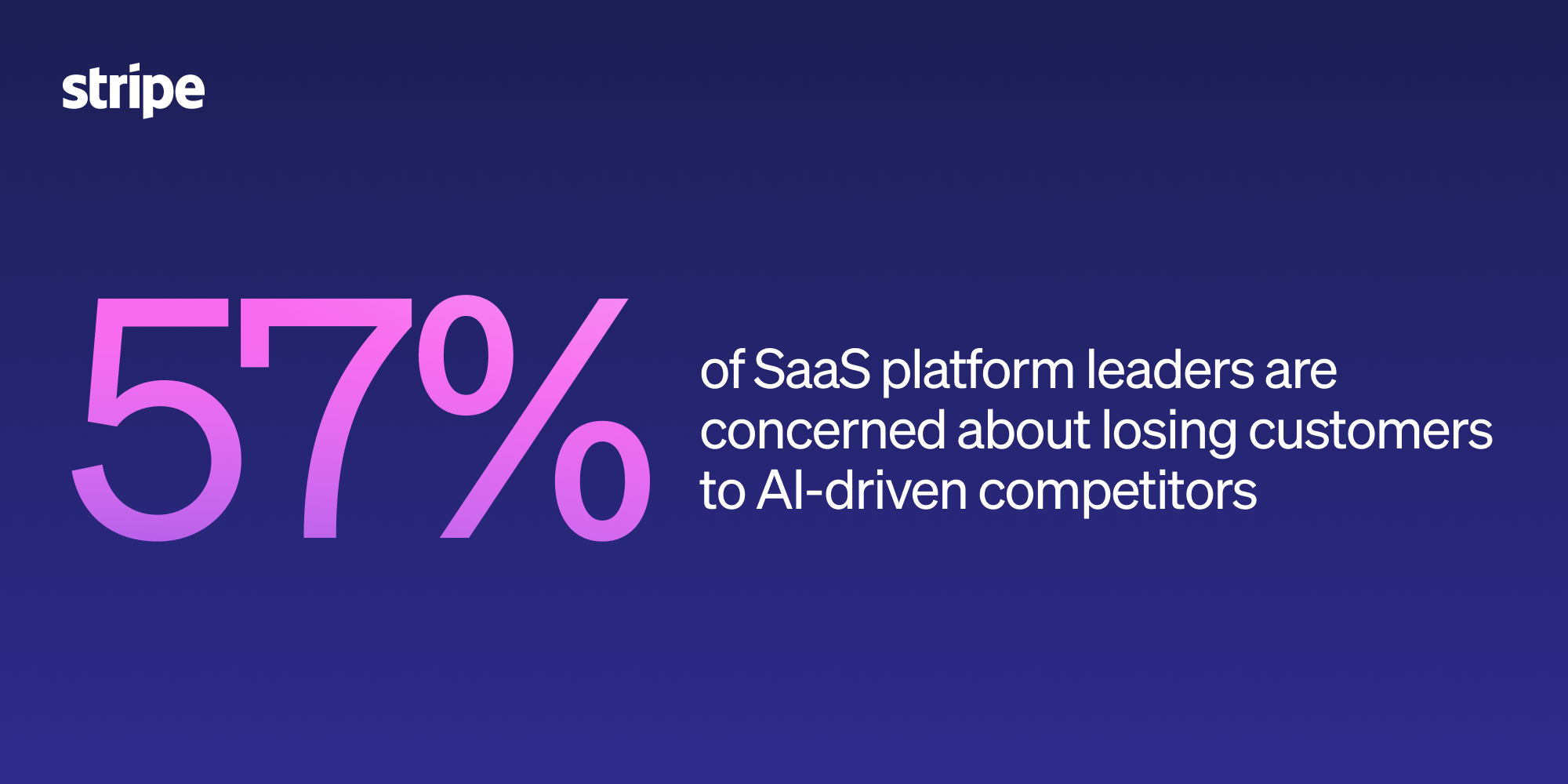
We surveyed 200 platform leaders across North America and Europe, half of whom use Stripe, and found that 57% are concerned about losing customers to AI-driven competitors. Leaders are reworking how they build products, set prices, and retain customers to protect margins and make their products harder to displace.
Our survey identified four ways SaaS platforms are adapting:
- Deploying AI internally and in customer-facing products
- Testing usage- and outcome-based charges alongside subscriptions
- Rebalancing their revenue mix around how their customers operate
- Offering embedded finance products to strengthen retention
1. Platforms are pursuing AI efficiency and AI products in parallel
Platforms are applying AI on two fronts: inside their own operations and in the products they sell. Internally, 81% have used AI to accelerate research and development over the past 12 months, and 58% are rebuilding workflows around agents. At Granum, for example, agents automate tasks across customer-facing teams, helping support staff handle 23% more tickets and onboarding specialists serve 34% more customers.
On the product side, 79% have added AI features to existing products over the past 12 months. Canva recently took that approach with Canva AI 2.0, a conversational, agentic workspace within its design suite.
These investments are already paying off. Forty-five percent of platform leaders say their AI investments have lowered operating costs. At GoodLeap, those costs have fallen even as payment volume has increased.
2. Seat-based pricing is losing ground, but not going away
Platforms adding AI are testing pricing tied to usage and outcomes as they look for ways to cover inference costs. Forty-four percent plan to make multiple pricing changes in the next 12 months.
Seat-based pricing will remain part of the mix, but fewer platforms expect it to be their primary model, falling from 16% in 2026 to 11% in 2027. Horizontal platforms are moving away from seats faster. By 2027, just 7% expect seats to remain their primary pricing model, compared with 14% of vertical SaaS.
The key difference is how closely growth has been tied to customer headcount. Horizontal platforms have traditionally grown by selling more seats to larger customers. But fewer seats may be needed as agents take on work that people used to do. Vertical SaaS platforms typically sell only a handful of seats to each merchant, but they’re still tied to people using the software.
Seat-based pricing still gives SaaS platforms a predictable base. One in four plan to keep per-seat fees, then charge separately for agent work based on credits, usage, or outcomes. Zendesk, for example, now charges for resolutions alongside its subscriptions. Another 7% plan to treat agents like seats, charging a base fee plus a license for each agent. The range of approaches suggests that no single metric captures every kind of agent work.
3. Horizontal and vertical platforms are split on leading revenue models
Our survey found a split in expected revenue models by platform and customer segment. Among horizontal platforms serving midsize and enterprise businesses, just 3% expect embedded finance—including payments, financing, financial accounts, and card issuing—to generate the largest share of revenue in 2027. That figure rises to 34% among vertical platforms serving micro and small businesses. That reverses for usage and hybrid pricing: 60% of the horizontal cohort expect these models to lead revenue, compared with 22% of the vertical cohort.
The gap likely comes down to merchant needs. Small businesses are more likely to want payments and working capital built into the software they already use. Vertical platforms can offer these services because they sit close to the transaction. Larger businesses usually have their own payments and financing infrastructure. But they also need more software to run their complex operations, so software fees can make for a steadier revenue source for horizontal platforms.
4. Embedded finance is emerging as a core retention strategy
Beyond its revenue potential, embedded finance can help platforms retain customers. Sixty percent of platforms say it will be very important or mission-critical to retention over the next 24 months.
Embedding payments and financial services deepens merchant relationships and makes a platform harder to replace. Payments also generate proprietary transaction data, which more than half of surveyed leaders named as a top competitive advantage. Platforms can use payments data to offer financing and let merchants manage more of their finances in one place.
More platforms on Stripe are following that playbook. As of September 2026, the number of active platforms offering Stripe Capital nearly doubled year over year.
Hear from SaaS leaders
Stripe helps more than 19,000 platforms onboard new merchants, accept payments, and grow revenue. Join SaaS leaders across verticals at our SaaS Platform Summit on Tuesday, November 3, in San Francisco to learn how they’re updating their pricing, products, and business models for AI.
Methodology
Stripe surveyed 200 C-suite and director-level leaders at SaaS platforms across North America and Europe in March 2026. Respondents represented startups operating for one to two years, early-stage companies operating for three to five years, established companies operating for six to 10 years, and mature companies operating for more than 10 years. The sample was evenly divided between vertical and horizontal SaaS platforms. Half of the respondents were businesses on Stripe.