- Enables users to interact with operational data through natural-language conversations
- Helps instantly uncover patterns, bottlenecks, and opportunities beyond standard reporting
- Recommends actions to maximize performance of imaging systems and unlock measurable value
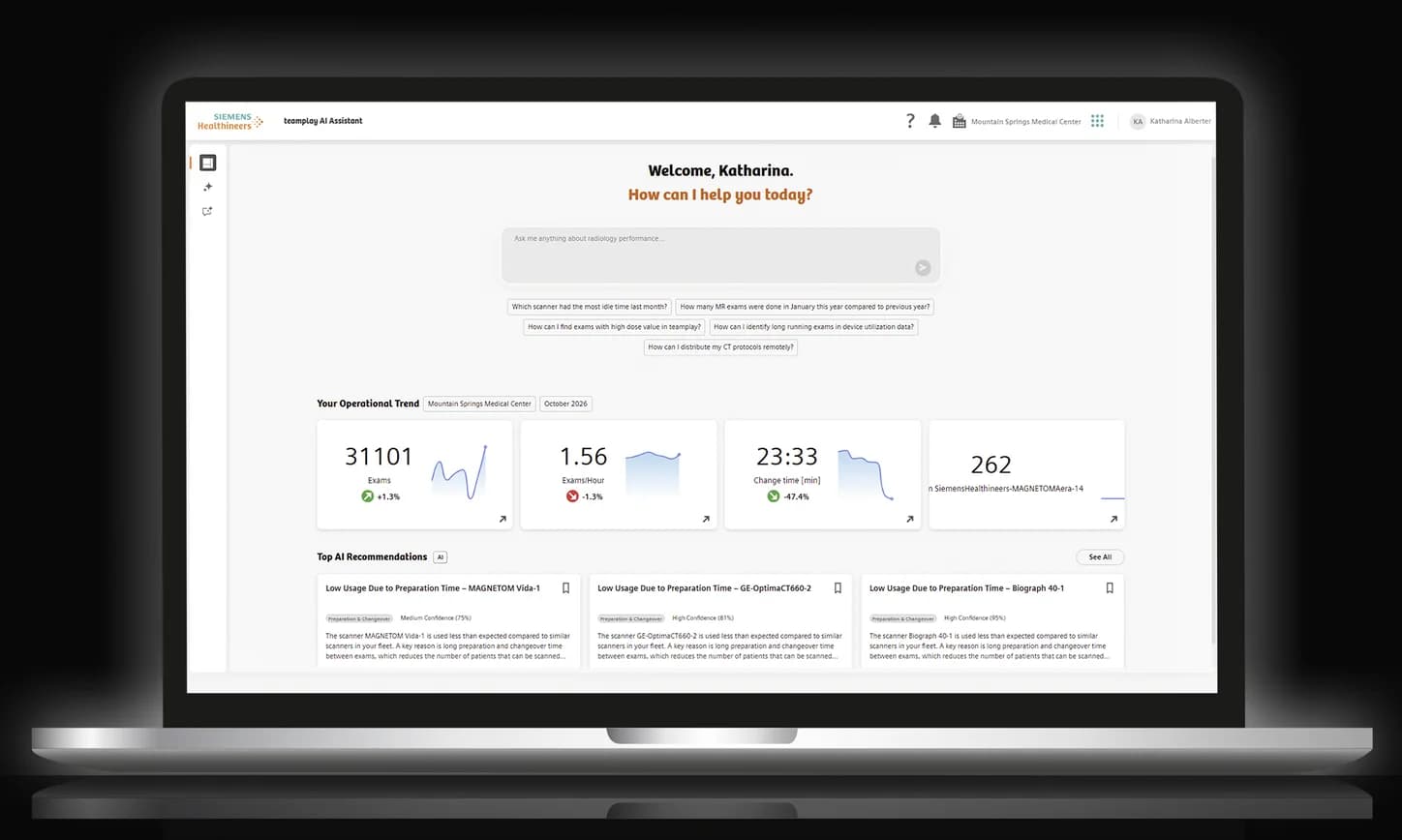
At this year's Congress of the Radiological Society of North America, Siemens Healthineers is presenting teamplay AI Assistant, an intelligent performance solution. The assistant helps users quickly understand and act on operational data to efficiently manage their imaging equipment. Based on agentic artificial intelligence (AI) and trained to understand natural language, teamplay AI Assistant delivers relevant operational information at a glance, making scanner fleet performance easier to understand and optimize.
Developed jointly by Siemens Healthineers and Microsoft Frontier Company, teamplay AI Assistant combines the deep clinical expertise and extensive healthcare data ecosystem of Siemens Healthineers with Microsoft’s trusted cloud and AI technology, including Microsoft Azure and Microsoft Foundry. Built on an advanced agentic AI architecture, it dynamically brings together relevant information from Siemens Healthineers data sources to provide users with relevant insights and recommendations, helping healthcare professionals access and act on information more efficiently.
“The future of healthcare will be shaped not by the amount of data we collect, but by how effectively we can use it,” said Christian Zapf, Head of Digital and Automation at Siemens Healthineers. “Yet many organizations still struggle to turn the fragmented performance data of their medical equipment into clear action. Our teamplay AI Assistant helps close that gap by enabling users to ask questions in natural language, understand what is driving performance, and receive recommendations on where to act next.”
With teamplay AI Assistant, users such as MR or CT technologists, heads of operations or radiology department heads can receive concise explanations, reports and visualizations, as well as recommended actions within seconds – rather than manually reviewing multiple dashboards and reports. The assistant can identify hidden patterns, bottlenecks and opportunities and recommend actions prioritized by their potential organizational impact, helping teams focus on areas with the greatest improvement potential. For example, it identifies when scheduling patterns leave scanners unused and recommends adjustments to make better use of available capacity.
Lindsey Crowe, MRI physicist at Hôpitaux universitaires de Genève (University Hospital Geneva), Switzerland, who has been part of the beta testing cohort for the teamplay AI Assistant, said: “It does save time. When you need to provide evidence or support for a statement and someone asks whether you have data to back that up, it becomes much easier to find and present the relevant information with the help of AI.”
The teamplay AI Assistant is integrated into teamplay Performance Management and is available through the teamplay platform from Siemens Healthineers.
Further information on the teamplay AI assistant can be found here: https://www.siemens-healthineers.com/digital-health-solutions/fleet-performance-management.