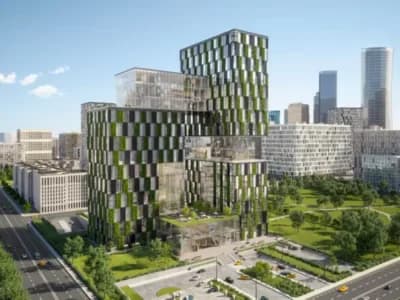
Construction is the backbone of modern society, playing a vital role in building essential structures like homes, schools, hospitals, and the infrastructure that powers daily life. As a dynamic and multifaceted industry, construction involves diverse projects, each with a specific purpose that contributes to the development of communities. From residential buildings to large-scale commercial developments, construction not only drives economic growth, social wellbeing and technological advancements but can also help achieve net-zero goals by 2050.
The building and construction industry remains one of the world’s largest industries. In 2023, $13 trillion worth of gross annual output was devoted to construction projects globally, constituting 7 percent of global gross output.
Urbanization has also had a significant impact on the construction industry, and this impact is expected to continue in the future. As urban populations continue to grow, the demand for new and affordable construction projects, including housing, commercial buildings, and infrastructure, will increase. It is estimated that global floor area is expected to double by 2060, the equivalent of adding New York City every month for the next 40 years.
Projects centered around renewable energy, low-carbon activities, circular solutions and improved building insulation will play a significant role in reducing the sector's carbon footprint.
MAKING BUILDINGS SMART AND ENERGY EFFICIENT
ABB supports the transformation of the buildings sector with smart solutions and energy-efficient technologies that help optimize energy use and reduce emissions across offices, factories, hospitals, and homes. Key energy efficient building projects :
Germany
Electrical engineering provider BAUER Elektroanlagen supports building owners with tailor-made electrical solutions, from power supply right through to building automation. ABB buildings control and automation systems have enabled them achieve energy self-sufficiency in its pioneering Berlin operations.
Egypt
In partnership with Quasi Systems For Energy & Control Solutions S.A.E, ABB is a key technology provider for Africa's tallest building, a grand presidential palace, and numerous ministry buildings, schools, hospitals and mosques in New Alamein. Their advanced energy-saving HVACR solutions, including nearly a thousand ultra-low harmonic (ULH) drives, ensure high levels of comfort, safety, and energy efficiency across the city’s critical infrastructure in Egypt's harsh desert climate.
Spain
For IKEA, one of the fundamental pillars of their sustainability strategy is the reduction of its carbon footprint. The company’s goal is to reduce emissions by 80 percent by 2030. As HVAC systems make up about 40% of commercial building energy use, IKEA installed energy-efficient air-conditioning systems optimized with ABB drives in two of its largest stores in Spain, covering 80,000 square meters.
Sweden
A new development in Brobyholm, Sweden, is set to become one of the world's smartest residential communities, thanks to advanced technology that enables energy generation, sharing, and optimization. Residents will benefit from lower energy bills and improved sustainability, with all smart home devices seamlessly connected through a joint ABB-free@home® and Samsung SmartThings system, managed via the SmartThings app.
CONSTRUCTION VEHICLES - REDUCING RELIANCE ON FOSSILS FUELS
The global construction industry mainly uses diesel-powered construction vehicles such as excavators, cranes and dozers that are estimated to collectively emit around 400 Mt of CO₂ per year. By developing electric drivetrains and power electronics specifically designed for the demanding conditions of construction sites, ABB is helping to reduce the industry's reliance on fossil fuels, enabling these machines to operate with minimal environmental impact.
Finland
Through partnerships with manufacturers like Junttan, ABB's technology is transforming construction sites. Supported by ABB's HES880 mobile inverter, Junttan's electric piling machine is a battery-powered construction vehicle that drives piles into the ground for foundation work. This electric working machine doesn't produce CO2 emissions and dramatically reduces noise pollution. This is another example of how ABB’s technology is enabling construction sites to be safer, smarter, and more sustainable.
Norway
One such example is Nasta AS in Norway which is collaborating with ABB to rebuild construction vehicles, like excavators, for electric operation using either battery power or a direct cable connection. Electric upgrades could eliminate up to 48 tons of CO2 emissions altogether, including sulfur oxides.