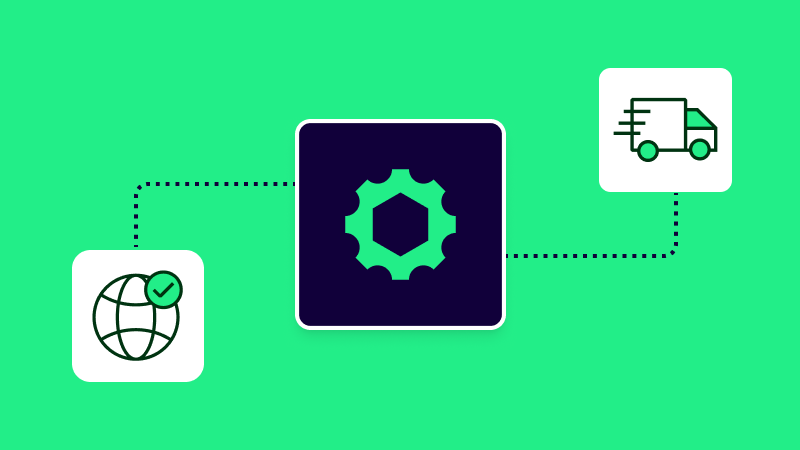
Most physical AI helps machines act. Physical AI by SAP helps businesses act. By linking robots and physical systems directly to the enterprise processes that run your organization, SAP turns physical execution into a governed, auditable extension of your business, extending the Autonomous Enterprise into the real world.
AI has gone from insight to action and now, with physical AI, it comes into the physical world.
Enterprises have made substantial investments in both AI and physical AI. AI helps business systems deliver remarkable insights and recommendations on financials, inventory, and supply chains. Physical AI creates value every day with physical systems—such as industrial robots, humanoids, sensors, or robot dogs—deployed across production lines, warehouses, field service teams, and logistics networks.
As automation, robotics, and sensing technologies have matured across industries, the volume and richness of the physical signals coming from physical execution has grown substantially; physical operations today generate continuous intelligence about factors such as asset health, task completion, quality, throughput, and exceptions.
Today, however, there is a gap between what the business knows and the intelligence generated by physical operations on the ground. This gap is one of the most common sources of operational friction across industries. It contributes to delayed responses, ill-informed decisions, and physical operations that never enter the business record. As a result, revenue and margins decrease while risk exposure increases.
From enterprise intelligence to physical action
This year at SAP TechEd, SAP revealed how our physical AI removes this operational friction: the system that runs your business is the same system that controls your physical operations.
The enterprise knowledge in your business system triggers the physical actions; physical signals arrive with the business context already attached; physical operations in the field flow back into SAP as structured data intelligence. Every physical action leaves a traceable, auditable record tied to the relevant business process.
The full context of your business is behind every physical action; verified outcomes are brought back into SAP in a secure and governed way for follow-up actions.
When the system that runs your business is also the system that governs how, when, and why physical tasks are executed, the result is a fundamentally different kind of operational capability. For enterprises already running SAP, this means physical execution inherits the intelligence, context, and governance already in place.
This is how physical AI by SAP transcends automation and extends the Autonomous Enterprise into the real world.
“Foxconn’s vision for intelligent manufacturing requires physical systems that understand business context, not just motion commands,” said Dr. Wang, head of Physical AI at Foxconn. “With physical AI by SAP, warehouse tasks from SAP Extended Warehouse Management directly orchestrate our humanoid robots and autonomous transport systems. Asset inspections triggered by maintenance plans flow to our robotic platforms and return verified outcomes back to SAP. This closed loop between enterprise systems and physical execution is what sets this collaboration apart: the robot knows why it acts, and the business system knows what happened.”
How physical AI by SAP capabilities are designed to transcend automation
1. Business-driven physical action
Physical AI is built to ground every physical execution in the business context: order priorities, safety rules, inventory status, and compliance constraints. Every action has a clear reason tied to business outcomes, and the business system remains in control of what gets executed, when, and why. The result is physical execution that is intelligent from the start, not just automated.
2. Physical evidence into digital workflows
Every physical task creates a complete audit trail and physical observations flow back into SAP automatically, transforming field outcomes into business insights rather than isolated records in a separate system. Physical world events become inputs to the decisions and processes that follow.
3. Enterprise-governed execution
Built on the SAP Business AI Platform, physical AI capabilities are designed to provide traceability, auditability, and human-in-the-loop control as first principles. Physical world data flows into SAP Business Data Cloud as new structured data products, enriching planning, predictions, and operational strategy over time.
4. Vendor and hardware agnostic
Working across device platforms, physical systems, and AI models of the customer’s choosing, customers retain freedom over their physical layer. SAP provides the business context, orchestration, and governance. Partners provide the physical execution.
Physical AI at work with customers and partners
Arçelik-LG: physical AI executes and records inbound storage tasks
Arçelik-LG is a joint venture between Turkish durable consumer, Arçelik and South Korea’s LG Electronics, manufacturing air conditioners. Physical AI by SAP enables a humanoid robot to execute and record inbound storage tasks. This has addressed the costly and persistent issue of incorrect storage placements in inbound logistics with potential savings of millions of euros.
- Associated SAP solutions: SAP Extended Warehouse Management
- Physical AI ecosystem partners: FairConsult 24|7
- Video: Arçelik-LG
Intel: physical AI in autonomous warehouse operations
Intel is one of the world’s largest semiconductor manufacturers, operating a vast global warehousing and logistics network and serves as both a proof-of-concept environment and a technology collaborator. By integrating SAP’s enterprise workflows and warehouse processes with Intel-powered edge AI and robotics technologies, warehouse transport tasks generated in SAP are automatically translated into robot missions and executed autonomously in the warehouse.
SAP provides the business context, workflow governance, and process orchestration, ensuring that every physical action aligns enterprise priorities and operational goals. Intel provides the physical AI hardware and software foundation at the edge, delivering the compute AI and real-time robotics capabilities that enable autonomous systems to perceive, decide, and act in dynamic environments. The combined capabilities of SAP and Intel create a closed-loop system; business decisions become physical actions and operational outcomes are continuously fed back into business systems.
In a proof of concept demonstrated at Intel’s Chengdu site in China, material movement is automated end-to-end, reducing both transport distances and repetitive manual handling. Physical AI capabilities from SAP and Intel demonstrate how enterprise decisions can directly drive physical execution in logistics workflows.
- Associated SAP systems: SAP Extended Warehouse Management
- Physical AI ecosystem partners: Anu Intelligence
Holcim: industrial asset inspections
Holcim is a Swiss multinational building materials and sustainable construction company, operating in heavy industry. The company has significant infrastructure assets with inspection, maintenance, and safety use cases. Since attending the Embodied AI Jam held in August 2026, Holcim has implemented physical AI capabilities for asset inspections with industrial drones and quadruped dogs.
On-site quadruped dogs inspect conveyor belts in dark, dusty areas and the status of kilns in extreme temperatures. Drones inspect assets in heights difficult for humans to reach. And end-to-end automation starts and finishes in a SAP system. In SAP’s asset management solution, the maintenance plan triggers an action for the industrial drone/quadruped dog; once the action is executed, a maintenance notification is created back into SAP.
- Associated SAP systems: SAP Plant Maintenance
- Physical AI ecosystem partners: Cyberwave, Field AI, Hybird
- Video: Holcim
Start your physical AI journey today
From warehouse operations to asset maintenance, from safety inspections to keeping your operations compliant, physical AI capabilities from SAP have the potential to transform your business. It connects the intelligence of your enterprise with real-world execution; the SAP system that you trust to run your business is the same system that informs the actions of your physical systems, be it a robot, an industrial drone, or a robodog.
As a part of Industry AI, you can begin your physical AI journey today with warehouse operations and asset inspection use cases or a physical AI use case, tailor-made to your requirements. Contact SAP via email for more information.
Lukasz Ostrowski is global head of Physical AI and Robotics at SAP.