Salesforce has agreed to acquire Braze, and the deal is expected to close in Salesforce's fiscal 2028, which begins in February 2027. Salesforce has not yet said how Braze will fit with Marketing Cloud, or what changes to pricing, support, or roadmap customers should expect.
This guide covers what is confirmed, what to ask your vendor, and how to plan a migration if you decide to move.
What Salesforce announced
Salesforce signed a definitive agreement to acquire Braze on October 20, 2026, and the deal has not closed. Here is what has been confirmed publicly:
- Announcement: Salesforce and Braze announced the agreement on October 20, 2026 (Braze 8-K, Exhibit 99.2).
- Price: about $5.66 billion in enterprise value, or $47.50 in cash per Braze Class A share (Salesforces press release).
- Timing: Salesforce expects the deal to close in its fiscal 2028, which begins in February 2027. Closing depends on Braze shareholder approval and regulatory clearance
- Braze's message to customers: Braze's CEO and co-founder, Bill Magnuson, said Braze will continue building as Braze and that he will remain CEO (Braze filing).
What is still unknown?
A lot. Acquisitions of this size usually take time to sort out, and Salesforce has not published answers to the questions customers are likely asking. Rather than guess, here is what remains open.
Open questions for Braze customers
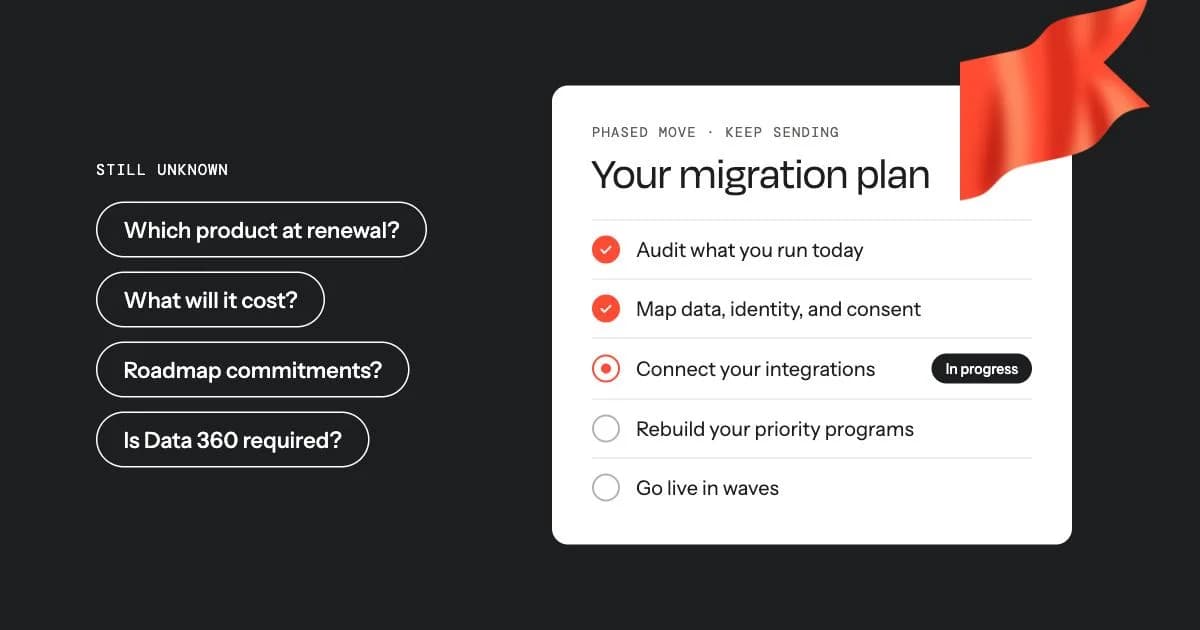
- Which Salesforce product Braze will live in, and will it stay a separate brand and product after close?
- How pricing, packaging, and bundling will work for existing and new customers, and whether contract terms change at renewal?
- What the support model, services, and partner programs look like through the integration period?
- What commitments exist on the roadmap?
Open questions for Marketing Cloud customers
- Will Marketing Cloud Engagement, Marketing Cloud Next, and Braze converge, and on what timeline?
- Which product Salesforce considers the long-term home for B2C engagement?
- How a customer running today's Marketing Cloud setup should think about renewals and roadmap while that is unresolved?
Open question for both
- Whether Braze data and Salesforce Data 360 (formerly Data Cloud) connect natively or through APIs, and what that costs?
What Salesforce has said so far is high level: Braze's real-time engagement and AI decisioning are meant to complement its broader architecture, including Data 360 and Agentforce. Braze's CEO has said Braze will keep building as Braze. Neither statement answers the practical questions above, and plans can change between signing and close.
How should you evaluate your options while the picture is unclear?
You do not need to decide today, but you can prepare. Start with the questions below, and ask your current vendor for answers in writing wherever possible.
Questions to ask your current vendor
- Which product will I be on at my next renewal, and what will it cost?
- Will roadmap, pricing, and support commitments be written into my contract through the integration period?
- Who owns my data model, my integrations, and any AI agents that talk to my customers after integration?
- When does my contract renew, and what notice or change terms apply? (Review the specifics with your own legal counsel.)
Questions to ask about your own operation
- How many people and partners does it take to launch a campaign, and how long does it take? What happens when something changes? How quickly can you iterate and make changes?
- Who owns data modeling and activation: marketing or engineering?
If you use Braze and are not in the Salesforce ecosystem, does Data 360 become part of your future?
Nobody outside Salesforce can say yet. What is public is that Salesforce describes Braze as complementing Data 360 as one layer of its broader architecture. What Salesforce has not said is whether Braze customers will need Data 360, how Braze and Data 360 will connect, or what that would cost.
So treat this as an open question to plan around, not an assumption. Three things to work through:
- Ask directly. Put the question to your Braze account team: Will my Braze contract require or bundle Data 360 at renewal? Will Braze data connect natively or by API, and who maintains that connection?
- Map your current data setup. Many Braze customers pair it with a separate CDP or warehouse. Know which system holds your source of truth today, so you can judge whether another data layer would add value or just add cost and complexity.
- Decide what you want your data foundation to be. If you would rather keep customer data, identity, analytics, and activation in one place rather than adding a layer, that is worth weighing now. It is also the reason some brands are looking at a platform with a built-in data foundation. If using a 3rd party CDP is ultimately your desired architecture, you’ll want to make sure your current setup will be supported.
If you already run Salesforce across sales, service, or commerce, the picture is different, and consolidation may be the point. The key is making that choice on purpose rather than by default.
Why are brands choosing Klaviyo?
Brands that move to Klaviyo tend to cite the same four things. They want their data, AI, and channels working on one customer profile, and they want marketers able to act without an engineering queue.
- Marketers move without engineering. Klaviyo keeps one profile with the full history and no up-front event whitelisting, so teams can launch, segment, and personalize on their own. Developers still connect data sources and build with APIs and custom objects. The aim is to free their time for bigger projects.
- One platform absorbs the stack. Email, SMS, RCS, WhatsApp, mobile push, data, analytics, and service run on the same profile, with 400+ prebuilt integrations. Fewer tools means fewer handoffs to manage.
- Attribution you can trust. Klaviyo offers omnichannel, multi-touch attribution (available with Advanced Klaviyo Data Platform or Marketing Analytics) so budget follows what drives revenue across the journey, not only the last click.
- AI that works on your data. Composer, Klaviyo’s AI agent, predictive models and Customer Agent run on the same profile as your marketing, rather than on a separate data layer. And, you can pull that data into a headless environment like Claude or OpenAI, or use Composer within Klaviyo itself.
What this looks like in practice
- Daily Harvest reduced tech costs by 18% by consolidating tools in Klaviyo.
- Helen of Troy reported 40% savings on total cost of ownership after switching to Klaviyo.
- Dollar Shave Club reported 30% lower total cost of ownership with Klaviyo B2C CRM.
Klaviyo is an independent, public company that powers 205,000+ brands across 100+ countries. For a side-by-side view, see the full Klaviyo vs Braze and Klaviyo vs Salesforce Marketing Cloud pages.
How do you plan a migration from Braze or Marketing Cloud?
Plan a migration as a phased move that keeps your current program sending while you build. Treat it as a chance to redesign, not to copy every legacy program one for one. That is how Klaviyo's migration approach works: map your data, rebuild what earns revenue, then go live when you are ready.
Here are a few practical steps:
- Audit what you run today. List every program, template, form, integration, and channel. Rank programs by revenue and lifecycle importance, and decide which to rebuild, consolidate, or retire.
- Map data, identity, and consent. Decide how each person is identified and matched across email, phone, and any customer IDs. Map existing consent and subscription status before anything sends. Validate sample records against your source system.
- Connect your integrations. Connect your commerce platform and key data sources, plus anything feeding your warehouse or CDP. List every connection that your programs depend on, including inbound feeds and outbound exports.
- Rebuild your priority programs. Start with the highest-value flows, such as welcome, abandoned cart, post-purchase, and win-back. Recreate email templates and forms in Klaviyo while your current platform keeps sending.
- Prepare your channels. Confirm sending domains and authentication for email. For SMS and WhatsApp, check number types, sender registration, and consent requirements early, since carrier and platform approvals can take time.
- Test, then go live in waves. Validate each program before it launches. Move lower-risk programs first, assign one sending owner per audience during the overlap so no one gets duplicate messages, and agree on rollback criteria in advance.
- Retire the old platform. Once every program runs in Klaviyo and results look right, decommission the old system and archive any historical reporting you want to keep.
Frequently asked questions
Is Salesforce acquiring Braze?
Yes. Salesforce signed an agreement to acquire Braze on October 20, 2026. The deal is subject to Braze shareholder approval and regulatory clearance.
When will the Salesforce and Braze deal close?
Salesforce expects it to close in its fiscal 2028, which runs from February 2027 to January 2028.
What happens to Braze customers after the acquisition?
Salesforce has not said which of its products Braze will live in, and has not published pricing, support, or roadmap commitments for Braze customers. Braze's CEO has said Braze will continue building as Braze. Ask your account team what will be written into your contract.
What does the acquisition mean for Salesforce Marketing Cloud customers?
Salesforce has not said how Braze will fit alongside its Marketing Cloud products. Customers on Marketing Cloud can ask which product Salesforce considers the long-term home for B2C engagement and plan renewals around the answer.
Will Braze customers need Salesforce Data 360?
Salesforce has not said. It describes Braze as complementing Data 360, but has not published whether Braze customers will need it or how the two will connect.
How do I migrate from Braze to Klaviyo?
You map your existing data and consent into Klaviyo, connect your integrations, and rebuild your flows. It is a phased move, sequenced so your current program keeps sending while you set up.
How do I migrate from Salesforce Marketing Cloud to Klaviyo?
The approach is the same: audit your programs, map data and identity, rebuild priority journeys, and move over in waves. Plan to rebuild personalization logic and audience definitions by purpose rather than copying them as is.
Does Klaviyo work at enterprise scale?
Yes. Klaviyo is a public company powering 205,000+ brands, with custom objects, flexible APIs, and unlimited history.
Do my marketers need developers to run Klaviyo day to day?
Marketers build and launch campaigns, flows, segments, and personalization in Klaviyo on their own. Developers still connect data sources and build with APIs and custom objects.
Can I run email, SMS, and WhatsApp together in Klaviyo?
Yes. Email, SMS, RCS, WhatsApp, and mobile push run from the same customer profile, with combined reporting across the whole program.
Plan your next move on your timeline
Whether you stay put, wait for more clarity, or start planning a move, it helps to know what you would be moving to. Unify your customer data, run every channel from one profile, and see what earned the revenue with Klaviyo.