AI tools are multiplying. The Open edX platform gives them somewhere to run.
Every week brings a new AI tutor, course generator, or grading assistant. Most of them work in isolation: their own login, their own data store, their own idea of which model to call. For the institutions running learning at scale, that creates a new problem. More tools do not automatically mean better learning.
At a recent Open edX® community meetup on AI tools, three presenters showed a different path.
- Ed Zarecor of Axim Collaborative walked through the Open edX® AI Extensibility Framework.
- Nicole Kessler and Ronak Pansuriya of Abstract Technology demoed AI Studio and AI Assistant.
- Zameel Hassan of Blend-ed introduced the open source Open edX MCP server.
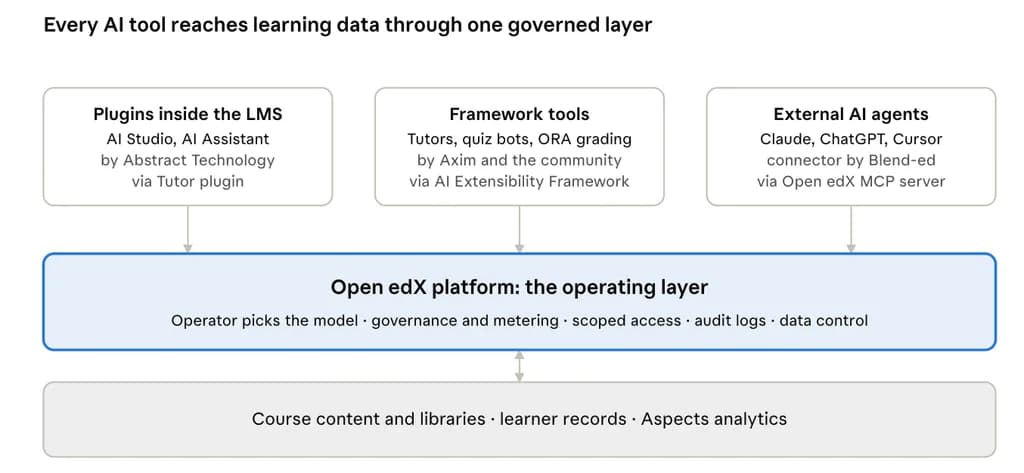
Taken together, the three talks point to the same idea: the Open edX® platform is becoming the operating layer for AI in learning. It is the governed foundation that any AI tool can plug into, whether that tool lives inside the LMS, ships as a plugin, or runs in an AI agent like Claude or ChatGPT.
What does “operating layer for AI” mean?
An operating layer is the shared foundation that every AI tool runs on. Instead of each tool wiring itself to course content and learner data on its own terms, the Open edX® platform provides one governed connection. Operators choose the model, set the rules, and see the results in one place.
The meetup showed three ways AI tools connect to that layer:
Whichever way a tool comes in, it reaches content and learner data through the same platform, under the operator’s rules.
The foundation: the Open edX® AI Extensibility Framework
The AI Extensibility Framework lets operators plug AI tools into the learner and educator experience through one managed framework. Axim Collaborative started the work about a year ago, with Felipe Montoya and Henry Pulgarín of eduNEXT central to its architecture. A first version was presented at the Open edX® Conference.
What it does today
- For instructors: ask a chatbot to pull multiple-choice questions from course content and save them to a content library, where a human reviews and edits them.
- For learners: use a chatbot that explains content, quizzes them, or generates flashcards.
- For measurement: interactions flow into Aspects, the Open edX® analytics platform, so teams can see how each tool affects learning.
Why “better, not more” is the design principle
Ed Zarecor cited recent education research meta-analysis raising concerns about how rarely edtech efficacy is measured. His argument: AI makes it easy to build more, but the goal is to build better, with differences that can be proven.
The Open edX® platform is unusually well placed for this. It has reached well over 165 million learners since its open source release. That scale makes it possible to run learning loops: propose a tool as an experiment, measure results, learn, and feed what works back into the roadmap. Proven tools can then be productized for every Open edX® installation.
What comes next: a thin API layer
The biggest lesson so far is that AI needs one simple, consistent API everywhere it plugs in. An architectural decision record (ADR 12, pull request 242 in the AI extensions framework repository) proposes a thin API layer, starting with XBlocks.
XBlocks can already call an LLM directly, but that leaves operators with little control. The new layer gives that control back:
- Operators set which models instructors can use.
- Metering and governance are applied consistently.
- System prompts are enforced on the back end.
- Every interaction is logged the same way and flows into Aspects.
The layer is meant to stay thin so it can extend beyond XBlocks to forums, recommendations, and the course catalog. The first feature to use it is an AI grading step in Open Response Assessment (ORA), which is itself an XBlock. Reusable prompts and workflows that authors can share in Studio are also on the roadmap.
AI is changing how Open edX® platform itself is built
Axim is also tracking AI in the project’s own development. Since February 2026, the share of merged pull requests built with AI assistance has risen steadily. That data will appear in the Open edX® Impact Report coming in December. The same principle applies here: use agents to build better code faster, not a codebase no one understands.
Inside the platform: AI Studio and AI Assistant from Abstract Technology
Abstract Technology, a Berlin-based Open edX® verified service provider and core contributor, has delivered more than 150 Open edX® projects over 11 years, reaching over a million users in 20+ countries. Its new AI toolkit targets the daily work of building courses and running a platform. Both tools keep a human in the loop for every change, let operators choose the model, and keep data with the operator.
AI Studio: from one idea to a full course
AI Studio opens from a button in Open edX® Studio. An author enters one prompt, such as “Introduction to Python for adult learners,” and answers planning questions about audience, goals, pacing, assessment, and structure. Several specialist AI tools then build a full outline of sections, subsections, and units that mirrors Studio.
Key capabilities:
- Skills: instructions that tell the AI how to write, for example simple and friendly.
- Project files: upload source documents so generated content is grounded in your own material.
- Templates: save a course structure and reuse it.
- Course settings: drafts the overview, short description, and effort estimate for approval.
- Three-level validation: checks structure (empty units, missing welcome or overview), assessments, and teaching quality against a chosen pedagogy.
- Export: create a new course or import into an existing one in one click, or download it.
- Translation: translates a whole course, including HTML content, quizzes, and video transcripts.
AI Assistant: run the platform by asking
AI Assistant sits inside both the LMS and Studio, and it knows who is asking. Learners get a limited set of tools; staff and admins get platform-level access.
- Learners can check upcoming assignments, see their grades, find teams, bookmark units, and update their profile.
- Admins and instructors can summarize course status, manage dates, enroll or unenroll learners (including bulk CSV uploads), change course modes, configure certificates, and toggle discussion notifications.
- Authors in Studio can get grading policy suggestions, scan content quality, and manage advanced modules. Deletion is blocked for security.
One standout: course rerun date shifting. Moving every date in a course to a new run took one client about 18 hours by hand. AI Assistant previews the full date shift in about five minutes and applies it on confirmation.
Both tools are delivered as a Tutor plugin with a frontend MFE and a Python/Django backend, compatible with the Ulmo and Verawood releases. They currently integrate with the platform directly rather than through the AI Extensibility Framework. Media generation and interactive components are on the roadmap, along with connections to internal APIs, LTI tools, and MCP servers. Both are available for testing, with open source release under discussion.
Outside the platform: Open edX® MCP from Blend-ed
Blend-ed built AI into the Open edX® platform for years: a learner assistant, an in-course AI tutor, a staff admin assistant, and an AI course creator that about 350 organizations tried. Then customers started asking a different question. Their planning, research, and content drafting already happen in Claude or ChatGPT. Why not bring the platform there?
The answer is the Open edX® MCP server, released as open source under the AGPL license. Its premise: control belongs where the context is. MCP (Model Context Protocol) lets an AI agent like Claude, ChatGPT, Codex, Cursor, or VS Code connect directly to an Open edX® instance.
What an agent can do through it
- Manage people and access: enroll learners, assign permissions.
- Create courses, read outlines, and publish edits.
- Generate certificates.
- Pull reports and analytics such as enrollment counts and learner lists.
Because the agent already has its own capabilities, the combination goes further. In the live demo, Claude pulled platform analytics and produced a branded monthly learning report and slide deck, scheduled that report to run on the first of each month, and built an at-risk learner list and a weekly academic briefing. An admin traveling with only a phone can enroll a learner by asking.
Guardrails built in
- Staff checks: confirms the request comes from an authorized staff user.
- Dry runs: previews every change and asks for confirmation before it happens.
- Scoped keys: each MCP key, minted in Django admin, gets specific scopes and an optional expiry.
- Rate limits and audit logs: every action is recorded.
Installation
Install the Tutor Open edX® MCP plugin [pip install tutor-contrib-openedxmc], rebuild the Open edX® and MCP images, and launch. A Django plugin is included. It supports Ulmo and later, and has been tested on Redwood and Teak. github.com/blend-ed/openedx-mcp
Operator control: data, privacy, and model choice
Across all three talks, one principle held: the operator decides. No part of the Open edX® approach to AI forces personal data to be shared with an LLM.
- Model-agnostic by design. The AI Extensibility Framework has been connected to ChatGPT, Claude, and Gemini (with help from UTEC), and tested with open models like DeepSeek. Abstract Technology’s tools run on OpenAI or Anthropic models, or on a local LLM. Blend-ed’s MCP works with any MCP-capable agent.
- Self-hosted when it matters. An organization can host an open source model on its own infrastructure and connect it through the framework, so learner data never leaves its servers.
This is why Axim describes the Open edX® platform as a building block for digital public infrastructure: software that organizations and nations can run themselves, with full control over where their data goes.
Frequently asked questions
Can I use AI tools with the Open edX® platform?
Yes. You can add AI through the Open edX® AI Extensibility Framework, install plugins such as Abstract Technology’s AI Studio and AI Assistant, or connect an AI agent like Claude or ChatGPT through the open source Open edX® MCP server.
Which AI models work with the Open edX® platform?
The Open edX® approach is model-agnostic. Tools shown at the meetup run on OpenAI, Anthropic Claude, Google Gemini, and open source models such as DeepSeek, including self-hosted local models.
Do Open edX® AI tools require sharing learner personal data?
No. Each Open edX ®operator controls what data is shared with an LLM. Operators can self-host models so data never leaves their infrastructure.
What is the Open edX® MCP server?
It is an open source (AGPL) Tutor and Django plugin from Blend-ed that connects AI agents to an Open edX® instance. Agents can manage enrollments, edit courses, issue certificates, and pull reports, with scoped keys, dry-run previews, rate limits, and audit logs.
Can AI grade assignments in the Open edX® platform?
An AI grading step for Open Response Assessment (ORA) is the first planned feature built on the framework’s new thin API layer.
Do these AI tools train on my course content?
The tools demoed do not train models. They use existing LLMs and ground responses in your course content and uploaded files at the time of use.
How do I know if an AI tool improves learning?
The AI Extensibility Framework logs interactions to Aspects, the Open edX® analytics platform, so operators can run experiments and measure impact on learners.
Get involved
The operating layer is being built in the open, and community input shapes what comes next.
Join the AI Extensions Working Group . It meets once a month to set the scope of the framework’s next phase.
- on the thin API layer and share which services XBlock and integration authors need.
- Test the tools. Contact Abstract Technology to pilot AI Studio or AI Assistant, or install the Open edX® MCP server from Blend-ed.
- Stay tuned for the Open edX® impact report in December, with new data on AI in the project’s development.
Watch the full meetup recording and explore more AI tools in the Open edX® Marketplace.