
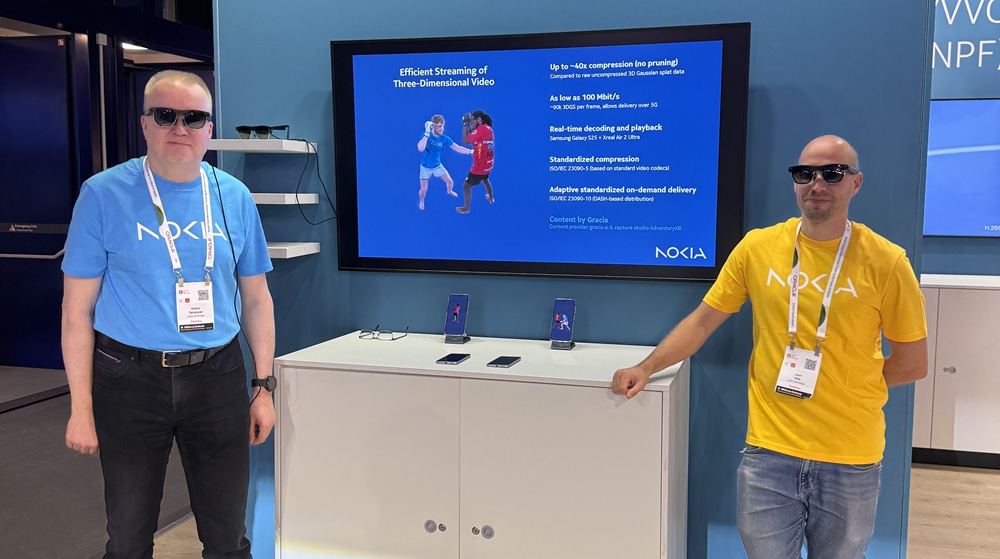
At IBC 2026, Nokia demonstrated a new milestone in volumetric video: dynamic Gaussian Splat streaming based on MPEG Visual Volumetric Video-based Coding (V3C) and MPEG V-PCC Gaussian Splat Coding (GS4), delivered using MPEG DASH. The demonstration showcased photorealistic volumetric content streamed to Samsung mobile devices, and XREAL XR glasses, highlighting an interoperable, standards-based path towards scalable volumetric media services. This demonstration builds on MPEG standards such as MPEG V-PCC Gaussian Splat Coding (ISO/IEC 23090-5) and DASH-based delivery of volumetric content (ISO/IEC 23090-10).
The demonstration combines GS4 encoding, MP4-based storage and DASH streaming with real-time volumetric rendering on consumer devices, demonstrating that dynamic Gaussian Splats can be delivered using the same adaptive streaming principles that have enabled the global success of video streaming. By leveraging international standards which are developed by ISO/IEC JTC1/SC29 (MPEG) and existing streaming architectures, the approach helps accelerate ecosystem adoption while maintaining interoperability across networks, devices and XR platforms.
For device manufacturers, Gaussian Splat streaming enables support for high-quality volumetric experiences through interoperable standards, reducing ecosystem fragmentation and simplifying integration across smartphones, XR glasses, and future spatial computing devices. For end users, it brings photorealistic and immersive 3D experiences that can be streamed efficiently over existing networks, making volumetric media as accessible and scalable as today's video streaming services.
“Our aim is to make volumetric media as streamable and interoperable as video is today. Combining GS4 with DASH delivery lets photorealistic 3D experiences reach mainstream devices without fragmenting the ecosystem — turning a promising technology into something the industry can actually deploy” — Ville-Veikko Mattila, Head of Multimedia Research and Standardization, Nokia.
“Gaussian Splatting is rapidly becoming a key representation for immersive visual media, but large-scale adoption will depend on interoperability. Open international standards such as GS4 provide the common framework needed to move this technology from impressive research demonstrations to deployable services. Combining standardized coding with established delivery mechanisms such as DASH is an important step towards a future in which volumetric media can be produced, distributed and consumed with the same level of interoperability and scalability that we expect from conventional video today.” — Prof. Marius Preda, Convenor, MPEG Coding of 3D Graphics and Haptics (WG 7), Institut Polytechnique de Paris.
“The demonstration has proven that the industry-prevalent ISOBMFF and MPEG DASH standards, originally developed for 2D video streaming applications, work seamlessly for emerging immersive media such as GS4. It shows that an MPEG standards-based solution will lower the entry barrier to volumetric media services and ensure fast growth of the ecosystem.” — Dr. Young-Kwon Lim, MPEG Systems (WG3) Convenor and Volumetric Systems AhG Chair, Samsung Research America.This demonstration reflects Nokia’s long-standing research and contributions in multimedia systems and immersive media coding standardization and highlights the industry's transition from experimental volumetric experiences towards deployable, standards-based streamable immersive experiences.