LTE-M vs NB-IoT looks like a spec comparison, but it’s a hardware decision you live with for the device’s whole life. NB-IoT (Cat-NB1/NB2) suits stationary devices that send small amounts of data from hard-to-reach places, like smart meters in basements. LTE-M (Cat-M1) suits devices that move, need firmware updates or must respond quickly, like trackers and alarms.
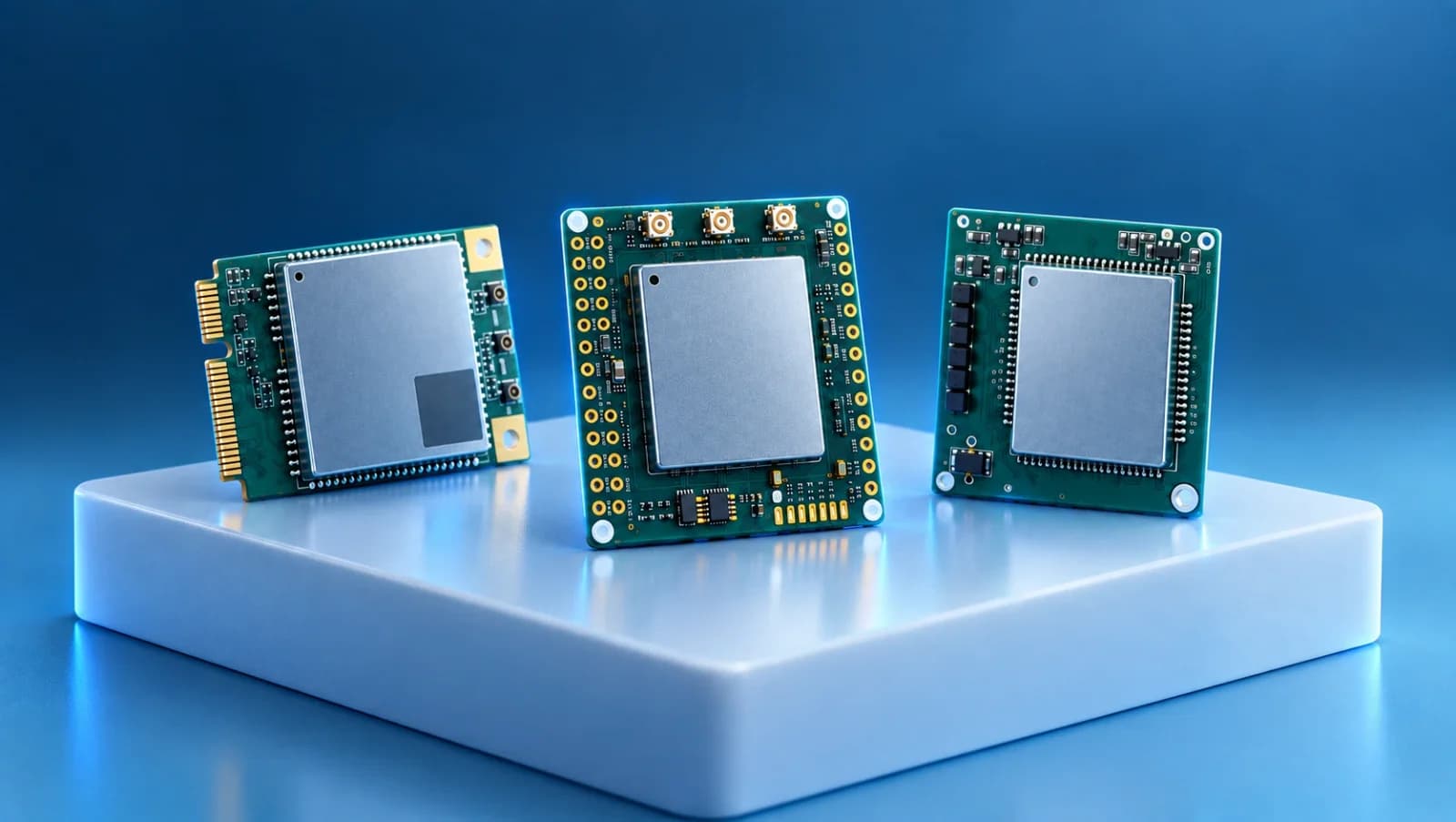
The module is fixed in the device, so a wrong call shows up later as dead zones, drained batteries or a redesign. With 2G on its way out in the UK, the choice matters more than it used to, and many teams now skip it altogether by fitting a dual-mode module. The checklist further down helps you make the call.
LTE-M vs NB-IoT: The Verdict in One Table
Neither standard is better overall. The right choice depends on how your device behaves: whether it moves, how much data it sends, where it sits and in how many countries it operates.
Both are 3GPP standards introduced in Release 13, and both run in licensed spectrum on existing LTE networks. That shared base is why so many modules support both. The real difference is bandwidth, and nearly everything else follows from it. LTE-M speed tops out around 1 Mbit/s, while NB-IoT trades throughput for reach. For definitions, see What is LTE-M.
LTE-M (Cat-M1)
NB-IoT (Cat-NB1/NB2)
Bandwidth
1.4 MHz
180 kHz
Peak data rate
Up to ~1 Mbit/s; half-duplex modules typically ~300 kbit/s down, ~375 kbit/s up
NB1: ~30 kbit/s down, ~60 kbit/s up. NB2: ~159 kbit/s down, ~127 kbit/s up
Latency
~10–100 ms
~1.5–10 s
Mobility
Handover between cells without dropping the session
No connected-mode handover; the device reconnects on the new cell
Indoor / deep coverage
Good
Deepest: basements, meter cupboards, underground
Power saving
PSM and eDRX; short airtime per message
PSM and eDRX; lowest draw for small, infrequent messages
Firmware updates over the air
Practical
Possible, but slow
Voice
VoLTE possible
Roaming
Widely supported
More limited
Module cost
Typically higher
Typically lower; dual-mode modules are common
Typical use
Asset trackers, alarms, wearables, payment terminals
Smart meters, parking sensors, environmental sensors
Sources: 3GPP Release 13 and 14, as summarised by the Nordic Developer Academy; 1NCE IoT Knowledge Base; 1NCE energy test. As of October 2026.
Read the table as a set of trade-offs. LTE-M spends its bandwidth on speed, mobility and responsiveness. NB-IoT spends it on reach and device density, and accepts slower, less frequent messages in return.
Smart Meters Run on NB-IoT, Trackers on LTE-M
A device that never moves and reports a few bytes a day points to NB-IoT. A device that moves, receives regular firmware updates or has to react quickly points to LTE-M.
Here is how that plays out across different industries:
- Utilities: a smart meter in a basement or meter cupboard sends a small daily reading, needs deep indoor coverage and never moves. NB-IoT fits.
Utilities: a smart meter in a basement or meter cupboard sends a small daily reading, needs deep indoor coverage and never moves. NB-IoT fits.
- Logistics and fleet: a pallet or container tracker moves between cells and often between countries. LTE-M keeps the session alive on the way.
Logistics and fleet: a pallet or container tracker moves between cells and often between countries. LTE-M keeps the session alive on the way.
- EV charging: the choice depends on the charge point and where it’s installed. Firmware updates and billing data favour LTE-M.
EV charging: the choice depends on the charge point and where it’s installed. Firmware updates and billing data favour LTE-M.
- Smart agriculture: latency-sensitive alerts, such as a pump failure, suit LTE-M. Low-power status reports from the field suit NB-IoT.
Smart agriculture: latency-sensitive alerts, such as a pump failure, suit LTE-M. Low-power status reports from the field suit NB-IoT.
- Infrastructure monitoring: remote assets that need over-the-air updates without a site visit favour LTE-M.
Infrastructure monitoring: remote assets that need over-the-air updates without a site visit favour LTE-M.
How utilities and smart cities use NB-IoT
Deep indoor reach is where NB-IoT earns its place. UK energy-metering company Hildebrand worked with Transport for London on a metering network that includes London Underground stations, a former connectivity dead zone. NB-IoT via 1NCE keeps those meters connected underground. Hildebrand runs 5,500+ SIM and eSIM chips from 1NCE and cut its eSIM/SIM-related fees by 75%.
The same pattern holds above ground. Sensoneo monitors 6,000+ waste bins in Madrid over NB-IoT, and its solution helps cut waste collection routes by 30–63%.
NB-IoT and LTE-M Battery Life Depends on Your Setup
Both standards are built for long battery life on small batteries, but your configuration decides more than the technology. Reporting interval, payload size, PSM and eDRX settings and signal quality together determine how long a battery lasts.
Signal quality shapes NB-IoT vs LTE-M power consumption
Signal quality is the factor teams underestimate most. NB-IoT reaches deep indoor locations partly by repeating each transmission. Every repetition adds airtime, and airtime costs energy. A meter in a basement can therefore drain its battery faster than the same meter at street level.
That also complicates the usual “NB-IoT uses less power” rule. LTE-M sends the same packet in less time thanks to its higher data rate. In good coverage, it can be the more efficient option per message.
CoAP vs MQTT: up to 47.5% less energy per transmission on LTE-M
Protocol choice matters as much as the radio. 1NCE tested CoAP against MQTT over NB-IoT and LTE-M on a Quectel BG96 module. On LTE-M, sending binary CoAP via Energy Saver used up to 47.5% less energy per transmission than MQTT. Less data on the air means less time with the radio switched on. The full set-up is in Energy Saving with 1NCE OS.
To estimate battery life for your device, model these factors:
- reporting interval and payload size;
reporting interval and payload size;
- PSM and eDRX timers agreed with the network;
PSM and eDRX timers agreed with the network;
- expected signal quality at the installation site;
expected signal quality at the installation site;
- the application protocol (CoAP, MQTT or LwM2M).
the application protocol (CoAP, MQTT or LwM2M).
NB-IoT vs. LTE-M: A brief comparison
LTE-M Leads for Moving and Cross-Border Assets
For devices that move or operate in several countries, LTE-M is usually the safer choice. It hands sessions over between cells and has broader roaming support than NB-IoT.
Handover is the first reason. When an LTE-M device moves into a new cell, the network transfers the active session. An NB-IoT device has no connected-mode handover, so it has to reconnect on the new cell. Each reconnection costs time and energy. Cat-NB2 improved this, but LTE-M remains the better fit for mobility.
Roaming is the second reason. LTE-M roaming is more widely supported, while NB-IoT roaming remains more limited. Check the current status per country on the GSMA Mobile IoT deployment map before you commit to a design.
For trackers, plan a fallback layer as well. A module that can drop to 4G or 2G where LTE-M is missing keeps data flowing across borders. See where LTE-M is live on the LTE-M coverage map, and read what to look for in a GPS tracker SIM card.
Use LTE Cat 1 Bis When Cat-M Isn’t Enough
Cat 1 bis isn’t better than LTE-M. It serves a different profile: far more bandwidth on standard 4G coverage, at the cost of higher power use.
Cat 1 bis is the single-antenna version of LTE Cat 1, added in 3GPP Release 13. It reaches up to 10 Mbit/s downlink and 5 Mbit/s uplink, with latency under 100 ms. Because it runs on regular LTE, it works wherever 4G is available. That includes markets where operators haven’t switched on LTE-M.
The trade-off is energy. Cat 1 bis draws more power than LTE-M, so it suits devices with a mains supply or larger batteries better than small battery-powered sensors.
Choose Cat 1 bis over LTE-M when you need the extra bandwidth
Cat 1 bis makes sense when:
- your device sends more data, such as images, frequent logs or large firmware images;
your device sends more data, such as images, frequent logs or large firmware images;
- LTE-M coverage in your target markets is patchy.
LTE-M coverage in your target markets is patchy.
1NCE’s US customer data shows this middle ground in practice. As of September 2026, a Cat 1 module ranks among the four most-used modules in the US by customer count.
NB-IoT vs LoRaWAN: Licensed vs Unlicensed Spectrum
NB-IoT runs on licensed spectrum in networks that mobile operators build and maintain. LoRaWAN runs on unlicensed spectrum, usually through gateways you install yourself or a separate network provider.
That difference drives the decision. Licensed spectrum is reserved for the operator, so interference is controlled. Unlicensed spectrum is shared, and you take on gateway planning and maintenance.
Cellular is usually the better fit when:
- devices are spread over wide areas or many sites;
devices are spread over wide areas or many sites;
- deployments cross regions or countries;
deployments cross regions or countries;
- you don’t want gateway infrastructure to install and maintain.
you don’t want gateway infrastructure to install and maintain.
With 1NCE OS, you can add LoRaWAN alongside LTE-M and NB-IoT on one platform, so you don’t have to choose.
For the full background, read licensed vs. unlicensed radio technology.
With 3G Gone and 2G Next, Plan Your Fallback Now
As of October 2026, all UK 3G networks are switched off, and 2G will follow by 2033 at the latest. Devices that rely on 2G or 3G fallback need a migration plan now.
LTE-M and NB-IoT are the long-term path, and the number of devices that need one keeps growing. According to Berg Insight, there were 4.2 billion cellular IoT connections worldwide at the end of 2025, up 11% in a year, and the research firm expects 6.5 billion by 2030.
Treat 2033 as a ceiling, not a target. UK operators set their own timetables, and the first announced 2G switch-offs start in 2029. A device designed today for a 10-year field life will outlive 2G on every UK network.
LTE-M and NB-IoT don’t carry that risk. Both are part of 3GPP’s 5G massive IoT path, so neither is a dead end. If your device still needs a fallback today, design it as a temporary layer with a planned end date.
Read how earlier switch-offs played out in our network shutdown overview.
Choosing Between LTE-M and NB-IoT: A 4-Step Checklist
Four questions about your device decide the standard: does it move, how much data does it send, where does it sit, and in how many countries? If the answers point in different directions, design for both.
- Does it move? If it changes cells while active, choose LTE-M.
Does it move? If it changes cells while active, choose LTE-M.
- How much data, how often? Small, infrequent messages suit NB-IoT. Regular firmware updates or larger payloads point to LTE-M. Megabytes on a regular basis point to Cat 1 bis.
How much data, how often? Small, infrequent messages suit NB-IoT. Regular firmware updates or larger payloads point to LTE-M. Megabytes on a regular basis point to Cat 1 bis.
- Where does it sit? Basements, meter cupboards and underground sites favour NB-IoT’s deeper reach.
Where does it sit? Basements, meter cupboards and underground sites favour NB-IoT’s deeper reach.
- In how many countries? Several countries favour LTE-M with a fallback. Check each market on the coverage map.
In how many countries? Several countries favour LTE-M with a fallback. Check each market on the coverage map.
If your device…
Choose:
is stationary, sends small amounts of data, sits deep indoors
NB-IoT
moves, needs firmware updates, low latency or voice, or crosses borders
LTE-M
sends more data, or LTE-M isn’t available in your target markets
LTE Cat 1 bis
fits more than one profile, or you’re not sure yet
Dual-mode module plus a SIM that supports both
The last row is where many teams end up. A dual-mode module keeps the decision open after launch. If a market lacks one standard, or a site turns out deeper indoors than planned, the device uses the other. For a wider look at all cellular options, see selecting the ideal cellular IoT network.
1NCE Supports LTE-M and NB-IoT on One SIM
With 1NCE, you don’t have to bet on one standard at SIM level. One 1NCE SIM supports all mobile radio standards, including LTE-M and NB-IoT where the network offers them, and switches between them automatically. In the UK, both LTE-M and NB-IoT are available on 1NCE (as of October 2026).
- Plug and play: insert the SIM and it works. The connectivity status shows in the 1NCE dashboard.
Plug and play: insert the SIM and it works. The connectivity status shows in the 1NCE dashboard.
- Coverage in 170+ countries: 2G, 3G, 4G/LTE-M and NB-IoT in selected European markets. Check yours on the coverage map.
Coverage in 170+ countries: 2G, 3G, 4G/LTE-M and NB-IoT in selected European markets. Check yours on the coverage map.
- IoT Lifetime Flat: €12 one-time for 10 years, including 500 MB and 250 SMS, for business customers. That’s about 4 MB a month, a predictable lifetime cost for low-data devices.
IoT Lifetime Flat: €12 one-time for 10 years, including 500 MB and 250 SMS, for business customers. That’s about 4 MB a month, a predictable lifetime cost for low-data devices.
- Energy Saver in 1NCE OS: up to 50–70% longer battery life, depending on use case.
Energy Saver in 1NCE OS: up to 50–70% longer battery life, depending on use case.
1NCE connects 40+ million products for 30,000+ customers. See the IoT Lifetime Flat or check LTE-M coverage.