What if reviewing for a quiz felt less like racing to the top of a leaderboard, and more like cheering your team through the final seconds of a championship game?
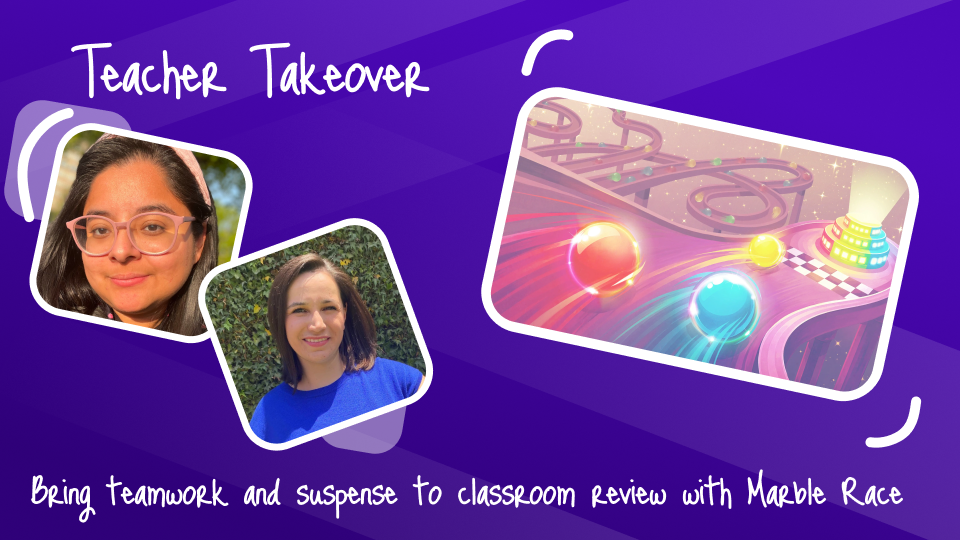
That’s the experience teachers and students are discovering with Marble Race, a new Kahoot! game mode experience that transforms knowledge into momentum. As students answer questions correctly, they earn marbles for their randomized team. Between rounds of questions, everyone pauses to watch those marbles tumble through a pinball-inspired course, with every bounce and turn creating a new opportunity for teams to surge ahead.
The result? A classroom that’s buzzing with excitement—and students who stay focused on what matters most: answering questions accurately.
Accuracy first, excitement follows
The classic game mode experience often rewards speed, and other game modes celebrate strategy. While speed can create energy, it can also make some students feel like they’ve fallen behind before they’ve had a chance to think.
Marble Race offers a different experience.
Without the pressure of speed, the emphasis shifts toward understanding the content rather than simply clicking first. Correct answers earn marbles, but what happens once those marbles enter the course is delightfully unpredictable.
Kahoot! Ambassador Ika M., a middle school teacher in Indonesia, explained:
“The best part is that it levels the playing field. It successfully captures the excitement of a live game while shifting the focus from ‘who is the fastest clicker’ to ‘who actually understands the material.’ It creates a healthy, high-energy competition where everyone feels they still have a chance to catch up.”
That subtle change has a big impact. Students spend less time worrying about the leaderboard and more time concentrating on solving the questions in front of them.
The best part is that it levels the playing field....It creates a healthy, high-energy competition where everyone feels they still have a chance to catch up. Ika M., middle school teacher, Indonesia
The best part is that it levels the playing field....It creates a healthy, high-energy competition where everyone feels they still have a chance to catch up.
Ika M., middle school teacher, Indonesia
Every question matters
One of the biggest strengths of Marble Race is how it keeps students engaged throughout the lesson.
Instead of viewing instruction and learning as something to “get through,” students remain invested because every correct answer contributes to their team’s success.
Elisabeth Lainez, a STEM teacher in New York City, noticed that students stayed focused from beginning to end:
“The most beneficial aspect of Marble Race was its ability to motivate students to participate and stay focused on answering questions. Students were excited by the marble racing theme and were eager to see how their performance would influence the outcome of the race.”
That sustained engagement makes Marble Race an excellent choice for content delivery and instruction when lectures, presentations, or even discussions might otherwise feel stale. An easy uplevel and improvement for so many classroom experiences, and Elisabeth suggests trying Marble Race for reviewing before an assessment, reinforcing recently taught concepts, checking for understanding during a lesson, practicing key skills in an engaging format.
Because the game mode works with existing kahoots, teachers don’t need to redesign lessons or build new content to introduce something fresh into the classroom. Instead, just select “Marble Race” as the game format for any lessons or materials already part of your Kahoot! Library or curriculum.
The most beneficial aspect of Marble Race was its ability to motivate students to participate and stay focused on answering questions. Elisabeth L, STEM teacher, USA
The most beneficial aspect of Marble Race was its ability to motivate students to participate and stay focused on answering questions.
Elisabeth L, STEM teacher, USA
A finish line no one can predict
If you’ve ever watched students lose interest once the leaderboard feels out of reach, Marble Race offers a refreshing alternative. The race itself introduces an element of suspense that keeps everyone watching until the very end.
Jisun Lee, an Ambassador in South Korea and primary school year, reflects:
“The fun part is that it’s hard to predict the outcome because the rankings change depending on where the beads land.”
While Alex L., in New York recalled:
“They have so much fun at the end when the marbles fall.”
That unpredictability creates shared excitement without diminishing the importance of learning. Students who answer more questions correctly earn more opportunities to help their team, but the final race still contains enough twists and turns to keep every classroom guessing. Instead of one student dominating from start to finish, everyone has a reason to stay engaged.
Competition that feels different
Competition can be a powerful motivator…but only when it’s balanced with inclusion.
Several teachers noted that Marble Race changes the emotional feel of competition compared with a traditional podium or leaderboard. Carla C., in Mexico City, reflected:
“It changes the traditional concept of the leaderboard and podium… it shifts students’ attention away from points and winning while they are answering the questions, allowing them to focus more on participation and accuracy.”
Rather than constantly monitoring scores, students can immerse themselves in the learning experience. The race becomes the shared payoff for everyone’s effort, creating moments of celebration that involve the whole class instead of just the highest-scoring players.
Randomized teams reinforce this collaborative spirit, encouraging students to cheer each other on as they watch their marbles navigate the course together.
It changes the traditional concept of the leaderboard and podium... it shifts students' attention away from points and winning while they are answering the questions, allowing them to focus more on participation and accuracy. Carla C., Director of Innovation, Mexico
It changes the traditional concept of the leaderboard and podium... it shifts students' attention away from points and winning while they are answering the questions, allowing them to focus more on participation and accuracy.
Carla C., Director of Innovation, Mexico
Built for any review session
One of the biggest advantages of Marble Race is its flexibility.
In their game testing and classroom practice, Kahoot! Ambassadors highlighted different formats that can be supported through Marble Race, and found a wide variety of instructional goals, including:
- formative assessment
- concept review
- skill practice
- reinforcing previously taught material
- increasing participation across the classroom
Ika M., summarized the whole experience of Marble Race, made for any classroom dynamic:
“Teachers will love it because it transforms abstract scores into a dynamic visual narrative. Instead of students just staring at shifting numbers on a leaderboard, they see a live race driven by their knowledge. It naturally promotes healthy competition, turns repetitive review sessions into an exciting classroom event, and requires zero extra prep time from the teacher since it applies to any existing quiz.”
That means educators can introduce an entirely new classroom experience while continuing to use the kahoots they’ve already created.
Bringing classrooms together, one marble at a time
At its heart, Marble Race isn’t just about watching marbles tumble through a maze.
It’s about creating a classroom where students stay engaged, celebrate one another, and remain invested in learning from the first question to the final race.
By combining self-paced learning, team-based play, and just enough unpredictability to keep every finish exciting, Marble Race encourages students to focus on accuracy, contribute to a shared goal, and enjoy the learning process together.
Because sometimes the most memorable part of a lesson isn’t who finished first—it’s the moment the entire class leans forward, cheering as the last few marbles race toward the finish line.