With several race weekends remaining in a Formula One season that saw a new era of cars and regulations, the Mercedes-AMG PETRONAS Formula One Team has already clinched the sport’s two championship titles, one for a driver and another for the team. Like any business, these two successes required months of design, development, and continuous refinement, along with faster and smarter decision-making, all enabled by technology from trusted partners like HPE.
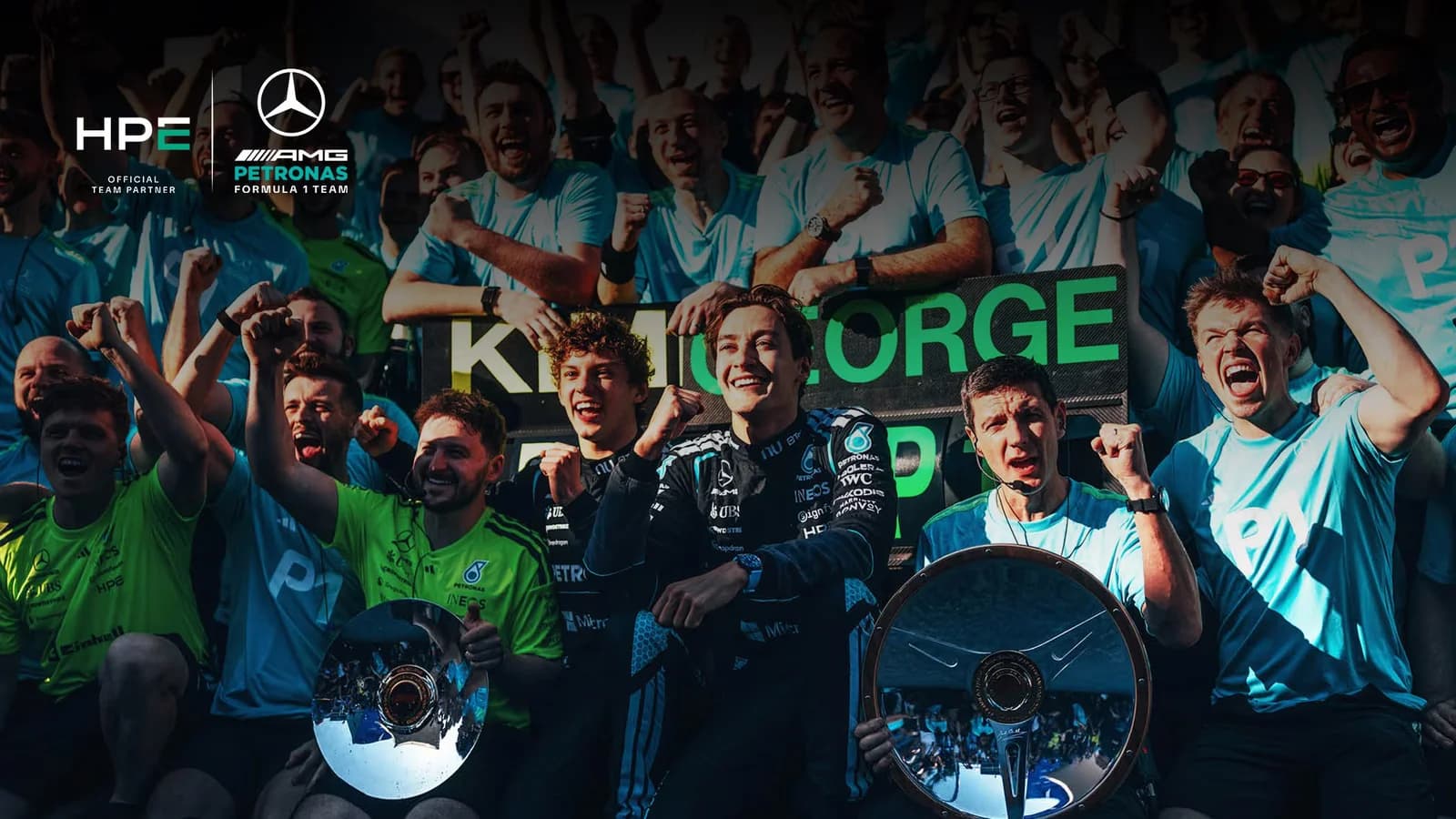
Setting a record as the youngest Formula One World Champion in history at 20 years old, Andrea Kimi Antonelli triumphed and won the 2026 FIA Formula One World Drivers’ Championship in only his second Formula One season. As the first Mercedes Junior graduate to progress through the programme and win the Drivers’ Championship, Antonelli accomplished the feat when he took his ninth Grand Prix victory of the season and amassed enough points to make it mathematically impossible for any other driver to catch him.
Similarly, the Mercedes F1 Team itself garmered sufficient points throughout the season to earn the FIA Formula One World Constructors’ Championship. This prize recognizes the capabilities of the cars based on the performance of a team’s top two drivers and includes financial rewards. Shaving milliseconds with analytics at scaleRemarkable outcomes under any circumstances, the Driver and Constructor’s Championship wins are even more impressive when considering the scale of data and analytics that contribute to an F1 car’s engineering and a driver’s ability to maximize a vehicle’s capabilities. With the cars generating about seven billion data points during every race, drivers and team rely upon the capability to analyze thousands of data streams both on and off the track.
For both Antonelli and the Mercedes F1 Team, this means leveraging HPE’s high-performance compute (HPC), storage, and networking platforms across all phases of operations to enable shaving milliseconds with every outing.
“Although we're classed as a sport, the car is effectively a rolling laboratory that changes from race to race, even sometimes from session to session, during a Grand Prix weekend,” said Michael Taylor, CIO of the Mercedes-AMG PETRONAS Formula One Team. This means drivers like Antonelli win championships by using their talents to optimize even the most subtle adjustments. Regulations and mandates make HPC criticalTightly governed by FIA, or Federation International de l’Automobile, F1 teams and their drivers operate similarly to other highly-regulated enterprises that must maximize outcomes under strict policies and protocols. For the 2026 racing season, this manifested as a considerably different landscape for teams and drivers due to multiple rules changes.
Among the new mandates was a hybrid power train with a 50:50 split between internal combustion engines and electric motor systems, requiring F1 engineering teams to completely redesign their cars. This, coupled with other associated rules changes, resulted in smaller, lighter, machines with new aerodynamic features and other enhancements. The rules also prescribed certain operating parameters for driving the cars, making Antonelli’s accomplishment even more exceptional as he deftly navigated both machine and rules changes.
As data and analytics are key to producing the cars and, for drivers like Antonelli, learning how to maximize their performance, it made the Team’s HPE technology solutions and support—both in the factory and on the track—more critical than ever before.
“Just as you start to think you're mastering the understanding of the regulations, they change and you have different treatments for different things,” said Taylor. “Then you have to go and find ways to be smarter and cleverer again.” Over 300 vehicle sensors feed CFD and other workloadsAs FIA rules include financial caps as well as stipulating everything from engineering limits, like time permitted for wind tunnel simulations, to the IT infrastructure that underpins car building, it’s imperative for teams to balance all resource expenditures. Essentially, it means that every efficiency gained from optimizing technology, data handling, and analytics can be reinvested into drivers, training, physical car components, engineers, strategists, and other operational needs.
One way the Mercedes-AMG PETRONAS F1 Team helps optimize its FIA-permitted resources is using HPE’s GreenLake platform and HPE ProLiant AMD-based servers. This infrastructure as a service solution enables the Team to significantly improve the performance of Computational Fluid Dynamics (CFD) workloads, which are fundamental to developing and refining F1 cars. For Antonelli, it also enabled visualizing the results of complex analytics that he could apply to improving his race performance.
With the ability to run CFD models and other analytics more rapidly, the Mercedes F1 Team and Antonelli could quickly determine which car and driving modifications would enhance race-day performance. In addition, the HPE infrastructure deployment enabled reducing pre-event simulations from three days to one, conferring additional advantages.
Another way the Team maximizes its budget constraints is using its HPE infrastructure for financial forecasting, which historically was an afterthought. “We’re now running as much data analysis against our financial forecasts as we are on some elements of the development of the car,” said Taylor. Crunching billions of data points into subtle changesTo collect data for CFD, and other strategic engineering applications, over 300 sensors dot the latest Mercedes F1 Team car, called the F1 W17. With each outing, whether training, trials, or races, the sensors provide the Team’s engineers with dozens of terabytes of information.
Supported by GreenLake, which is also a VMware alternative, the Team’s engineers and simulation specialists run diagnostics whenever a car is on the track to ensure it’s operating properly for performance and driver safety. Next, advanced simulation applications are used to make adjustments, which are communicated to the Team’s HPE-enabled mobile data center trackside.
Then, drivers test the updates and report on considerations like cornering stability, understeer, or oversteer, which kicks off more fine-tuning in the factory for application on the track. In between race weekends, additional car-generated data from the engine control unit (ECU) is downloaded undergoes processing at the factory, resulting in yet more refinements.
“All obviously focused on how we find that next few milliseconds of performance for car and driver,” Taylor said. “Every week the car is different in some subtle way, shape, or form.” Next-generation compute on deckFurther, the Team’s HPE infrastructure solutions provide the flexibility to run engineering and enterprise workloads where they make the most sense as part of hybrid cloud management.
Across public and private clouds, from back office to factory to trackside, the Mercedes F1 Team can optimize workloads while maintaining speed, agility, operational resilience and centralized control. Cost-effective transmissions contribute to successAnother technology vital to the Mercedes F1 Team is HPE Networking and its progression toward a Self-Driving Network. The Team’s journey began with network telemetry to provide visibility, evolved to insights and recommendations that help identify issues, and has progressed to assisted network operations that help teams respond more effectively. By making network operations more consistent and reducing routine manual tasks, it frees Mercedes F1 Team specialists to focus their expertise on finding the next marginal gain in performance.
Based on Zero Trust security principles, the Team’s HPE Self-driving Network ensures information is transmitted swiftly, reliably, securely, and cost-effectively from car to track to factory using SD-WAN optimization technology. Reliable, optimized connectivity enables engineers at the factory and track to access the data and computing resources they need to contribute to decisions during a race weekend, while helping the Team maximize both bandwidth and cost efficiency.
For instance, the Mercedes F1 Team has replaced expensive MPLS with the most budget-friendly connections available at any given race location, whether it’s direct internet access, satellite, 4G, or 5G. “The beauty is that we’re now in a much better place from a cost perspective and a bandwidth perspective,” said Taylor. Congratulating Antonelli and Team on a historic seasonWhat makes the Mercedes F1 Team’s successes particularly relevant for all HPE customers is that the challenges the Team and its drivers face are the same as at many enterprises: regulated environments, marginal gains, maximizing performance, ensuring reliability, improving operational efficiency, and doing all of it securely and sustainably.
With the 2026 season one for the record books, we congratulate Antonelli and the Mercedes-AMG PETRONAS Formula One Team. We look forward to continuing our shared commitment to innovation and excellence as the 2026 F1 season wraps up and attention turns to the 2027 season. Related resources: