Healthcare touches nearly everyone, and it’s one of the highest stakes environments to get AI right. A hospital runs on thousands of small decisions a day, which patient gets seen next, what a chart actually says, whether a safety event needs a second look. These decisions have direct consequences for the people involved but most AI isn’t built to handle decisions where the cost of being wrong falls on a real person.
Over the past year, we’ve worked inside hospitals with leading healthcare providers, including a top-ranked U.S. health system, helping clinicians catch safety events sooner. We believe hospital AI has to be evaluated by clinicians, keep data within the health system, and be built alongside the people who use it.
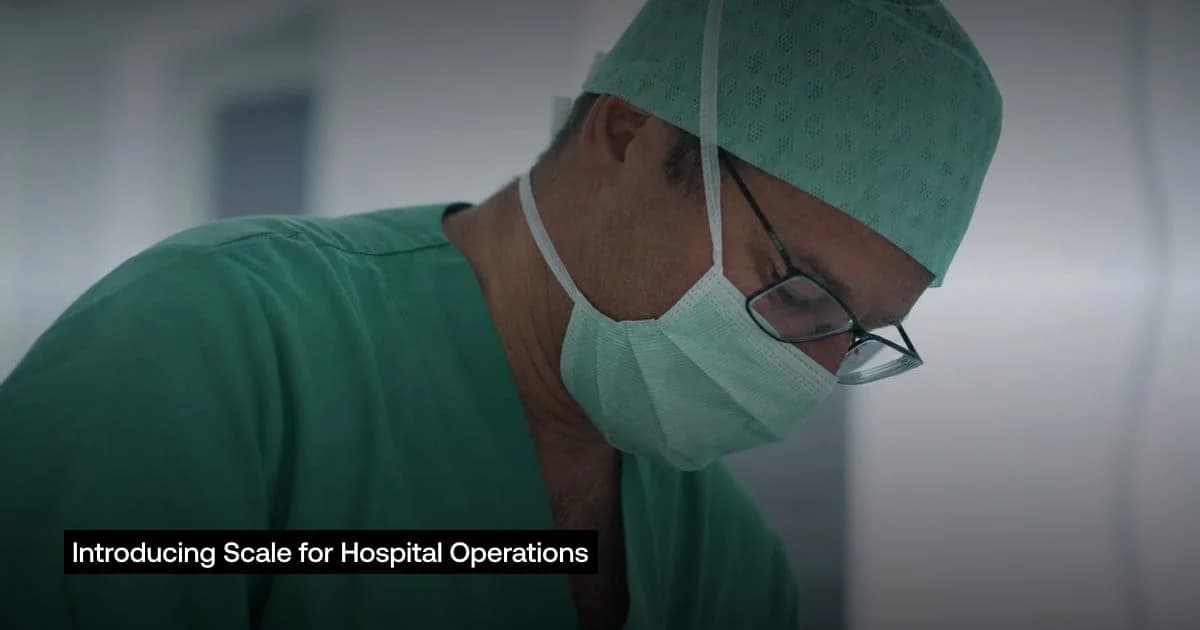
Today, we’re bringing that same approach to hospitals with Scale for Hospital Operations, five applications built to solve the workflows that keep hospitals running. They can run on any model, and be deployed directly into your environment. This is just the first part of a broader and growing portfolio, with additional applications and agents rolling out over the coming months.
Hospital operations is one of the most meaningful places to apply AI because it’s where high-volume, high-stakes work piles up outside the exam room. Referrals need to be triaged, records need to be summarized, and safety events need to be investigated, often faster than providers and their teams can keep up, and when that work falls behind, care falls behind with it. Results show AI can relieve that pressure: after 30 days with an AI documentation tool, clinician burnout across six U.S. health systems fell from 51.9% to 38.8%, according to a 2025 study.
We spent the past year working alongside providers learning exactly where that backlog hurts the most, and built a constellation of agents to take it on, available to health systems starting today. Each one is designed for work hospital teams already do every day, just not at the volume AI makes possible:
- Scheduling Intelligence Agent triages referrals by clinical urgency and matches each one to a slot that fits the visit’s requirements, including room, equipment, and physician preference. It can rework existing schedules to accommodate urgent patients and coordinate visits across specialties into one plan of care.
- Order Guidance Agent reviews a patient’s history, flags missing tests, and recommends labs, imaging and prescriptions for clinician review, with the evidence cited. If a patient’s chart is missing a routine test their history suggests they need, the agent catches that gap before the appointment instead of after.
- Medical Record Review & Summarization Agent pulls the key clinical facts from a patient’s records and assembles their history, with each finding linked to its source. Rather than a clinician scrolling through years of scattered notes before a first visit, they get a short summary of what matters, with a link back to the original record for anything they want to double check.
- Safety & Incident Investigation Agent prioritizes patient safety events and finds recurring patterns, so teams can investigate the highest-risk incidents first. Instead of safety reports piling up in the order they arrive, the agent surfaces the one that looks like part of a pattern.
- Clinical Documentation & Quality Review Agent drafts clinical reports for clinician review and checks documentation against hospital guidelines, with auditors confirming each finding. A clinician reviews and signs off on a draft report instead of writing it from scratch, and compliance teams can see exactly which guideline each finding was checked against.
Every agent runs inside the health system’s own environment, works with any model, and is deployed with Scale engineers and clinical SMEs.
Research you can use to measure reliability
Hospitals cannot deploy an agent at scale in the hope that it works. Before any agent touches patient records or safety reports, they need proof that it performs reliably on that work and assurance that it won’t fail upon deployment. Scale’s research team builds healthcare-focused tasks knowing that experienced clinicians can reasonably disagree on the same case, so it is important to measure how agents handle genuine ambiguity, not just whether they get the answer right.
- CliniCARE-Bench tests whether an agent reviewing a real health record reaches the right conclusion for the right reasons, and knows when to defer to a clinician.
- PSEBench tests whether an agent triages patient safety reports correctly against a written reporting policy.
- DistressBench tests whether a patient-facing chat tool recognizes a person in crisis and routes them to help.
Beyond giving health systems a common way to compare models, this research is the foundation for how we build. Drawing on our background in data and evaluation, we use it to continuously refine every agent we deploy, measuring performance against custom evaluations built around each health system’s own workflows.
Get started
Healthcare at Scale is available today. If you’re at HLTH USA this week, visit the Scale booth at #3863 for a live demo of the hospital operations agents.
You can also talk to our team or learn more at scale.com/enterprise/healthcare.