Modern engineering teams have made tremendous progress improving the quality of their monitoring and alerting strategies. Today’s observability platforms can detect issues across applications, infrastructure, Kubernetes, cloud services, databases, and networks with remarkable speed and accuracy. Yet even as alert quality continues to improve, many organizations still face a familiar operational challenge. During a single customer-impacting incident, responders are often flooded with multiple alerts describing different symptoms of the same underlying problem.
Every alert may be legitimate. Every alert may deserve attention. But engineering teams are still forced to determine which alerts are connected before meaningful investigation can begin.
That process consumes valuable engineering time, slows incident response, and often results in multiple responders independently investigating different parts of the same operational issue. Instead of immediately solving the problem, teams first need to assemble the operational picture.
New Relic Compound Alerts was built to solve exactly that challenge.
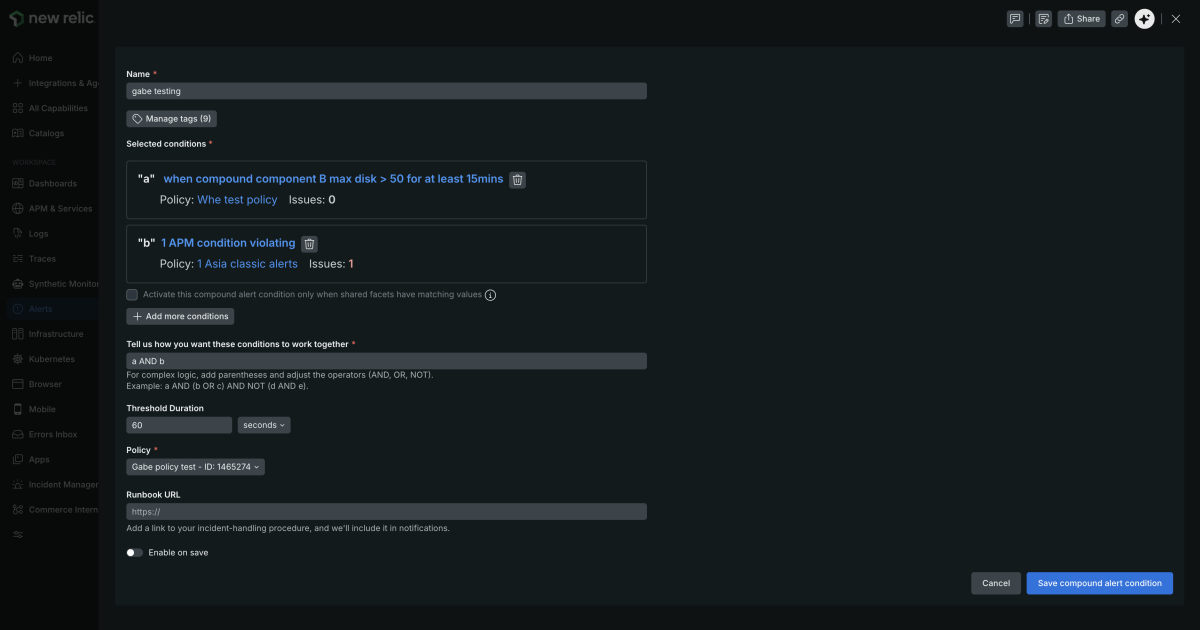
By intelligently correlating related alert conditions into a single actionable issue, Compound Alerts helps engineering teams reduce fragmented investigations, improve operational awareness, and begin incident response with a clearer understanding of what is happening across their environment.
From Fragmented Alerts to Actionable Issues
Traditional monitoring systems were designed to notify engineers whenever predefined conditions were met. A single service disruption may now trigger notifications from infrastructure, application services, cloud resources, databases, Kubernetes clusters, and supporting dependencies.
New Relic Compound Alerts changes that experience by automatically grouping related alerts into a single issue. Responders immediately receive a consolidated operational view that reflects the broader problem rather than requiring them to manually piece together individual symptoms.
The result is a simpler, more efficient investigation process that helps engineering teams focus on resolving incidents instead of organizing information.
Reducing Investigation Effort While Improving Operational Visibility
One of the most significant costs associated with modern incident response is not identifying that a problem exists. Modern observability platforms already perform that task extremely well.
The greater challenge is understanding the scope of the problem quickly enough to make effective decisions.
Engineering teams frequently receive alerts from multiple services that ultimately describe the same operational event. Different responders may begin separate investigations, duplicate work, or escalate issues before realizing they are working on the same incident.
Compound Alerts reduces that unnecessary operational overhead by consolidating related alert conditions into a single issue. Engineers spend less time deciding where to begin and more time understanding customer impact, identifying contributing factors, and restoring service.
Engineering organizations are under constant pressure to deliver reliable digital experiences while managing increasingly complex technology environments. Every minute spent manually By simplifying how operational information is presented, Compound Alerts helps organizations improve responder productivity while reducing the cognitive load associated with managing complex cloud-native environments.
Designed to Complement Smart Alerts
Compound Alerts builds naturally upon the foundation established by Smart Alerts.
Smart Alerts focuses on improving the quality of individual operational signals. Using intelligent recommendations and dynamic alert capabilities, Smart Alerts helps organizations create better alert conditions and reduce unnecessary noise before incidents occur.
Once high-quality alert conditions are in place, Compound Alerts intelligently correlates related alerts into actionable issues that provide responders with a clearer operational picture.
Together, these capabilities improve both the quality of operational signals and the quality of operational understanding. Rather than replacing existing alerting strategies, Compound Alerts extends their value by helping engineering teams understand the relationships among alerts more quickly and efficiently.
Built for the Future of Intelligent Operations
While Compound Alerts delivers immediate operational value, it also represents another important step in New Relic’s broader Intelligent Observability strategy.
As organizations continue adopting AI-assisted operations, the quality of operational information becomes increasingly important. Engineers and AI systems alike depend upon clear, organized, and meaningful operational inputs before effective decisions can be made.
Within the New Relic Intelligent Observability Platform, each capability builds upon the previous one. Telemetry captures what is happening throughout the environment. Smart Alerts improves the quality of operational signals. Compound Alerts transforms related alert conditions into actionable issues that improve operational understanding. Ground Truth enriches those issues with trusted operational context. Autopilot then helps engineering teams investigate and act using that richer operational intelligence.
Viewed together, these capabilities create a continuous progression toward Autonomous Operations while delivering meaningful customer value at every stage.
Helping Engineering Teams Focus on What Matters Most
Engineering organizations are under constant pressure to deliver reliable digital experiences while managing increasingly complex technology environments. Every minute spent manually organizing alerts is a minute not spent resolving customer-impacting issues or delivering new innovation.
Compound Alerts helps remove that friction by presenting responders with a clearer operational starting point. Instead of asking engineers to determine which alerts belong together, it automatically correlates related alert conditions into actionable issues that simplify investigation and improve operational awareness.
As cloud-native architectures continue to grow in complexity, operational success will increasingly depend not only on detecting problems quickly, but on understanding them just as quickly.
With Compound Alerts, New Relic is helping engineering teams take that next step toward more intelligent, efficient, and ultimately more autonomous operations.