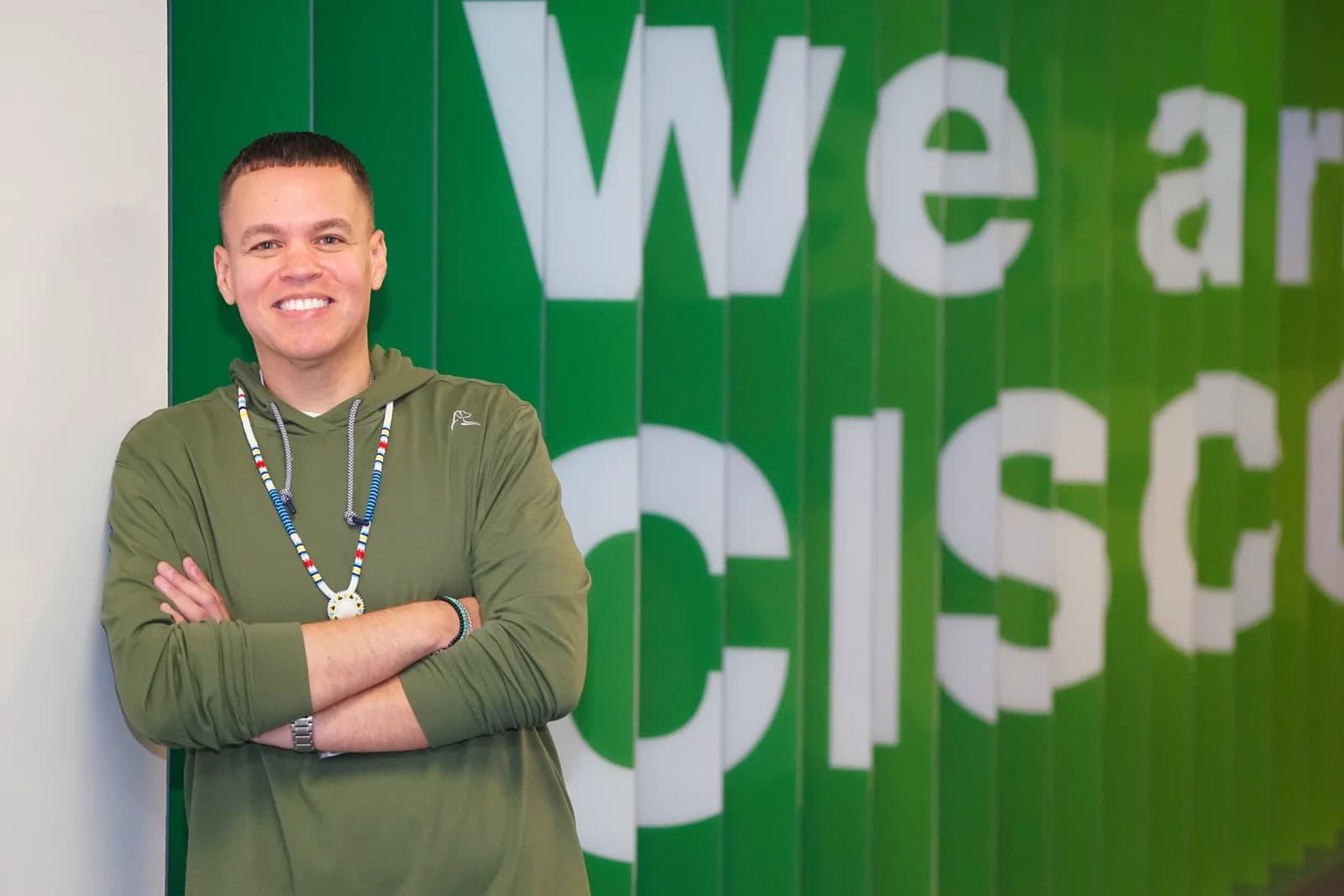
I was in the fifth grade when a teacher, Mrs. Britt, changed my perspective on what I could do in life. Two years later, in the 7th grade, that same Mrs. Britt introduced me to the Advancing Indigenous Science and Engineering Society (AISES), where I saw NASA astronaut Commander John Herrington speak. He’s the first enrolled member of a Native American tribe to fly in space. I remember sitting there, a Lumbee kid from North Carolina, watching a Native man talk about orbiting the Earth, and something just clicked. A door opened that I didn’t even know was there.
That moment, hard work, and a lot of luck put me on a path that eventually led me to Cisco.
Growing up as a citizen of the Lumbee Tribe of North Carolina, in rural Southeastern North Carolina, the “good” career paths are doctor, nurse, lawyer, teacher, and plenty of people walk them well. But I always wondered if there was room for someone like me in technology. Native Americans make up less than 1% of the STEM workforce. That’s not a number you think about in the abstract when you’re the only Native person on a conference call. You feel it.
When I first joined Cisco, I started in internal IT support, then moved to the executive support desk. I then had an opportunity to join the Technical Assistance Center (TAC). I didn’t want it. I didn’t think I knew enough. But it put me in a situation where I was forced to learn, and now, I love my job. I get to solve problems, and not just simple problems. The most difficult problems come to us in TAC.
At first, I thought I was the only Native American working here. Then, I found the Native American Network (NAN), an employee-led community at Cisco for Indigenous people and our allies, open to all, and they quickly became family. I connected with people who understood exactly where I was coming from. People who didn’t ask me to leave my culture at the door. People who said, “Bring it in. We need it here.” That’s what makes Cisco different.
I see this inclusivity in everything we do. Whether it’s bringing Indigenous students onto campus for hands-on STEM experiences, showing up at conferences like AISES to connect — not just recruit — or hosting fireside chats with Indigenous leaders, the message is the same: culture isn’t something to celebrate in a corner. It’s meant for sharing. We even carry that into our broadband work on tribal lands, because connectivity isn’t a luxury. It’s a foundation for education, healthcare, and opportunities.
And I’ve learned that what’s good for our communities is good for business, too. Tribal Nations are Cisco customers, and in those relationships, trust is everything. When we show up authentically, we’re seen as trusted partners, and examples of how employees can shape those relationships.
Here, the work I do for my community doesn’t have to be separate from my career. Cisco doesn’t just let me do this work. It makes it possible. Of all the things I get to do here, the most rewarding is talking to Native youth from tribal communities across the country, showing them what a career in technology can look like. I want to make sure every Native student or young professional knows they can come find me — for encouragement, for help, or just to talk to someone who’s been where they are.
We Lumbees are known for our accent and hearing it in a place like this tells a kid that they don’t have to change how they speak to belong. That’s why representation matters so much: when you never see yourself in a room, it’s hard to believe you belong in it. Seeing someone from your community already in the work? That changes everything about what you think is possible.
This year, I was honored to receive the Blazing Flame Award at the AISES National Conference, recognizing STEM professionals who “blaze” a path for Indigenous people in STEM careers. But this isn’t a solo milestone. It’s an emotional one that belongs to the community that made it possible: the Cisco teammates who traveled to stand with me, including Alice Sanchez — 2024 AISES Indigenous Excellence Award winner — who knows exactly what this journey looks like, and every NAN member who gives their time to our events, youth summits, fundraisers, and broadband efforts. This recognition belongs to all of us who believe that Cisco can be a force for good in Indian Country.
I am living proof of what happens when a company creates space for you to be your whole self. From a seventh grader watching an astronaut speak to a technical leader at Cisco, my path has run through a lot of doors. But Cisco is the one that stayed open.
I said luck was part of how I got here. It was. I got lucky to land at a company like Cisco. I walked in the door in the spring of 2007. Since that day, I’ve been working so other Native American youth and young professionals don’t have to rely on luck to find a place like this.
If you’re looking for a company where your background isn’t just accepted but celebrated, where you can do work that matters to your community and your career at the same time, I can tell you from experience: this is that place.
My life changed because of one conversation with a teacher in grade school. Just go have a conversation. You never know, it could lead to the moon, or the cube right next to you.
Ready to join a company where cultures and careers thrive? Explore careers at Cisco.