November 23, 2026
| Joslyn McIntyre, Editor, Box
When companies in regulated industries look for practical ways to apply AI, the biggest wins often come from addressing slow manual workflows that involve multiple teams. At General Atomics Aeronautical Systems, Inc. (GA-ASI), the continuous grind of supplier NDAs moving through the business was a prime application for AI-powered automation.
GA-ASI is the world’s foremost builder of Unmanned Aircraft Systems (UAS). Logging more than 9 million flight hours, its Predator line of UAS has flown for over 30 years. In this hyper-regulated world, non-disclosure agreements (NDAs) are critical because suppliers routinely gain access to sensitive technical information that must be legally protected. Government contracts with agencies like the DoD and DoE often require GA-ASI to flow down confidentiality obligations to the supply chain, making NDAs a standard part of doing business, not just an occasional formality.
The NDA process had long relied on questionnaires, email chains, manual reconciliation, and repeated approvals. John Stricklin, Supply Chain & Procurement Business Process Project Manager for GA-ASI, partnered with Box to create a more streamlined, governed workflow that will cut NDA cycle times from days to just hours.
Key takeaways:
- Workflow automation on Box means NDA intake, document generation, reconciliation, signatures, and access can all happen in one place
- It will take mere hours to complete an NDA signing, instead of days of back and forth
- Renewals will be much quicker and easier, and stakeholders can easily access accurate information on the Box Apps dashboard at any point
Box for Federal Government
One secure content layer for all federal content and any AI agent
- Argonne achieved 85% case deflection and saved 20-30 hours per research task with Box Hubs
Argonne achieved 85% case deflection and saved 20-30 hours per research task with Box Hubs
- How government agencies should evaluate content management platforms in the age of AI
How government agencies should evaluate content management platforms in the age of AI
The long, drawn out status quo of NDA signingThe long, drawn out status quo of NDA signing
At GA-ASI, when a buyer or subcontract administrator submitted an NDA request, the NDA team emailed a questionnaire to the third party, which they filled out and emailed back as a Word document. The NDA team then manually created a contract using specific legal language pertaining to that supplier.
If the NDA team had questions or needed clarification, back another email would go — and so on and so forth, with attachments piling up. Finally, the contract was signed by the supplier and the GA-ASI NDA team via a standalone e-signature app. Then, the NDA coordinator manually uploaded the signed document to SharePoint. It wasn’t a super speedy process, and workflow visibility was limited. “The process could take days or weeks, in some cases,” confides Stricklin.
Instead of treating NDA workflow as a series of disconnected email exchanges, Stricklin’s team reimagined it based on Box AI.
Instead of treating NDA workflow as a series of disconnected email exchanges, Stricklin’s team reimagined it based on Box AI.
Instead of treating NDA workflow as a series of disconnected email exchanges, Stricklin’s team reimagined it based on Box AI.
Automation, consolidation, speed, accuracy
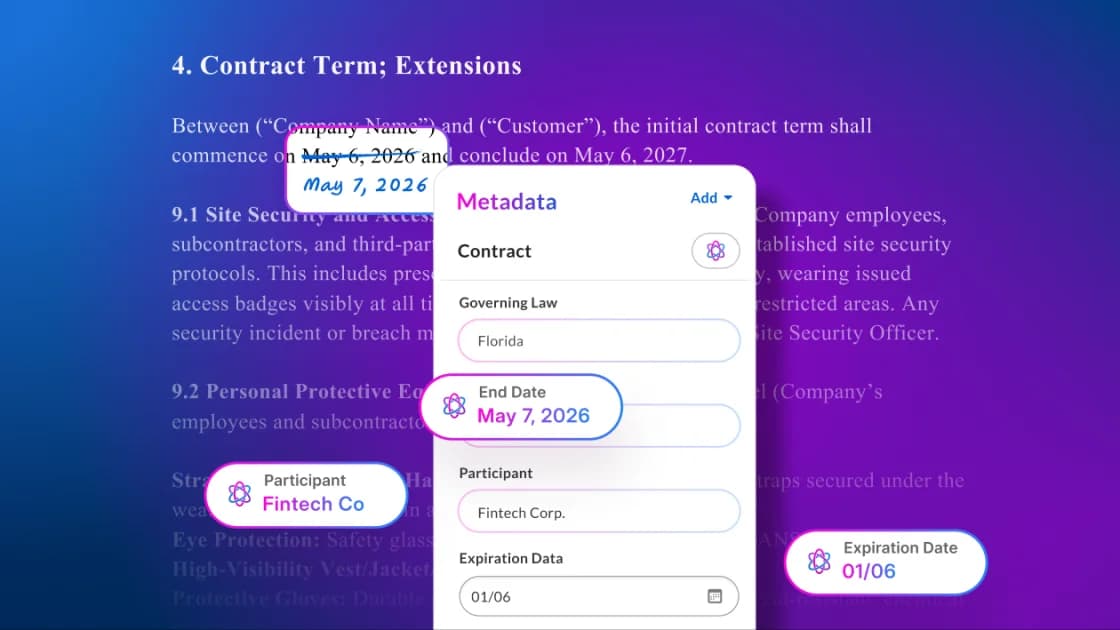
Stricklin redesigned the NDA workflow with end-to-end automation based on Box. Intake, document generation, reconciliation, signatures, and access can now happen in one place. Information is captured once and reused throughout the workflow. Metadata comes directly from the initial document submission, then flows through the process, reducing friction and creating more consistency.
“When you’re constantly copying over information,” Stricklin explains, “human error can come into play. When you’re entering it one time and using it consistently across the board, human error is eliminated. And people don’t have to worry about emails; they just go into a form, answer the questions.”
The operational mindset of the organization has shifted from the status quo of lengthy workflows to quick solutions.
The operational mindset of the organization has shifted from the status quo of lengthy workflows to quick solutions.
The Box Apps dashboard gives teams a way to manage not just the initial NDA signing, but future renewals. Rather than rebuilding agreements from scratch, the process is designed to preserve the same language, update the term, and move directly to execution.
It’s a workflow designed not just for initial execution, but for repeatability over the full NDA lifecycle. Here are the gains GA-ASI anticipates from NDA automation with Box:
- Cycle time improved from days to hours
- Renewal speed improved to minutes
- Manual copying decreased, helping reduce human error
- Cost savings realized with native e-signature within Box, instead of a third-party e-signature solution
And as a bonus, the operational mindset of the organization has shifted from the status quo of lengthy workflows to quick solutions.
The new system will not submit until all required information is recorded, cutting down prolonged communication with the requestor.
The new system will not submit until all required information is recorded, cutting down prolonged communication with the requestor.
Luke Downing, Contract Administrator at GA-ASI, says “The new process is more organized and ensures all required information is recorded. For example, in the past, requestors could accidently leave items blank on the request form, which would then prompt us to reach out to them for clarification, further delaying the process. The new system will not submit until all required information is recorded, cutting down prolonged communication with the requestor.”
Taking the risk out of language reconciliation
When it comes to NDAs, legal language must be precise. Using Intelligent Content Management to combine content management, agentic AI, and compliance gives GA-ASI a lot of possibilities around legal workflows.
Stricklin says, “When reconciling legal language, AI could tell us the implications of that language. Right now, the NDA person can’t do that themselves; they have to pass it along to two or three other parties. Box AI would allow them to streamline without having to take so many paths back and forth.”
For a regulated defense/energy company, governance, auditability, access controls, and secure collaboration are all important to any content-based flow. The team sees opportunities to use AI and governance capabilities to improve reconciliation and clause review as well. Future controls could even compare language against expected standard clauses.
The company is also exploring compare-and-contrast capabilities to accelerate the process and help legal review by showing compliance-related information. AI agents also have the potential to keep all critical content in line with the particular compliance rules GA-ASI must follow, flagging when any language deviates from the protocol.
Next up?
“This has not been a hard process,” notes Shane Steinfeld, Director, Contracts & Procurement Operations for GA-ASI. “The Box team is very diligent and collaborative in trying to make it as easy as possible.”
The Box team is very diligent and collaborative in trying to make it as easy as possible.
The Box team is very diligent and collaborative in trying to make it as easy as possible.
The Box-based NDA workflow has proven to be a good starting point for further automation. Stricklin says, “There are so many small processes like this that consume so much time. The minute we get this one done, we’ll rinse and repeat and apply it to those solutions as well.”
It’s not just NDAs, and it’s not just companies subject to federal compliance. Any kind of company that manages sensitive agreements through inboxes, attachments, and manual review steps stands to gain a lot from AI-based automation.