The ambition-action gap
Our research shows the gap between ambition and action. 84% of executives plan to redesign roles and teams around AI agents within five years. 38% of C-suite leaders anticipate that AI will change roles significantly. Yet only one in five are rethinking the way work gets done with AI at the core. This gap defines where the next wave of competitive advantage will be won or lost.
When work is deconstructed, a powerful principle emerges: match the mode of work to the source of value. Some tasks are best done by machines, while others require human imagination and ethical judgment.
Seeing work differently is only the beginning. The real breakthrough comes when leaders use this clarity to move talent where it matters most, build the right skills and make bolder choices about investment, resourcing, location strategy, role design and team structures.
A new talent blueprint: building a dynamic workforce with AI
A human+ AI talent strategy uses data and AI to continuously match human strengths with technological capabilities. It shifts beyond today’s roles and designs systems that evolve with the work itself. It combines the strengths of people and technology to take advantage of their respective strengths, to solve problems and deliver breakthrough results.
This shift changes how organizations measure workforce capabilities, direct investment and drive growth. Instead of optimizing for hierarchy, leaders can redesign for value. Not only for efficiency but also for human ingenuity.
As work is redeployed across humans and machines, success depends on how effectively leaders orchestrate these into a coherent, value-creating whole. Tasks now shift fluidly across five interconnected workforces:
- Human workforce: applying empathy, ethical judgment, creativity, leadership.
- Human+ machine collaboration: amplifying what people do with digital tools.
- Intelligent automation workforce: applying technology to rules-based, repetitive tasks.
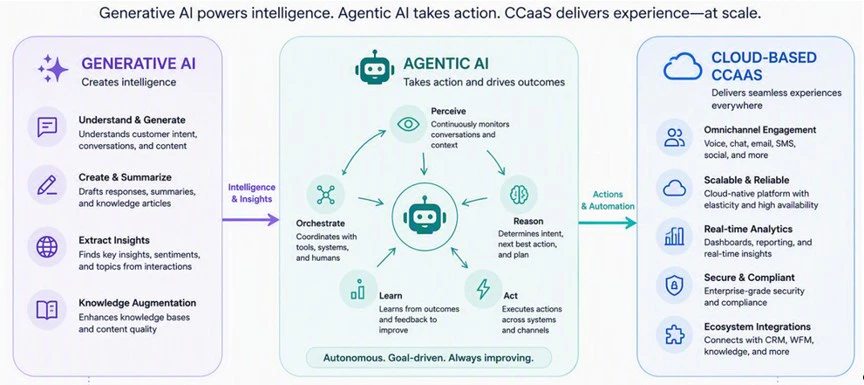
- Generative AI workforce: creating content, designs, insights, code.
- Agentic AI workforce: engaging autonomous agents in managing multi-step processes.
The building blocks of agentic AI
Agentic architecture organizes AI agents into a hierarchy that drives efficient workflows and decision-making. The foundation is Utility Agents, which handle tasks like data collection, sorting and analysis. Utility agents ensure smooth, repetitive processes run without friction.
Super Agents act as managers. They oversee Utility Agents, coordinate workflows and ensure alignment with broader objectives. Super Agents orchestrate complex task sequences with advanced reasoning, turning tactical execution into strategic impact.
Above this, Orchestrator Agents manage interactions across multiple Super Agents and sometimes directly with Utility Agents. Orchestrator Agents ensure harmony and scalability across enterprise-wide operations. This tiered approach enables businesses to automate tasks as well as entire workflows, driving productivity, cost efficiency and innovation at scale.
Imagine a task starting with a human, moving to automation for efficiency, scaling with the help of generative AI and returning to human oversight for ethical nuance, sometimes orchestrated entirely by agentic AI. This isn’t theory – it is happening now.
Success depends on dynamically allocating work to the most capable worker, whether human, machine or human+ machine. Organizations must continuously adjust this balance as people and technologies evolve.