Written by
Reviewed by
Last editedNov 20265 min read
Our top five takeaways from the FCA’s AI Live Testing programme:
- A2A payments suit AI agents
A2A payments suit AI agents
- Design by doing
Design by doing
- Challenging design principles
Challenging design principles
- Education is key
Education is key
- Who is on the hook if agents make a mistake
Who is on the hook if agents make a mistake
As AI agents start shopping and paying on people's behalf, it raises a practical question for any business that takes payments: how do you accept a payment when the party at checkout is an AI agent? That’s why we joined the FCA AI Live Testing Programme.
What is AI Live Testing?
The FCA’s AI Live Testing programme lets businesses trial AI in live environments. It provides a safe space for businesses to test agentic payments with regulatory support and oversight, giving structured, evidence-based feedback while the product is still taking shape.
The UK government encourages businesses to use AI, and this programme supports its AI Opportunities Action Plan, which sets out how AI can grow the UK economy. The FCA wants businesses to feel confident deploying AI in ways that are good for both consumers and markets and to take the learnings from every test of how AI behaves in practice to shape its own approach.
Who participated?
Places were competitive. The FCA required applicants to have AI that has moved beyond the idea stage and is ready for live environments. In April 2026, we joined the second cohort as one of eight firms and the only payment provider - alongside Barclays, Experian, Lloyds Banking Group and UBS. Businesses in our cohort tested a variety of AI use cases, from investment support and credit score insights to anti-money laundering checks. Our use case was agentic payments.
Thanks to being part of this programme, we’re helping set the standards for what the future of agentic payments looks like, including how it can be done with payer security front of mind.
How we tested agentic payments
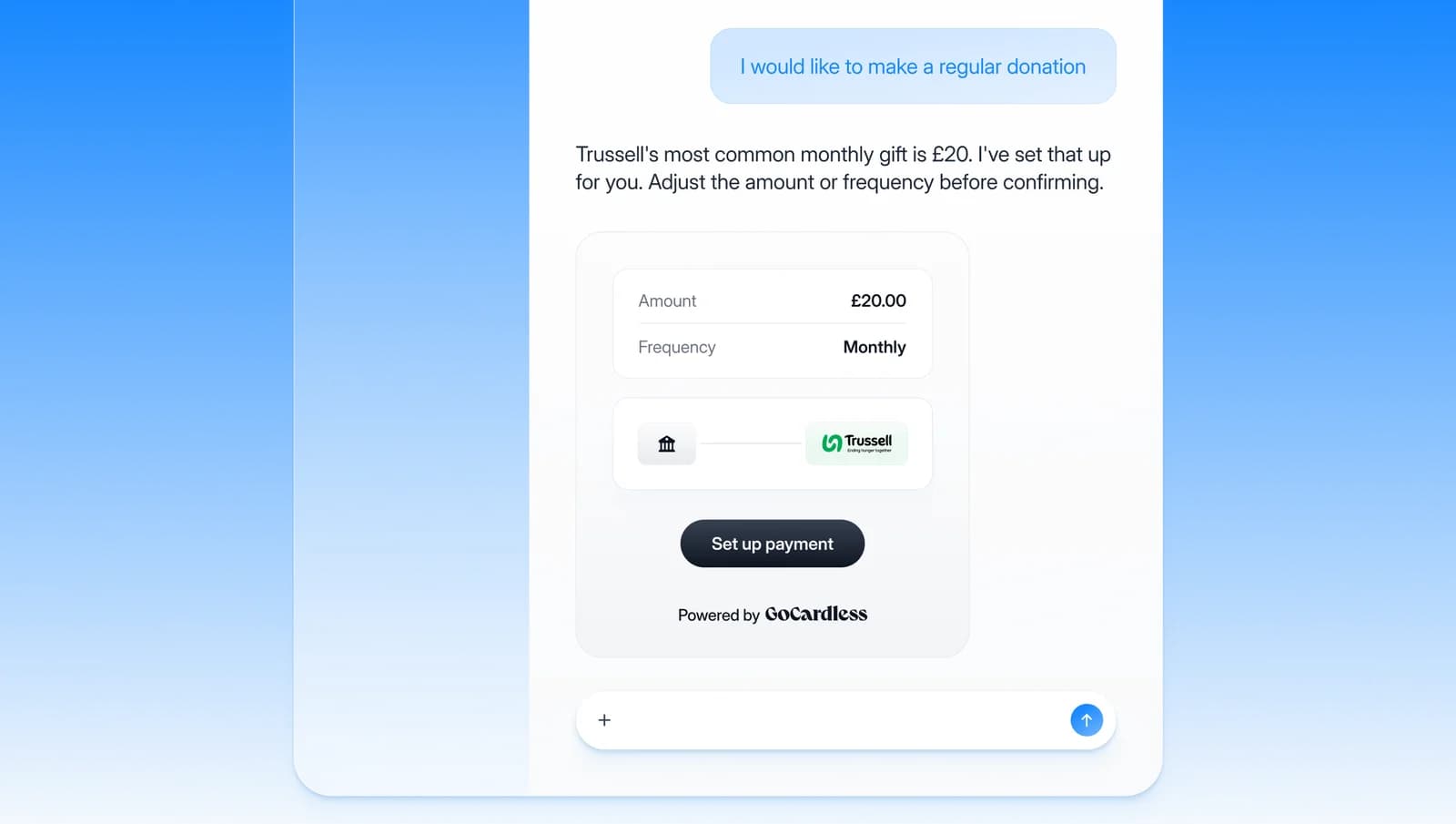
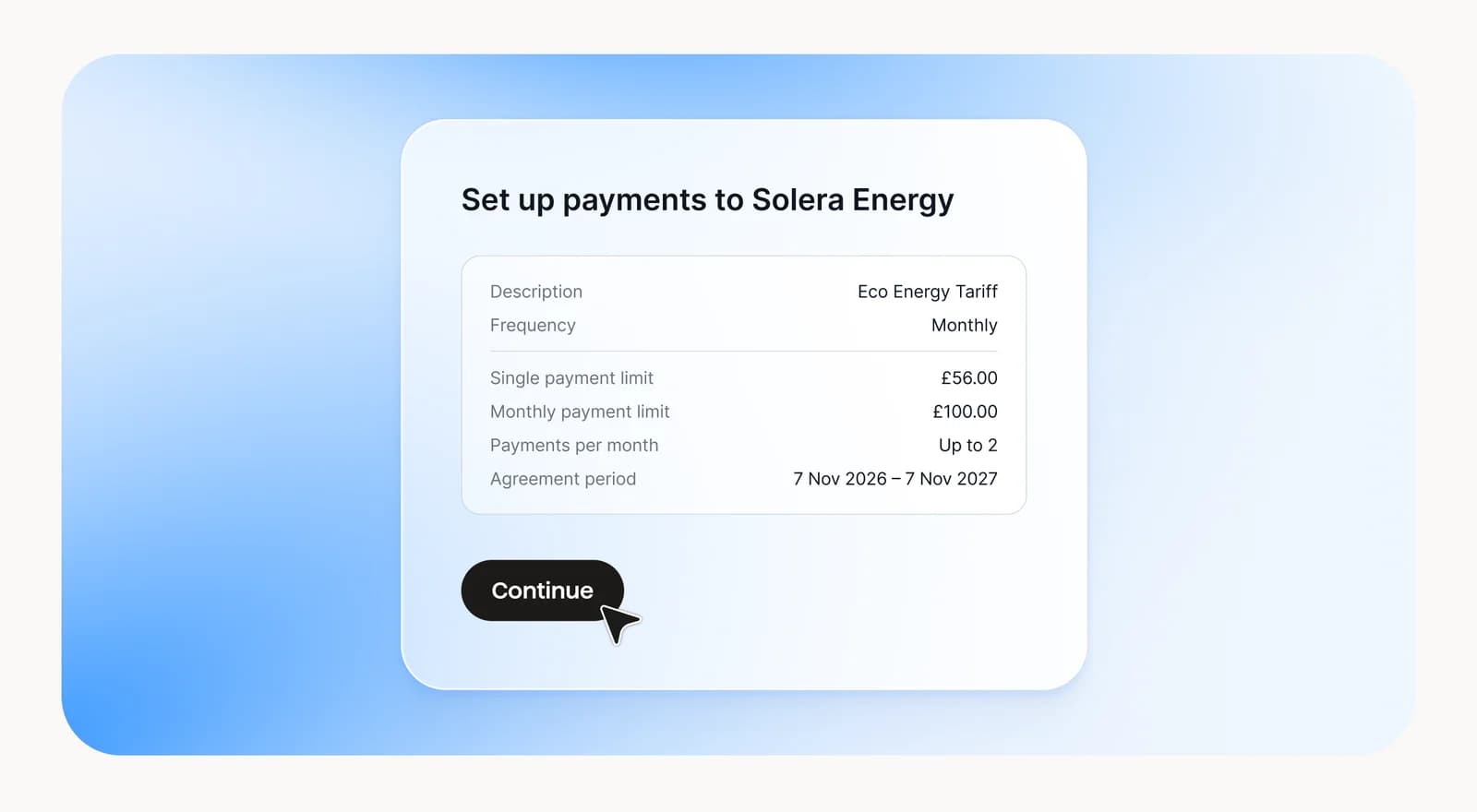
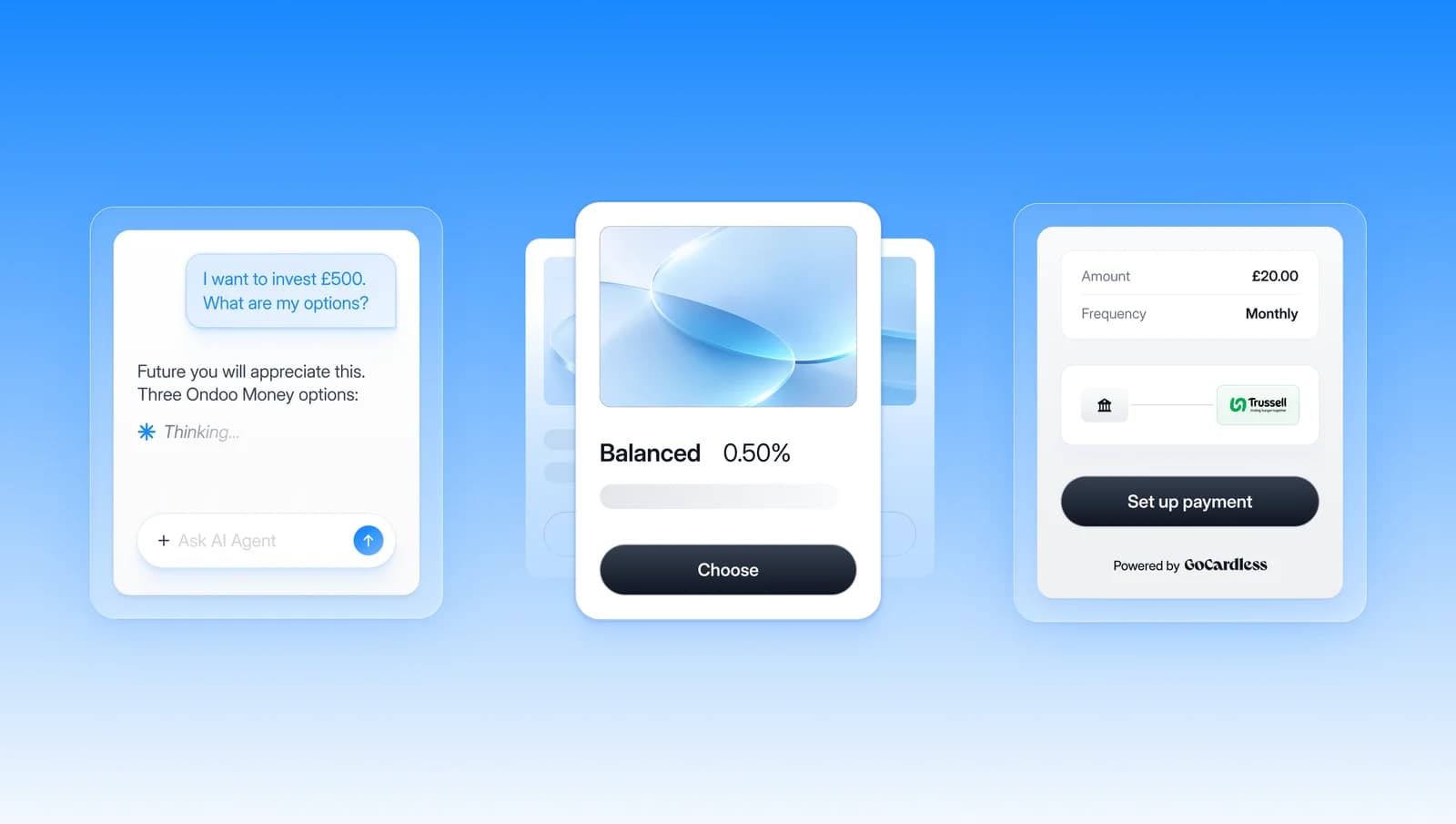
We built a conversational checkout, where an AI agent sets up a Direct Debit mandate for a payer, entirely inside a chat window with an AI assistant. The payer can ask questions and discover offerings and information about the business; the agent then talks the payer through the offer, and the payer confirms payment in a GoCardless checkout served within the chat.
In September 2026, we took this process live with Trussell, the anti-poverty charity and community of food banks. Together we collected the UK's first live agentic account-to-account (A2A) payment. A donor can chat with the agent, ask about donations and how they would be used, set up a recurring donation, and authorise it - all in one conversation. This payment is processed like any other Direct Debit transaction.
This is just the beginning of exploring how A2A payments can be used for agentic commerce, and since launching Direct Debit in this way, we’ve expanded to one-off payments too.
Five lessons we learned from AI Live Testing
1. A2A payments suit AI agents
We entered the programme with a hypothesis that A2A payments are structurally best for agentic payments, and thanks to this testing programme, our hypothesis has been validated.
Card-on-file was originally designed around a person typing in their card number or being present for a single authentication. This convenience often justified the fees. With A2A payments and for Direct Debit in particular, the payer gives an instruction (a mandate) for payments to be collected for an agreed amount and schedule. Take a person wanting to buy an annual car insurance policy, for example: they can explore different coverage options with a provider’s agent and set up their monthly payments in one conversation.
Direct Debits were made for this kind of automation and make them an obvious fit for agentic commerce. Payers stay in control with the ability to cancel at any time and the security of the Direct Debit Guarantee, while businesses benefit from avoiding unnecessary card fees.
2. Design by doing
With agentic commerce, you can’t fully script the experience in advance, because an AI agent won’t respond the same way every time - it’s non-deterministic. So it became critical to design by doing: testing in real conditions, with real payments, and refining as we went along.
The FCA AILT programme gave us the environment to test and help shape the regulation of agentic payments before it's decided. Instead of trying to predict every scenario on paper, we saw how agents actually behave, where they need guardrails, and what people need to feel confident in using an agent to make a purchase. The result is a design process built on live learning rather than upfront specification.
3. Challenging design principles
Traditional payer experiences follow a funnel with a distinct journey, with each step carefully designed. Agentic commerce brings a new challenge as those steps blend into one seamless conversation with an agent. AI is unpredictable; regulators and the industry need to work together to stay ahead of the technology. That forces us to rethink traditional user experience (UX) design principles and adapt from years of sequential, guided steps to continuous conversation interfaces.
We now have to make sure people can trust the experience even when the AI doesn’t respond the same way every time. For example, our Trussell agent is tuned for donations rather than general use. If a user goes off-topic or changes direction, it guides them back to the donation journey.
Working in the FCA AILT programme showed us that design, legal and compliance have to work together from day one, moving even faster than the technology itself.
4. Education is key
The term agentic can mean different things in different contexts. Properly understanding and grasping the concept of agentic payments and how it tangibly works for a business makes education so important. Looking for businesses to partner with us through the FCA AILT programme, we found they are curious, but unsure what it looks like in practice or how it would fit into their business. Many are still a little cautious.
They want reassurance on how it works and what it means for their customers. Once they’ve seen a clear use case and how it can be used for their business scenario, they engage. So our job is to clearly demonstrate the use cases, explain the finer details to build trust and assurance, and then let the value speak for itself.
5. Who is on the hook if an agent makes a mistake
Traditional payment rules were written with a person giving the instruction, but agentic commerce changes that. Once an AI agent can act on someone’s behalf, the question is no longer just whether the payment works but who is accountable, and who can be trusted? Testing with real payments showed us where today’s rules strain under that question, as they were never designed for it.
What struck us is that no single firm, and no single regulator, can close that gap alone. The answer sits across the whole chain: regulators, payment rails, standard setters, banks, businesses and, increasingly, the companies building the AI itself.
44% of respondents in a YouGov consumer survey we commissioned believe that if an AI assistant makes a payment mistake, such as paying the wrong amount or the wrong business, the company that provides the AI agent should be responsible for putting it right.
That is why we believe the next step is working out who is on the hook if the agent makes a mistake with a shared trust framework. It would be a common set of expectations that every party can rely on, built through a grand bargain between everyone involved. It is a conversation the industry needs to start, and we are proud that we're already leading the conversation.
What's next for agentic payments?
Now we’ve finished our testing with the FCA; they will publish their evaluation report on our cohort in the first quarter of 2027. We'll continue to share what we learn with the businesses and partners who build on GoCardless. This is only the start of our work on agentic payments. Over the coming months, we’ll expand the features and capabilities of how this new experience can help businesses grow.
If you're curious what agentic commerce could mean for your checkout, talk to our team.